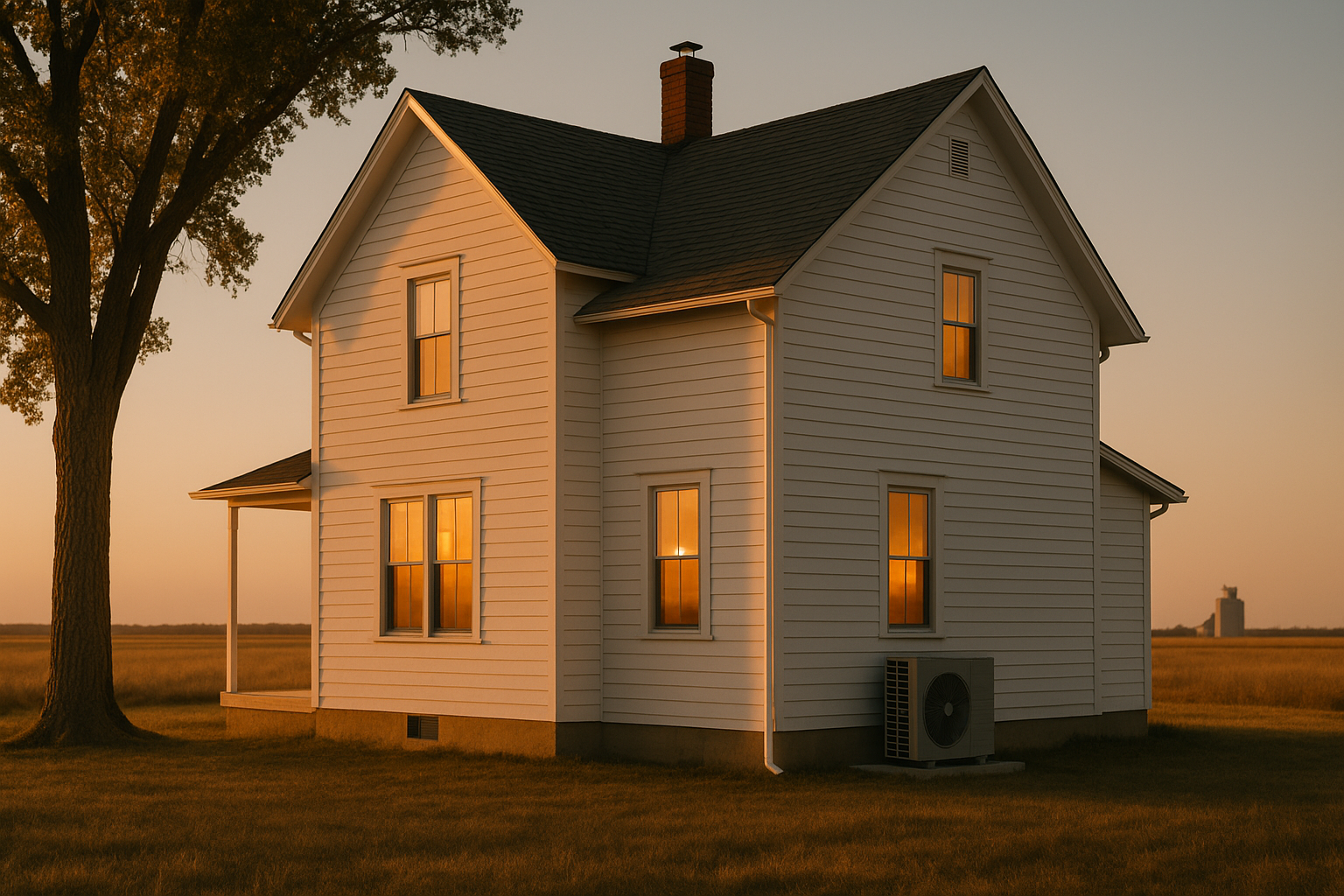
The federal Home Electrification and Appliance Rebates program — still searched for under its original name, HEEHRA — caps a single household at $14,000, with as much as $8,000 of that aimed directly at a heat pump. In most states, that money lands on top of a utility rebate, a state credit, or both.
Kansas works differently. There is no statewide residential heat pump rebate and no broad state electrification tax credit, which leaves the federal income tiers, the per-measure caps, and the equipment qualification rules carrying almost the entire affordability story.
That changes how the program should be read here. A Massachusetts or New York buyer can treat HEEHRA as one line in a longer stack, while a homeowner in Wichita, Salina, or Dodge City generally needs the federal line to carry the project on its own.
Kansas has no statewide heat pump rebate and no state electrification tax credit, so HEEHRA sets the affordability ceiling for most households. Utility offers exist but are narrow and territory-specific.
Why Kansas Is Effectively A Federal-Only Rebate Market
Kansas electricity runs roughly 13 to 14 cents per kilowatt-hour for residential customers according to EIA state data, which places it near the national middle. What Kansas lacks is the incentive infrastructure that surrounds heat pump purchases in the Northeast and on the West Coast.
Evergy is the dominant investor-owned electric utility across its Kansas Central and Kansas Metro territories, and its Kansas residential HVAC offers have historically been thinner than the programs it runs on the Missouri side of the state line. Black Hills Energy, Kansas Gas Service, roughly two dozen rural electric cooperatives, and a set of municipal utilities fill in the rest of the map, each with its own rules.
One Kansas program does stand out, though it is not a rebate. Midwest Energy's How$mart program offers tariffed on-bill financing, where efficiency improvements are repaid through the meter rather than discounted at the point of purchase.
The practical consequence is that Kansas households cannot assume a utility layer sitting under the federal one. Before building a budget, it is worth calling your specific electric provider and confirming what, if anything, is active in your territory this year.
Kansas received approximately $19 million for the electrification rebates specifically under the Department of Energy's published state allocation tables, alongside a comparable amount for the separate HOMES performance rebates. The Kansas Energy Office, housed within the Kansas Corporation Commission, is the designated administrator, and the current application window and approved-contractor list should be confirmed there before any work is scheduled.
How The HEEHRA Income Tiers Actually Work In Kansas
HEEHRA sorts households into three tiers, and the tier determines what share of project cost the rebate covers rather than a flat dollar award. Those tiers are set against area median income, adjusted for household size.
Households below 80% of area median income can have up to 100% of a qualifying project covered, subject to the per-measure caps. Households between 80% and 150% of area median income can have up to 50% of project cost covered, again subject to those same caps.
Households above 150% of area median income are not eligible for HEEHRA at all. That cliff is the single most consequential number in the program, and it is also the one most often estimated incorrectly.
HEEHRA income tiers use HUD county or metro area median income adjusted for household size, not the Kansas statewide median. The same income can fall under 80% AMI in Johnson County and above it in a rural county.
Kansas statewide median household income sits near $70,000 according to Census ACS estimates, but that figure does not decide anything. Eligibility runs off HUD's published income limits for your county or metropolitan area, and the Kansas City metro figures that govern Johnson and Wyandotte counties sit well above the limits used across rural western Kansas.
Household size compounds the spread. A four-person household and a single-person household in the same county face materially different 80% thresholds, which is why two neighbors with identical paychecks can land in different tiers.
There is also a shortcut worth knowing about. Federal guidance allows states to accept categorical eligibility, meaning documented participation in programs such as LIHEAP, SNAP, or the Weatherization Assistance Program can establish the under-80% tier without a separate income calculation.
Keep in mind that the tier is verified at application, not at installation. Kansas homeowners planning a project across a tax-year boundary may want to confirm which year's income documentation the state will accept before committing to a schedule.
What HEEHRA Pays, Measure By Measure
The caps themselves are federal and identical in every state, Kansas included. What varies state to state is administration, timing, and which contractors are approved to deliver the discount.
| Measure | Federal cap | Under 80% AMI | 80–150% AMI |
|---|---|---|---|
| Heat pump (space heating and cooling) | $8,000 | 100% of project cost | 50% of project cost |
| Heat pump water heater | $1,750 | 100% | 50% |
| Electric stove, cooktop, range, or oven | $840 | 100% | 50% |
| Heat pump clothes dryer | $840 | 100% | 50% |
| Electrical panel upgrade | $4,000 | 100% | 50% |
| Electrical wiring | $2,500 | 100% | 50% |
| Insulation, air sealing, and ventilation | $1,600 | 100% | 50% |
| Household maximum | $14,000 | — | — |
All of the above sits under a single $14,000 household ceiling, so a full electrification project reaches the limit quickly. A heat pump at $8,000 plus a panel upgrade at $4,000 leaves only $2,000 of headroom for everything else in the house.
HEEHRA caps are per measure: up to $8,000 for a heat pump, $1,750 for a heat pump water heater, $4,000 for a panel upgrade, and $14,000 total across one household.
Note that the caps are ceilings rather than entitlements. An 80% to 150% AMI household installing a $9,000 heat pump receives 50% of cost, or $4,500, rather than the headline $8,000.
What Counts As Qualifying Equipment
Equipment qualification is where Kansas claims most often stall, and the failure is usually paperwork rather than hardware. The requirements stack on top of each other, so a unit can be efficient enough and still fail on documentation.
Here is what a qualifying heat pump package has to demonstrate:
- ENERGY STAR certification. Federal program rules require ENERGY STAR certified appliances wherever a certification category exists, and the criteria version matters because ENERGY STAR revises its specifications on a published schedule.
- A matching AHRI certificate. The certificate has to name the exact outdoor unit, indoor unit, and coil combination installed, since a rated system is a combination and not a single box.
- Current SEER2 and HSPF2 ratings. Equipment rated under the older SEER and HSPF procedures cannot be converted by arithmetic, and the M1 test procedure figures are what the certificate needs to show.
- A state-approved installing contractor. HEEHRA is delivered as a point-of-sale discount applied by an approved contractor rather than as a consumer reimbursement, so hiring outside the approved list forfeits the money entirely.
Heat pump water heaters follow their own path, rated on uniform energy factor rather than SEER2, and the $1,750 cap applies whether the unit is a hybrid tank or a split system. Our guide to heat pump water heater sizing and performance covers where those units struggle in unconditioned Kansas basements and attached garages.
Qualifying equipment must be ENERGY STAR certified and backed by an AHRI certificate naming the exact outdoor unit, indoor unit, and coil installed. Model mismatches are the most common rejection.
Ranges, cooktops, and ovens qualify at up to $840 each under the electric appliance line, and heat pump clothes dryers carry that same $840 cap. Induction and standard electric resistance ranges both qualify, which surprises homeowners who assume the program is induction-only.
For equipment selection itself, our roundup of cold climate heat pump brands covers which manufacturers publish extended performance data at low ambient temperatures. That data matters more in Goodland than it does in Coffeyville.
Sizing Rules That Decide Whether The Money Is Well Spent
A rebate that buys the wrong size equipment is an expensive mistake with a discount attached. Kansas winter design temperatures run roughly 0°F to 8°F depending on county, with the western counties running colder than Wichita or the Kansas City suburbs.
Kansas winter design temperatures run roughly 0°F to 8°F by county. Size from an ACCA Manual J load calculation at your design temperature rather than from the nameplate of the furnace being replaced.
The furnace being replaced is almost never a valid sizing reference, because gas furnaces in Kansas housing stock were routinely oversized by 30% or more. Carrying that oversizing into a heat pump produces short-cycling, poor humidity control in July, and a compressor that rarely reaches steady-state efficiency.
Our walkthrough of cold climate heat pump sizing covers the load calculation itself, and the heat pump load calculator produces a first-pass number before you call contractors. Both are worth running in advance, since a contractor proposal is far easier to evaluate when you already hold an independent number.
Backup heat is the second Kansas-specific decision. Electric resistance strips are the default, and a 15 kW strip package draws enough current to push an older 100-amp service past its limit, which is precisely why the panel line exists in the rebate table.
Our explainer on heat pump backup heat strategies covers how strip staging changes that calculation. Dual-fuel configurations, where an existing gas furnace handles the coldest hours, also remain common in Kansas because natural gas service is widespread and comparatively inexpensive.
Setting the changeover point correctly is what makes a dual-fuel system pay rather than simply exist. Our breakdown of balance point controls covers the arithmetic behind that setting.
The Enabling-Upgrade Rule Kansas Projects Run Into
The $4,000 electrical panel cap and the $2,500 wiring cap come with a condition attached. Both are enabling upgrades, claimable only in connection with a qualifying appliance installed in the same project.
Panel and wiring dollars are enabling upgrades tied to an appliance. A Kansas household can claim the $4,000 panel cap only when a qualifying appliance is installed as part of the same project.
This matters more in Kansas than the rule's plain text suggests. A large share of the pre-1970 housing stock in Topeka, Wichita, and the older Kansas City suburbs still runs 100-amp service, and adding a heat pump with resistance backup frequently exceeds what that service can carry.
The sequencing question follows directly from that. A homeowner who upgrades the panel first and installs the heat pump a year later may have spent $4,000 of eligible rebate capacity out of pocket for no reason.
Our analysis of heat pump panel capacity covers the load calculation that determines whether an upgrade is genuinely required. A properly configured system with a smaller strip package sometimes fits an existing service, and that determination is worth making before the panel quote rather than after it.
Where HEEHRA Stops And Other Money Starts
Federal rules bar spending HOMES rebates (IRA §50121) and HEEHRA rebates (§50122) on the same individual measure. Some states permit splitting different measures across the two programs within one home, and whether Kansas does is a question for the Kansas Energy Office rather than for a contractor.
Federal tax credits are the other half of the stack, and their status shifted at the end of 2025. Our federal tax credit status tracker covers what is currently claimable, and the 25C versus HEEHRA decision tree walks through which instrument to reach for first when both are available.
Remember that rebates and credits interact on the math side. A point-of-sale rebate reduces what you actually paid, and the amount paid is what any percentage-based credit gets calculated against — a mechanism our HEEHRA and 25C stacking guide covers in detail.
For households well under the income limits, the Weatherization Assistance Program remains a separate federal channel administered through the state's designated housing agency, generally covering envelope work rather than equipment. Insulation and air sealing delivered that way can free the $1,600 HEEHRA envelope cap for other measures.
A Decision Rule By Where You Are In The Process
The right next step depends less on the equipment than on timing. Three phases cover most Kansas households:
- Pre-purchase, no urgency. Pull your county's HUD income limit for your household size, run a load calculation, and confirm the Kansas Energy Office's current approved-contractor list before requesting quotes.
- Mid-application. Verify that the AHRI certificate on the proposal matches the equipment actually being installed, since substitutions made during a supply delay are a frequent cause of denied claims.
- Emergency replacement. A failed furnace in January rarely allows for a full application cycle, and homeowners in that position often install first and lose the rebate entirely, which is the strongest argument for doing the paperwork groundwork before equipment fails.
All of these come back to the same Kansas-specific reality. Without a state layer to absorb mistakes, a missed qualification detail here costs the full value of the incentive rather than a fraction of it.
Reading The Kansas Numbers Against Other States
Comparing markets clarifies how much weight the federal tiers are carrying. Our HEEHRA in Arizona breakdown and the HEEHRA in Alaska guide show the same federal caps landing in very different local cost structures, while the complete HEEHRA program guide holds the tier mechanics that apply everywhere.
Kansas installed costs are a further variable worth pricing before assuming the cap covers the job. Our data on heat pump installation cost gives the ranges that determine whether $8,000 covers most of a project or roughly a third of one.
Have you confirmed which income tier your household falls into and which contractors are currently approved in your county? Those two answers set the entire budget, and both are available before you request a single quote.
This article is for informational purposes and is not financial, tax, or legal advice. Consult a licensed professional — a CPA, a licensed HVAC contractor, or the Kansas Energy Office at the Kansas Corporation Commission — before acting on any rebate or credit decision.