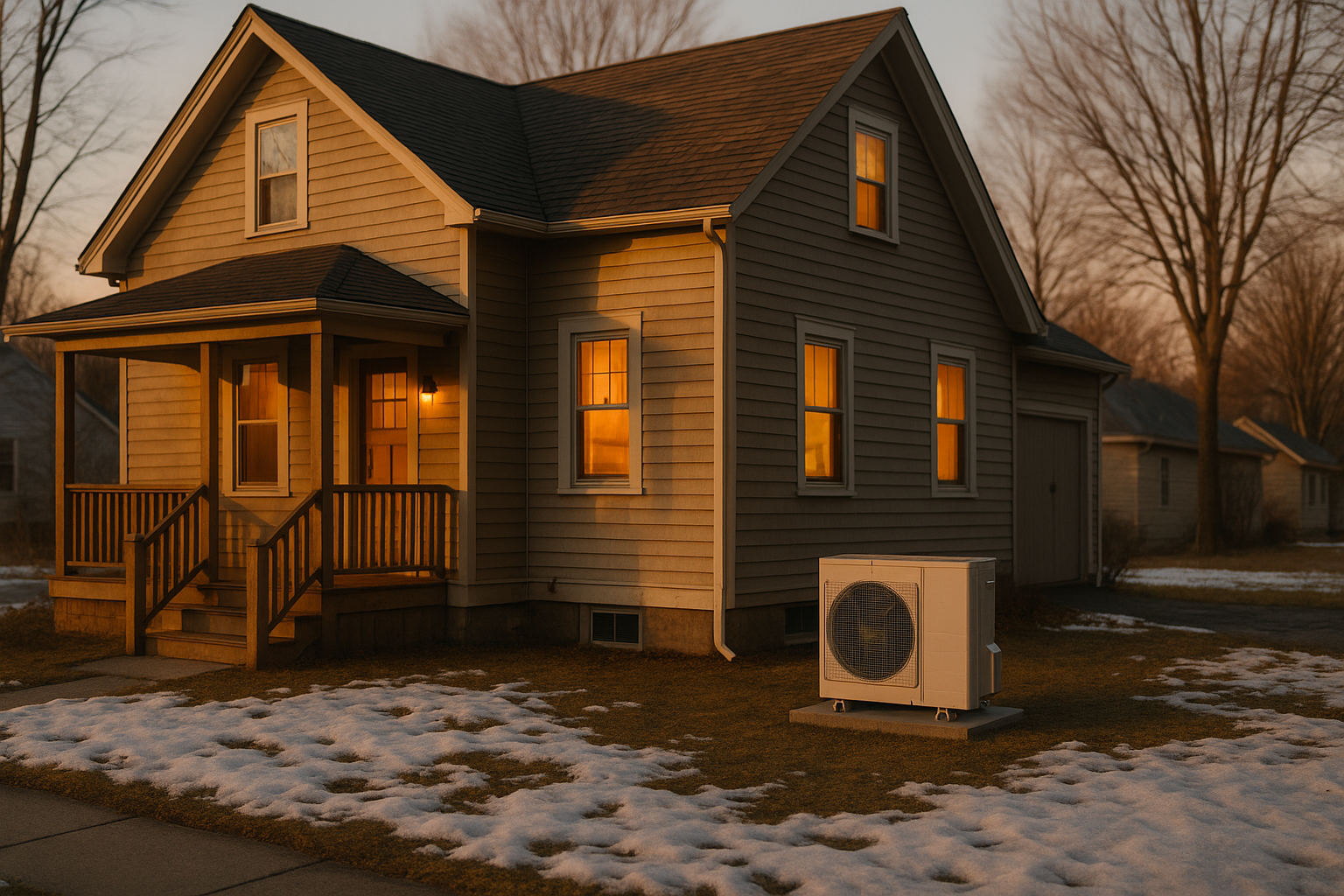
Walk through any conversation about home electrification and you'll hear the same anchors — cold-climate heat pumps, panel upgrades, induction ranges. The water heater, somehow, gets buried at the bottom of the list.
That ordering is backwards. The heat pump water heater is the single highest-ROI electrification upgrade most homes will ever make — and it qualifies for both the 25C federal tax credit and HEEHRA rebates on the same install.
What is a heat pump water heater? A heat pump water heater (HPWH) uses a refrigerant cycle to move heat from surrounding air into a tank of water, rather than generating heat directly. Modern integrated units achieve a coefficient of performance (COP) between 3.0 and 4.0, delivering roughly three to four units of hot water heat per unit of electricity consumed.
What COP Actually Measures (And Why It Matters Here)
COP — coefficient of performance — is the ratio of useful heat delivered to electrical energy consumed, measured at a defined set of test conditions. A COP of 3.0 means one kilowatt-hour of electricity moves three kilowatt-hours of heat into your water tank.
Resistance electric water heaters and gas-fired tanks both have a theoretical efficiency ceiling of 1.0 — they can never produce more heat than the energy they consume. A heat pump breaks that ceiling because it moves heat rather than creates it, which is why HPWH efficiency reads as 300-400% in marketing copy.
The Department of Energy uses a different metric on the yellow EnergyGuide sticker — Uniform Energy Factor, or UEF — which accounts for standby losses and a standard usage pattern. Energy Star Most Efficient HPWHs land at UEF 3.0 or higher; the best variable-speed integrated models from Rheem, AO Smith, and State currently push past UEF 3.7.
What's the difference between COP and UEF for water heaters? COP measures instantaneous efficiency at a single rated condition. UEF is the federal regulatory metric that simulates a daily usage pattern including standby losses, recovery, and varying inlet water temperatures. UEF is the number you'll see on the EnergyGuide label and the figure Energy Star uses for certification thresholds.
How Climate Zones Affect HPWH Performance
A heat pump water heater pulls its heat from ambient air, which means the temperature of the room where you install it directly governs efficiency. Manufacturer rating tests typically use 67.5°F air — a value that's optimistic for an unheated basement in February.
That said, most HPWHs are designed to operate across an ambient range of roughly 37°F to 145°F before defaulting to resistance-only backup mode. The COP degradation curve is gradual — a unit rated at COP 3.5 at 67.5°F may settle to COP 2.5 at 50°F and COP 2.0 near 40°F.
For homes in colder climate zones 5-7, the install location matters more than the model selection. A 600-square-foot conditioned basement at 60°F maintains good performance year-round; an attached garage at 30°F in January drops the unit into resistance mode and undoes most of the efficiency advantage.
Do heat pump water heaters work in cold climates? Yes — but the install location matters more than the climate zone itself. HPWHs installed in unconditioned spaces below 40°F lose most of their efficiency advantage and may default to resistance-only operation. Basements that stay above 50°F year-round, including most insulated New England and Midwest basements, support COP 2.5+ even in deep winter.
Why HPWHs Are the Highest-ROI Electrification Upgrade
The economics for a heat pump water heater are unusually clean compared to whole-home electrification. Equipment cost runs $1,400 to $2,400 for a 50-80 gallon integrated unit; installed cost typically lands $3,000 to $4,500 depending on electrical work.
Annual operating cost for a standard household drops from roughly $400-600 on a gas tank or resistance electric to $120-180 on a HPWH at average U.S. electric rates. That's $250-400 in annual savings against an installed-cost delta — over a gas tank replacement — of maybe $1,500 once rebates apply.
Payback is three to five years before factoring rebates, one to three after. Compare that to a whole-home heat pump retrofit, where simple payback often runs 8-12 years and depends heavily on the gas-versus-electric rate spread in your utility territory — covered in detail in our whole-home electrification ROI breakdown.
| Water Heater Type | Installed Cost | Annual Operating Cost | 10-Year Total Cost |
|---|---|---|---|
| Standard gas tank | $1,500-2,000 | $400-550 | ~$5,500-7,500 |
| Resistance electric tank | $1,200-1,800 | $500-700 | ~$6,200-8,800 |
| Tankless gas | $3,500-5,500 | $350-450 | ~$7,000-10,000 |
| Heat pump water heater | $3,000-4,500 (pre-rebate) | $120-180 | ~$4,200-6,300 |
Note that these ranges assume average national electric and gas rates. In high-gas-cost markets like New England, HPWH payback compresses further — Mass Save program data has shown sub-two-year payback for typical four-person households once Mass Save rebates apply.
How long does it take to pay back a heat pump water heater? Most households see simple payback in three to five years before rebates, and one to three years after stacking 25C plus HEEHRA or utility rebates. High-gas-cost markets like the Northeast see the shortest paybacks. Resistance electric replacements see the fastest absolute savings — typically $400-500 per year.
Eligibility for 25C and HEEHRA
Heat pump water heaters are explicitly named in both the 25C Energy Efficient Home Improvement Credit and HEEHRA — the IRA's Section 50122 high-efficiency electric home rebate program. They are one of the few electrification upgrades eligible for both programs on the same equipment.
The federal 25C credit covers 30% of equipment plus installation cost, capped at $2,000 per year for heat-pump-category items. The status of the credit has been in flux since mid-2025 — see our coverage of the July 2025 25C changes before assuming current-year eligibility.
HEEHRA caps HPWH rebates at $1,750 per dwelling under program design, with income-tier multipliers — 100% of equipment plus install cost covered for households below 80% of area median income, 50% for households between 80% and 150% AMI. State administration adds another layer of variation we cover in our HEEHRA income tier breakdown.
The stacking order matters for total recovery. HEEHRA is treated as a point-of-sale rebate that reduces the basis used to calculate the 25C credit, which means filing both is not double-counting — but it does shrink your tax-credit denominator, walked through in our rebate stacking application order guide.
Can you claim both 25C and HEEHRA on a heat pump water heater? Yes — HPWHs are eligible for both programs simultaneously. HEEHRA is applied as a point-of-sale rebate that reduces your equipment basis; 25C is then claimed on the post-rebate net cost at 30%, capped at $2,000 annually. Stacking order affects total recovery and matters at higher equipment costs.
Installation Considerations Most Contractors Skip
The single biggest install failure mode is mounting a HPWH in a space too small to support its airflow demand. Manufacturers specify a minimum room volume — typically 700 to 1,000 cubic feet for a 50-gallon unit — below which the compressor short-cycles and efficiency collapses.
Ducted installation kits are available from every major manufacturer and solve the volume-and-cooling problem at once. They pull intake air from a larger space (or from outside in mild climates) and exhaust the cooled-and-dehumidified output where you actually want it.
Most contractors quoting a like-for-like swap will skip the duct conversation entirely. Ask explicitly whether the install location meets the manufacturer's minimum room-volume spec, and ask for the spec-sheet line in writing.
Electrical work is the other common surprise. HPWHs run on a standard 240V/30A circuit — the same as a resistance electric unit — but homes with gas water heating typically don't have that circuit run to the water heater location.
Budget $400-900 for the electrical pull if you're converting from gas. This is often the line item that breaks down the simple-payback story for homeowners who assumed a like-for-like swap.
Common HPWH Myths Worth Correcting
Are they too loud for a basement?
Modern integrated units operate at 45-55 dB at the compressor — quieter than a dishwasher and roughly equivalent to a refrigerator. Concerns from 2014-era first-generation units do not apply to current Rheem, AO Smith, and State equipment.
Can they keep up with a family of four?
A standard 65 or 80-gallon HPWH in hybrid mode — heat pump primary, resistance backup — delivers first-hour ratings of 65-85 gallons. That's enough for back-to-back showers without resistance fallback in most households.
Do cold basements kill them?
Conditioned and semi-conditioned basements at 50°F or above support COP 2.5+ year-round. The genuinely problematic install locations are unheated garages and exterior closets, not basements.
Does the dehumidification ruin your basement?
The byproduct dehumidification — roughly 1-2 gallons of condensate per day in summer — is actually a benefit in most Northeastern and Midwestern basements. Moisture is the dominant problem in those climates, not dryness.
How to Choose: Tank Size and Mode Selection
The sizing math for a HPWH differs from a gas tank because of recovery rate. A gas tank recovers fast and can be undersized; a HPWH recovers slowly in heat-pump-only mode, which means most households should upsize one tier — 65 gallons instead of 50, 80 instead of 65.
All modern HPWHs include a hybrid mode that prioritizes the heat pump but allows resistance backup during high-demand windows. Hybrid is the correct default for most households and gives up only 5-10% of the available efficiency advantage compared to heat-pump-only mode.
Vacation mode is genuinely useful for second homes and seasonal applications. Heat-pump-only mode is appropriate for retirees, light-use households, or anyone who wants maximum efficiency and can tolerate slower recovery.
How HPWHs Fit Into a Whole-Home Electrification Sequence
If you're sequencing a multi-year electrification project, the heat pump water heater is the right first move. It has the lowest install complexity, the fastest payback, the cleanest rebate stack, and the smallest panel-load implication.
Cold-climate heat pump space heating is the larger and longer-payback project and typically comes second — see our air-source vs. ground-source comparison and mini-split vs. central heat pump breakdown before sizing that project. Induction ranges and EV chargers are independent decisions on their own timelines.
The 25C credit annual cap of $2,000 for heat-pump-category items effectively forces sequencing anyway. Most households can't claim a HPWH and a whole-home heat pump in the same tax year without leaving credit on the table — the natural order is HPWH this year, central heat pump next year.
The bottom line. If you're trying to decide where to start with electrification, the heat pump water heater is the answer for the vast majority of homes. The payback is faster than any other upgrade, the install complexity is lower, and the rebate stack — 25C plus HEEHRA plus most utility programs — is the most generous available on any single piece of equipment.
The honest caveats are the install location (basements yes, unheated garages no), the upsized tank tier, and the electrical pull cost if converting from gas. Address those three and the economics do the rest.
Frequently Asked Questions
How many gallons do I need for a heat pump water heater?
Upsize one tier from a comparable gas tank. A household that runs a 50-gallon gas tank should look at a 65 or 80-gallon HPWH because recovery is slower in heat-pump-only mode. Four-person households typically land on 65-80 gallons; two-person households on 50-65 gallons.
Will a heat pump water heater work in my garage?
Generally, no — not without compromise. Attached garages routinely drop below 40°F in winter across most of the U.S., which forces resistance-only operation and erases the efficiency advantage. Insulated, conditioned basements are the strongly preferred install location. Heated mechanical rooms work well; unheated exterior closets and unconditioned crawlspaces do not.
How much do HEEHRA rebates cover for a heat pump water heater?
HEEHRA caps HPWH rebates at $1,750 per dwelling under federal program design. Households at or below 80% of area median income qualify for 100% of equipment and install cost up to that cap; households between 80% and 150% AMI qualify for 50%. State administration introduces variation — see our HEEHRA state-by-state status tracker for current rollout in your state.
Does a heat pump water heater require a 240V circuit?
Yes — all standard residential HPWHs operate on a 240V/30A dedicated circuit, the same as a resistance electric water heater. Homes converting from gas typically need this circuit pulled, which adds $400-900 in electrical labor. 120V plug-in HPWHs do exist for retrofit applications where running a new circuit is cost-prohibitive, but capacity is lower.
What's the lifespan of a heat pump water heater?
Manufacturer warranties run 6-10 years on tank and compressor; field expectations are 10-15 years before major service. That's comparable to a gas tank and modestly shorter than a resistance electric tank. Anode rod replacement at year 5-6 extends tank life materially and is the single highest-leverage maintenance action.
This article is for informational purposes and is not financial, tax, or legal advice. Consult a licensed HVAC contractor, electrician, and CPA before making purchase decisions or claiming federal tax credits. Program eligibility and rebate amounts vary by state and change frequently.