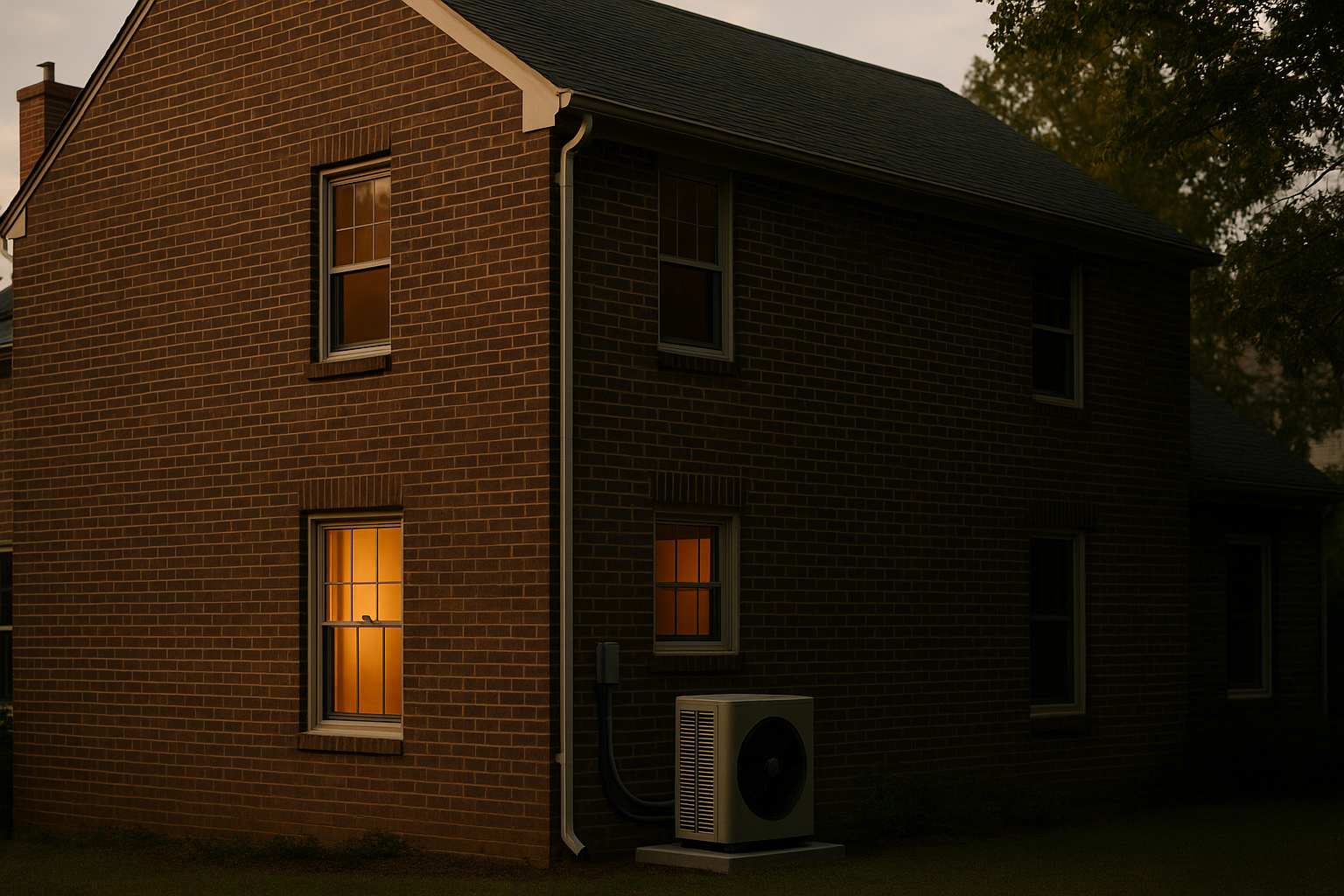
Search for what a heat pump costs to install and nearly every result hands back the same answer: somewhere between $8,000 and $30,000. That is close to a four-to-one spread, wide enough to describe both a one-day equipment swap in a mild climate and a whole-house duct replacement with an electrical service upgrade attached.
A ducted central heat pump is priced as six largely independent line items, and any one of them can move by several thousand dollars based on conditions that already exist inside your house. Break a proposal into those six pieces and each one becomes arithmetic you can check against a bid.
A 3-ton ducted heat pump replacement typically runs $11,000 to $17,000 installed in 2026. Equipment accounts for roughly 40 to 50 percent of that total, with labor, electrical, line set, permits, and ductwork carrying the rest.
Where The Published National Range Comes From
The $8,000 figure at the bottom of that range generally describes a like-for-like changeout in a mild climate: a two- or three-ton single-stage system, ducts left in place, an existing 240-volt circuit reused, and a crew finished in a day. The $30,000 figure at the top usually describes a cold-climate inverter system in a high-labor metro, with full duct replacement and a panel or service upgrade folded into the same contract.
Both numbers are real, and neither functions as a national average you can budget against. What sits between them is a set of house-specific conditions that a contractor prices individually, which is why two homes on the same street can receive quotes $9,000 apart for identical nameplate tonnage.
Every dollar figure in this article is an estimated range reflecting 2026 contractor proposals and published program terms. Use them as a check on the bids you collect, and confirm current incentive amounts with your state energy office and your utility before you build a budget around them.
The Six Line Items On A Ducted Heat Pump Replacement
A complete ducted proposal breaks into equipment, refrigerant line set, labor, electrical, permits and documentation, and ductwork. Here is what each line covers and what makes it move.
| Line item | Typical 2026 range | Primary cost driver |
|---|---|---|
| Equipment (outdoor unit + air handler or coil) | $4,000 – $10,500 | Tonnage and efficiency tier |
| Refrigerant line set | $150 – $1,800 | Reuse versus new; run length |
| Labor and old-equipment removal | $1,800 – $4,500 | Crew-days and access |
| Electrical | $0 – $5,000 | Circuit only versus service upgrade |
| Permits, load calculation, inspection | $150 – $1,400 | Jurisdiction and code-mandated testing |
| Ductwork | $0 – $14,000 | Static pressure and duct condition |
| Ancillary (pad, controls, condensate, commissioning) | $500 – $2,200 | Site conditions and thermostat tier |
1. Equipment
Equipment covers the outdoor condensing unit, the matched indoor air handler or cased coil, and the factory controls that pair them. A NEEP-listed cold-climate variable-speed ducted system carries roughly $4,000 to $10,500 in equipment cost across the two- to five-ton range, while an entry-tier single-stage ducted system in the same tonnage typically lands 25 to 40 percent lower.
Efficiency tier prices twice: it raises the equipment line, and it determines whether the project clears the SEER2, HSPF2, and cold-climate listing thresholds that most utility and state rebate programs set as a floor. That is why the cheaper box sometimes produces the higher net cost.
Our breakdown of cold-climate heat pump brands covers where those tiers actually differ in capacity retention. Matching tonnage to a real load calculation matters more than brand selection does, which is the subject of our guide to cold-climate heat pump sizing.
2. Refrigerant Line Set
The line set is the insulated copper pair running between the outdoor unit and the indoor coil. Reusing an existing line set with a flush, a nitrogen purge, and a pressure test typically costs $150 to $400, while a new 25- to 50-foot run costs $600 to $1,800 installed.
The refrigerant transition changes this calculation for 2026 projects. As the industry moved off R-410A to A2L refrigerants such as R-454B under the AIM Act phasedown, many manufacturers now condition warranty coverage on a new or verified-compatible line set, which pushes more projects toward the higher figure than was true three years ago.
3. Labor And Old-Equipment Removal
A straightforward ducted changeout is two to three crew-days and generally prices at $1,800 to $4,500 in labor. That figure covers EPA Section 608 refrigerant recovery from the outgoing system, disconnection and haul-away of the old furnace or air conditioner, setting and brazing the new equipment, evacuation, and startup.
Access drives the variance here more than tonnage does. An air handler in a finished attic reached by a pull-down ladder, a crawlspace with 30 inches of clearance, or a rooftop position requiring a crane can each add a full crew-day to the same nominal job.
4. Electrical
Most ducted retrofits need a dedicated 240-volt circuit, an outdoor disconnect, and a whip, which together add $400 to $1,200. A subpanel adds $1,000 to $2,500, and a 200-amp service upgrade adds $2,000 to $5,000 before any utility-side coordination charges.
The upgrade is frequently avoidable. An NEC 220.83 load calculation on an existing dwelling often shows adequate capacity, particularly when the project removes an electric furnace or resistance strip heat, and our guide to heat pump panel capacity walks through that arithmetic.
Backup heat sizing feeds directly into this line. Specifying 15 kW of strip heat where 5 kW would cover the design-temperature shortfall is one of the most common reasons a quote arrives with a service upgrade attached, a tradeoff covered in our post on heat pump backup heat.
Most ducted retrofits need only a dedicated 240-volt circuit, disconnect, and whip, adding $400 to $1,200. A full 200-amp service upgrade adds $2,000 to $5,000 and is the single largest electrical variable.
5. Permits, Load Calculation, And Inspection
Mechanical permits typically run $150 to $600 depending on jurisdiction. A third-party Manual J load calculation, where the contractor does not perform one in house, adds $300 to $800, and code-mandated verification adds more in certain states.
California is the clearest example, where Title 24 requires HERS verification of duct leakage and refrigerant charge on qualifying alterations. Load calculation documentation is also becoming a rebate prerequisite rather than a courtesy, which is one reason to run the numbers yourself first with our heat pump sizing calculator.
6. Ductwork
Ductwork is the line item that separates a $12,000 project from a $24,000 project. Sealing an existing system adds roughly $1,000 to $3,000, adding a return runs $400 to $1,200, partial replacement runs $2,000 to $6,000, and full replacement runs $6,000 to $14,000.
The reason this surfaces so often on heat pump retrofits is airflow. A heat pump delivers heat at a lower supply temperature than an 80 percent furnace and therefore needs substantially more airflow to move the same BTU/hr, so a duct system that was merely mediocre behind a furnace becomes a hard capacity limit behind a heat pump.
Static pressure is the measurement that settles it. A system reading well above 0.8 inches of water column on a 0.5-rated blower is telling you the duct line item is real, and our guide to duct static pressure explains how to have that number measured before you sign anything.
Ductwork is the line item that separates a $12,000 quote from a $24,000 quote. Sealing adds $1,000 to $3,000, partial replacement $2,000 to $6,000, and full replacement $6,000 to $14,000.
Taken together, the six lines explain why the published range is so wide: two of them, electrical and ductwork, have a floor of zero and a ceiling in five figures. A proposal that itemizes all six can be compared against another proposal, while a single lump sum cannot.
Installed Cost By System Tonnage
The table below assumes the common retrofit baseline: serviceable ducts, an existing 240-volt circuit or a simple new one, a standard permit, and a variable-speed ducted system. Add the ductwork and electrical line items separately wherever they apply.
| Nominal size | Typical conditioned area | Equipment | Gross installed total |
|---|---|---|---|
| 2 ton | ~900 – 1,300 sq ft | $4,000 – $6,500 | $9,000 – $13,000 |
| 3 ton | ~1,300 – 1,900 sq ft | $4,800 – $7,500 | $11,000 – $17,000 |
| 4 ton | ~1,800 – 2,600 sq ft | $5,600 – $9,000 | $13,000 – $20,000 |
| 5 ton | ~2,400 – 3,400 sq ft | $6,500 – $10,500 | $15,000 – $24,000 |
Square footage in that table is a sanity check, not a sizing method. Rule-of-thumb sizing by area routinely oversizes cold-climate systems by a full ton, which raises equipment cost, worsens short-cycling and humidity control, and can push the electrical line into upgrade territory for no comfort benefit.
Equipment is 40 to 50 percent of a typical ducted heat pump quote. Labor runs 15 to 25 percent, ductwork anywhere from 0 to 30 percent, and electrical, line set, and permits together account for the remainder.
How Region Moves The Number
Labor rates, permit regimes, and code-mandated testing produce far more regional spread than equipment prices do, since equipment moves through national distribution at broadly similar cost. The multipliers below apply to the gross installed totals above.
| Region | Multiplier | What drives it |
|---|---|---|
| Northeast metro (Boston, New York, coastal Connecticut) | 1.15 – 1.40× | Prevailing wage, dense permitting, older housing stock |
| Pacific coast (Seattle, Portland, Bay Area) | 1.15 – 1.35× | Labor rates plus state code verification and HERS testing |
| Midwest and Mountain West | 0.95 – 1.10× | Moderate labor, cold-climate equipment tier |
| Southeast and South Central | 0.85 – 1.00× | High contractor density, lower efficiency-tier floor |
The regional multiplier and the incentive landscape often move in opposite directions. High-cost Northeast and West Coast markets tend to carry the strongest utility programs, which compresses the net gap considerably.
Regional labor rates move the installed total more than equipment prices do. Northeast and Pacific-coast metros commonly price at 1.15 to 1.4 times the national midpoint, while much of the South prices at 0.85 to 1.0.
What Comes Off The Gross Number
Three separate incentive layers can reduce a heat pump project, and each follows its own rules and its own verification timeline. Here is what each layer does:
- HEEHRA, the state-administered IRA rebate. The program provides up to $8,000 toward a qualifying heat pump within a $14,000 per-household cap, covering 100 percent of project cost for households under 80 percent of area median income and 50 percent for households at 80 to 150 percent. Rollout, contractor enrollment, and application mechanics vary state to state, which is why our HEEHRA state guide tracks them separately.
- 25C, the federal Energy Efficient Home Improvement Credit. The credit is structured at 30 percent of qualifying cost with a $2,000 annual cap for heat pumps meeting the applicable efficiency tier. Federal credit availability has shifted by placed-in-service year, so confirm current status on our federal tax credit status page before counting it against a quote.
- Utility and state programs. This is the most variable layer and often the largest reduction outside HEEHRA, ranging from prescriptive per-ton rebates to whole-home conversion incentives and demand-response enrollment such as ConnectedSolutions in the Northeast. Program pages worth reading include Eversource rebates, ComEd rebates, and Energy Trust of Oregon incentives.
Stacking order matters as much as the individual amounts do. Rebates generally reduce the cost basis before a tax credit is calculated, a sequencing question covered in our HEEHRA and 25C stacking guide and the 25C versus HEEHRA decision tree.
Net cost turns on income tier. A household under 80 percent of area median income may see HEEHRA cover up to $8,000 of a heat pump, while higher-income households rely on utility rebates and any available federal credit.
Three Worked Net-Cost Examples
The scenarios below apply the six line items and the three incentive layers to realistic project shapes. Amounts are illustrative and depend on program year, state administration, and eligibility verification.
| Scenario | Gross | Incentives applied | Estimated net |
|---|---|---|---|
| 3-ton changeout, Southeast, ducts serviceable, circuit exists | $11,500 | Utility rebate $1,000 | ~$10,500 |
| 4-ton cold-climate, Midwest, duct sealing plus new circuit | $19,000 | Utility $2,000 plus 25C $2,000 where available | ~$15,000 |
| 3-ton cold-climate, Northeast, partial duct replacement, income-qualified | $24,000 | HEEHRA $8,000 plus state and utility $6,000 | ~$10,000 |
Notice that the highest gross number in that table produces one of the lowest net numbers. Income-qualified households in strong-program states frequently pay less out of pocket for a cold-climate system than an unqualified household pays for a basic changeout in a low-cost market.
The Line Items That Blow Up A Quote
Four conditions account for most of the distance between a mid-range and a top-of-range proposal. Be aware that a contractor may fold all four into a single lump sum unless you ask for them separately.
Watch for these four when you compare bids:
- Service or panel upgrade. Adds $2,000 to $5,000, and is often triggered by oversized strip heat rather than by the heat pump itself.
- Duct replacement. Adds $6,000 to $14,000 when static pressure and duct condition rule out sealing as a fix.
- New line set with A2L-compatible components. Adds $600 to $1,800, and increasingly arrives as a warranty condition rather than an option.
- Oversizing by a full ton. Adds equipment cost, degrades part-load performance and humidity control, and can cascade into the electrical line.
All four are diagnosable before a bid is signed. A load calculation, a static pressure reading, and a panel load calculation are three measurements that resolve most of the uncertainty behind the published national range.
How To Read A Contractor's Proposal
A comparable set of bids requires the same scope priced on each one. Here is what a proposal should show before you treat two numbers as comparable:
- Nominal tonnage plus the load calculation behind it. A Manual J output, not a square-footage rule of thumb and not a match to the outgoing equipment.
- AHRI-matched system numbers. The outdoor unit, the indoor unit, and the AHRI certificate number, since rebate eligibility is verified against the matched combination rather than the outdoor model alone.
- Rated capacity at your design temperature. Nameplate tonnage at 47 degrees says little about capacity at 5 degrees, and capacity retention is where cold-climate equipment earns its price premium.
- Electrical scope, itemized. Circuit, disconnect, subpanel, or service upgrade, each priced on its own line.
- Duct scope, itemized. Sealing, added returns, partial or full replacement, and whether a static pressure reading was actually taken.
- Commissioning and documentation. Refrigerant charge verification, measured airflow, and the paperwork your rebate program requires at submission.
Proposals structured this way are comparable line by line. They also tend to expose the two or three places where one contractor has priced a real condition and another has quietly left it out.
A comparable bid shows nominal tonnage with its Manual J basis, the AHRI-matched system number, itemized electrical and duct scope, and commissioning. Lump-sum quotes cannot be compared line by line.
Where To Take This Next
Before collecting bids, it is worth establishing your own load number and your own panel headroom, since those two figures determine two of the six line items. Our heat pump guide covers equipment selection and sizing, and the rebate stacking guide covers the order in which the incentive layers apply.
If your project may span two tax years, the timing of the federal credit becomes its own question, addressed in our post on the annual 25C reset. Whichever path you take, three itemized bids from licensed contractors will tell you more about your actual number than any national range can.
This article is for informational purposes and is not financial, tax, legal, or medical advice. Consult a licensed professional (CPA, HVAC contractor, or your state energy office) before acting.