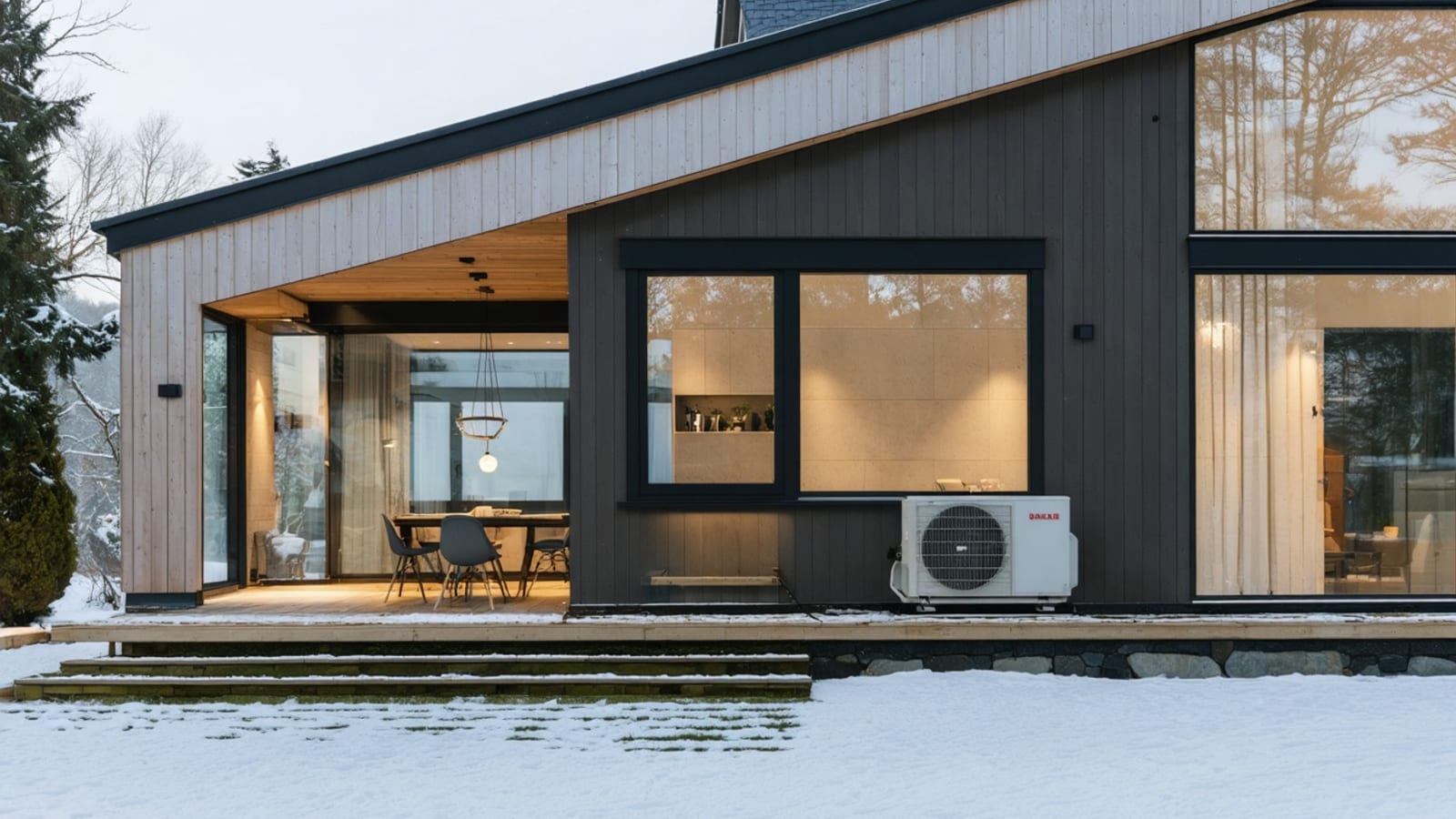
Heat pumps work in cold climates. That question was settled a decade ago by field data from Maine, Minnesota, and Manitoba. The current question is how to size one correctly for climate zones 5, 6, and 7, because the failure mode when it's done wrong is not "inefficient" — it's "can't hold setpoint at -10°F and the homeowner hates the system."
This guide walks through the sizing methodology, what to look for on the AHRI certificate, when to spec backup heat, and why every rule of thumb you've heard about oversizing is wrong for variable-speed cold-climate heat pumps.
Why Manual J under-sizes for cold climates
The ACCA Manual J load calculation is the industry standard for HVAC sizing. It works well for gas furnaces, where rated output is flat across ambient temperatures. It is a starting point, not an ending point, for heat pumps.
The problem is capacity de-rating. A heat pump rated at 36,000 BTU/hr at 47°F ambient will produce substantially less at 17°F and dramatically less at -15°F. A standard heat pump might deliver 40% of rated capacity at -5°F. A cold-climate unit might hold 75% of rated capacity at the same temperature. Neither delivers the rated number in the coldest week of the year, which is exactly when you need it.
Manual J gives you the design heating load at your 99% design temperature — the temperature exceeded in 99% of hours during the heating season. In climate zone 6 cities like Burlington, VT or Bangor, ME, the 99% design temperature is typically around -10°F to -5°F. Your heat pump needs to produce your Manual J load at that ambient, not at 47°F.
The fix is straightforward: pull the heat pump's capacity curve from the manufacturer submittal, overlay it against your Manual J load at design temperature, and confirm the unit meets or gets close to the load at the cold end. If it doesn't, you either upsize, add backup, or spec a different unit.
What "cold-climate heat pump" actually means
The term "cold-climate heat pump" (CCHP) is not a formal certification. It is shorthand for variable-speed inverter-driven heat pumps that hold usable capacity down to -15°F or lower.
The technical markers are specific. A CCHP uses a variable-speed compressor (not single or two-stage), enhanced vapor injection or two-stage compression, and electronic expansion valves. Outdoor units designed for cold climates add base pan heaters and extended defrost cycles. The result is a unit that can deliver 75 to 100% of its rated 47°F capacity at 5°F, and 60 to 80% at -15°F.
Compare that to a conventional heat pump, which is typically a two-stage or single-stage scroll compressor. Those units start losing capacity rapidly below 30°F and often auxiliary-lock out entirely below 5°F, handing all the load to electric resistance strips. That's where "my electric bill tripled in January" stories come from.
CCHP-class units are available from Mitsubishi (Hyper-Heat H2i), Daikin (Aurora), Fujitsu (XLTH), Bosch (IDS), Trane (Link), Carrier (Greenspeed), and several others. All are AHRI-listed. Most qualify for HEEHRA and utility rebates.
How to read an AHRI certificate for low-ambient ratings
AHRI (Air-Conditioning, Heating, and Refrigeration Institute) is the industry certification body that verifies manufacturer-claimed performance. Every AHRI-certified heat pump has a reference number that lets you look up its tested performance in the AHRI Directory.
The standard AHRI certificate shows three key metrics. SEER2 is cooling efficiency. HSPF2 is seasonal heating efficiency. The individual test points are at 47°F (standard rating), 17°F (cold rating), and — for CCHP-class units — 5°F or -15°F low-ambient extension.
For cold-climate sizing, the 47°F and 17°F numbers are necessary but not sufficient. Look at the low-ambient test data if available. A CCHP will list a COP (coefficient of performance) at 5°F in the range of 1.75 to 2.2. A non-CCHP will either not publish a 5°F COP or show it below 1.3. At -15°F, CCHP-class units publish COPs from 1.2 to 1.7, which is still substantially better than electric resistance (COP of 1.0).
HSPF2 alone is misleading for cold-climate sizing. It's a weighted seasonal average that reflects a lot of mild-weather hours and relatively few extreme-cold hours. A unit with HSPF2 of 9.5 and great 47°F performance can have terrible -15°F performance and still look fine on the certificate. Always go deeper than HSPF2.
The backup heat question
A correctly sized CCHP in climate zone 6 typically covers 95 to 99% of annual heating hours without backup. The remaining hours are when ambient drops below the unit's balance point — the temperature at which the heat pump's output equals the building's load.
You have three backup strategies.
Electric resistance strips are the default for all-electric homes. They bolt into the indoor air handler and activate on thermostat demand when the heat pump can't keep up. Sizing: enough capacity to cover design load minus CCHP output at design temperature. For a 30,000 BTU/hr design load and a CCHP producing 20,000 BTU/hr at -5°F, you need about 10,000 BTU/hr of strips — roughly 3 kW. Electric strips have COP of 1.0, so this is your most expensive operating mode, but the total annual hours are small.
Dual-fuel switchover pairs the CCHP with an existing gas or oil furnace. The thermostat monitors ambient temperature and switches to the fossil fuel unit below a preset outdoor temperature (typically 5°F to 25°F). This is the right move for retrofits where the existing furnace is working and gas is cheap. Dual-fuel systems maximize annual operating cost savings at the expense of keeping the fossil equipment in service.
Integrated hydronic backup uses an indirect water heater or small boiler to feed a hydronic coil upstream of the heat pump air handler. This is the least common option but is used in some multifamily and high-end residential projects.
The wrong answer is oversizing the heat pump to eliminate backup entirely. In zones 6 and 7 you would need to spec a unit roughly twice the nominal tonnage you'd pick for cooling, which wrecks shoulder-season and cooling efficiency.
Why oversizing kills variable-speed efficiency
Variable-speed compressors modulate from roughly 30% to 110% of rated capacity. The peak COP point is typically between 40% and 70% of rated capacity, at long cycles with low compressor speed. A right-sized unit runs at medium-low speed for hours at a time during moderate conditions, which is the efficiency sweet spot.
An oversized VSVR heat pump runs at minimum speed (30% of rated) most of the time, in short cycles, because the house load rarely demands more than a fraction of the unit's output. Short cycling has three costs. It drops seasonal COP by 10 to 20% because startup transients dominate run time. It hurts dehumidification because cycles are too short for meaningful moisture removal. And it shortens equipment life because the compressor racks up more starts per year.
The rule of thumb that works for gas furnaces — "size it for the coldest day, extra capacity is free insurance" — is actively harmful for inverter heat pumps. Size tight. Spec slightly undersized with backup rather than oversized with none.
Rebate considerations for cold-climate models
Most HEEHRA state portals maintain an approved model list derived from AHRI-certified ratings meeting CEE Tier 2 or higher for the climate zone. CEE Tier 2 for cold climates requires HSPF2 of 9.5 or higher plus specific cold-ambient performance metrics. Many CCHP-class units meet CEE Advanced Tier (the highest tier) and qualify for the maximum rebate across programs.
Utility programs layer additional requirements. Mass Save, ConnectedSolutions, Xcel Energy, and Efficiency Maine all maintain their own qualified product lists (QPLs), which are tighter than the state HEEHRA list. A model that qualifies for HEEHRA may or may not qualify for the utility rebate — always cross-check both before signing a quote.
The rebate stack in climate zone 6 for a correctly sized CCHP can be substantial. A Massachusetts household under 80% AMI could in principle combine $8,000 HEEHRA (once the state portal opens), $10,000 Mass Save ConnectedSolutions, and $0 federal (25C is dead). That's $18,000 against a typical $14,000 to $18,000 cold-climate install — effectively the entire project.
Ducted vs ductless in cold climates
Ducted CCHPs (central air handlers with a variable-speed outdoor unit) and ductless CCHPs (mini-split head units) have different capacity curves in cold weather. Ductless multi-zone systems often de-rate harder at low ambient because the outdoor unit is sized to the sum of zones and partial-zone operation fights the compressor's efficient range.
Single-head ductless units typically hold capacity better than multi-head systems at -15°F. If you're in zone 7 and considering ductless, one head per zone with dedicated outdoor units outperforms one outdoor unit feeding four indoor heads on the coldest days. The cost is higher upfront but the capacity curve is cleaner.
Ducted systems have the advantage of simpler backup integration — electric strips slot into the air handler, and the thermostat logic for switchover is standardized. Ductless backup is harder to retrofit and usually means a separate wall-mounted electric baseboard in the zone that struggles most.
Commissioning — the step most installs skip
A properly sized and installed CCHP only delivers its rated cold-climate performance if it's commissioned correctly. Commissioning means verifying refrigerant charge, static pressure, airflow, and thermostat configuration against the manufacturer's spec at installation.
The biggest single cause of underperforming cold-climate heat pumps is incorrect refrigerant charge. An undercharged system loses capacity fastest at low ambient, which is exactly when you need full capacity. A 10% undercharge can cost you 25% of rated output at 5°F. This shows up in homeowner complaints as "the system can't keep up in February" — and the installer often misdiagnoses it as undersizing.
Ask your contractor to document commissioning in writing. You want airflow measurements (CFM/ton at rated conditions), static pressure readings, and refrigerant charge verification (subcooling or superheat, depending on the metering device). This paperwork is also often required for utility rebate claims.
Where to go next
The heat pump guide covers equipment basics and duct-vs-ductless tradeoffs. The heat pump calculator pulls every live rebate in your ZIP and flags which programs require specific AHRI-listed cold-climate models. For the program-by-program stacking rules, the rebate stacking guide has the full matrix.
If you're in a HEEHRA-live state and income-qualified, confirm your chosen CCHP model is on your state's approved list before signing. The HEEHRA guide has the full eligibility checklist, and the rebate finder shows which state programs are active today.