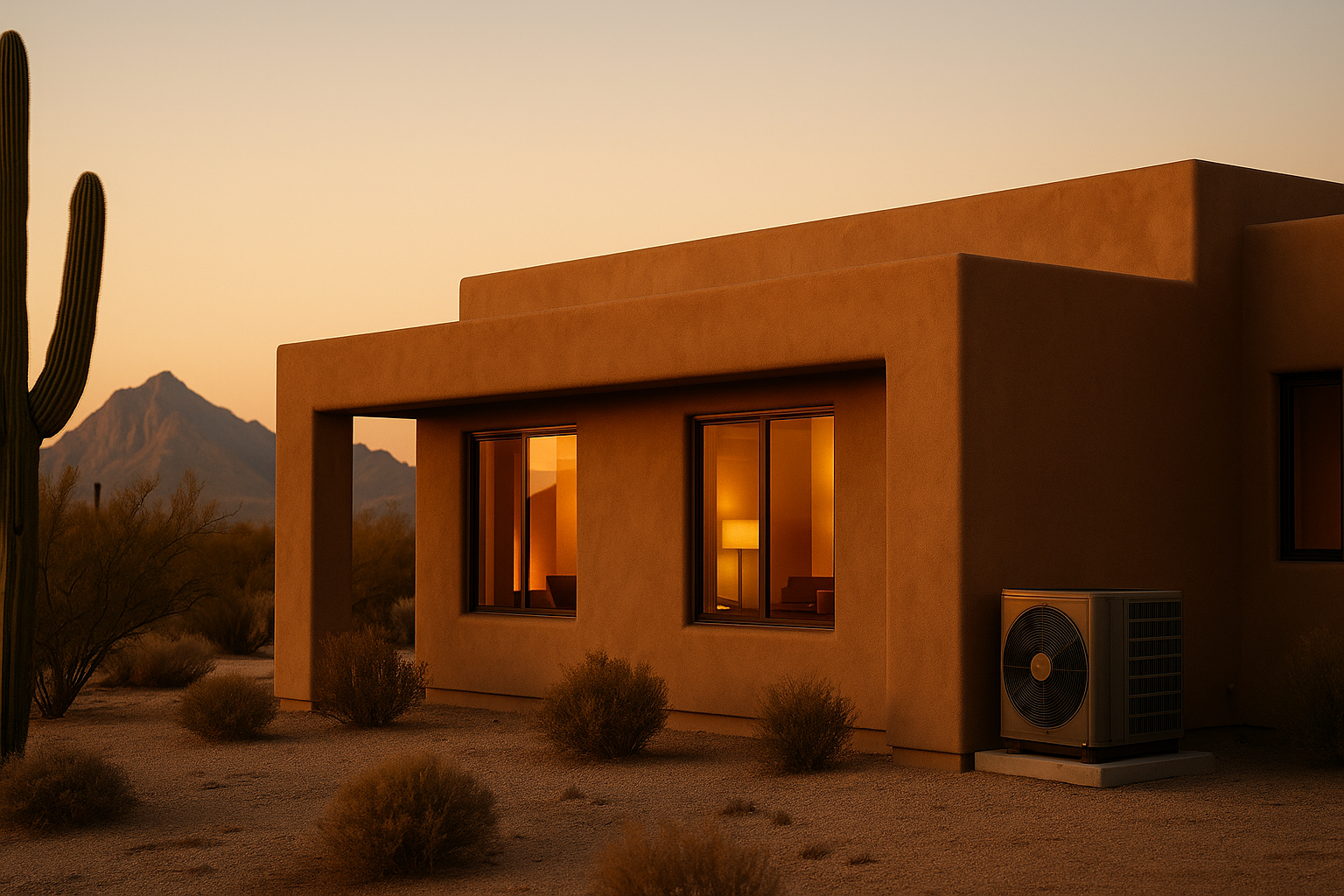
Arizona ranks among the top states in the country for residential air-conditioning use, with the EIA consistently placing it near the head of the list for cooling electricity consumption. That reality does something subtle to the HEEHRA rebate program — it changes which heat pumps actually qualify for the money.
Most HEEHRA state guides, including the cold-climate heat pump sizing posts that lead this network, build their equipment math around winter heating and lean on HSPF2 and cold-climate certification. In a cooling-dominant state, the qualifying math turns on a different set of numbers entirely.
In Arizona, HEEHRA still caps at $8,000 for a heat pump and $14,000 per household, but the equipment you buy must clear a cooling-efficiency threshold — SEER2 and EER2 — rather than the heating specs cold-climate states emphasize.
Why Arizona Changes the HEEHRA Equipment Math
HEEHRA — the High-Efficiency Electric Home Rebate program funded through the Inflation Reduction Act — is federal money that each state administers on its own timeline. The rebate amounts are set nationally, but the equipment that qualifies is filtered through ENERGY STAR certification, and ENERGY STAR draws a line across the map.
That line splits the country into a North region and a South region, each with its own efficiency criteria. Arizona sits firmly in the South, where the certification thresholds are written around cooling performance rather than heating.
What's more, the separate cold-climate ENERGY STAR designation — the tier that governs qualification across New England and the Upper Midwest — carries almost no weight for a Phoenix or Tucson buyer. The number that decides whether your equipment is rebate-eligible is a cooling metric.
ENERGY STAR splits the U.S. into North and South regions. Arizona is in the South, so HEEHRA-qualifying heat pumps are judged on SEER2 and EER2 cooling thresholds, not the HSPF2 heating and cold-climate specs used up north.
HEEHRA Rebate Amounts in Arizona
The dollar figures in Arizona match the federal HEEHRA caps, because the statute fixes the maximums for every participating state. Here is how the program breaks down by measure.
| Upgrade | HEEHRA maximum rebate |
|---|---|
| Electric heat pump (heating and cooling) | Up to $8,000 |
| Heat pump water heater | Up to $1,750 |
| Heat pump clothes dryer | Up to $840 |
| Electric stove, cooktop, or range | Up to $840 |
| Electric panel or service upgrade | Up to $4,000 |
| Electric wiring | Up to $2,600 |
| Insulation, air sealing, and ventilation | Up to $1,600 |
| Household total cap | Up to $14,000 |
Keep in mind that these are ceilings, not guaranteed payouts — the amount you actually receive depends on your income tier and the real cost of the project. The heat pump line is the anchor for most Arizona households, since cooling is the load that runs hardest here.
In cooling-dominant homes, the panel and wiring line items often matter less than they do up north. A house that already runs central air conditioning frequently has the electrical service to support a heat pump, so the $4,000 panel allowance and $2,600 wiring allowance may go partly unused.
Who Qualifies — Income Limits in Arizona
HEEHRA is income-scaled, and eligibility is measured against your Area Median Income, or AMI, for the county you live in. Maricopa County, Pima County, and the rural counties each carry their own AMI figures, so the same salary can land in different tiers depending on where you sit.
Households below 80% of AMI fall into the low-income tier, which covers up to 100% of the project cost. Households between 80% and 150% of AMI can have up to 50% of the cost covered.
Above 150% of AMI, HEEHRA no longer applies. That does not leave higher earners empty-handed, though — the federal 25C tax credit remains available regardless of income, and our HEEHRA income tiers explained guide walks through where each bracket lands.
HEEHRA eligibility in Arizona runs on Area Median Income. Below 80% of AMI covers up to 100% of project cost; 80–150% of AMI covers up to 50%. Above 150%, HEEHRA does not apply, but the 25C credit still does.
What Cooling-Dominant Means for Qualifying Equipment
A cooling-dominant home is one where the annual air-conditioning load outweighs the heating load — the defining condition across most of Arizona's populated low desert. That balance is the reason the qualifying-equipment question looks different here than it does in the network's cold-climate guides or in neighboring states like HEEHRA in Nevada.
For a split-system central heat pump, current ENERGY STAR South-region criteria center on SEER2, seasonal cooling efficiency, and EER2, peak cooling efficiency at high outdoor temperatures. The HSPF2 heating figure still appears on the spec sheet, but it is not the number carrying your certification in the South.
EER2 deserves particular attention in Arizona. It measures efficiency at a 95°F-plus outdoor condition, which is a routine summer afternoon in Phoenix rather than an edge case — so a system that looks efficient on paper can fade exactly when the grid and your bill are under the most strain.
Because the exact thresholds are revised as ENERGY STAR updates its specifications, the reliable move is to confirm a specific model in the AHRI directory and the ENERGY STAR product finder before assuming it qualifies. A contractor's word that a unit is high-SEER is not the same as a verified certification.
EER2 measures cooling efficiency at 95°F-plus — an ordinary Phoenix afternoon, not an edge case. In cooling-dominant Arizona it predicts real summer performance, so it carries unusual weight when choosing HEEHRA-eligible equipment.
Dual-Fuel or Full Electrification in a Cooling-Dominant Climate
Dual-fuel systems — a heat pump paired with a gas furnace that takes over in cold weather — are a common recommendation, and in cold climates the logic is sound. In Arizona, that logic gets weaker with every mild winter.
The heating season in the low desert is short and rarely severe, so the gas furnace in a dual-fuel setup spends most of the year idle. A properly sized heat pump can carry nearly the entire heating load on its own, with simple electric backup heat covering the handful of cold mornings.
HEEHRA will rebate the heat pump portion of a dual-fuel installation as long as it is ENERGY STAR certified. That said, the program is built to encourage electrification, so a household that skips the gas furnace entirely lines up more cleanly with both the rebate's intent and Arizona's actual climate.
HEEHRA rebates the heat pump in a dual-fuel system if it is ENERGY STAR certified. But Arizona's short, mild heating season means a well-sized heat pump plus electric backup usually covers the load, weakening the case for a gas furnace.
Sizing Runs Backward From the Cold-Climate Playbook
In a cold-climate guide, the sizing conversation starts with the design heating load and works toward a balance point where backup heat kicks in. In Arizona, that sequence inverts — the summer cooling load sets the equipment size, and heating becomes the afterthought.
This matters for the rebate because oversizing to chase a heating number you will rarely use wastes both capacity and money. A Manual J calculation run on the actual cooling load, at a Phoenix design temperature near 108°F, is the honest basis for equipment selection — the same discipline our Manual J load calculator is built around.
Oversized systems short-cycle, dehumidify poorly, and wear faster — none of which the rebate reimburses. Sizing to the cooling load first is how you keep a HEEHRA-funded system efficient across the twenty-plus weeks a year it runs hard.
How HEEHRA Stacks With the Federal 25C Credit
HEEHRA and the 25C tax credit are separate instruments — one is a point-of-sale rebate, the other a credit you claim at tax time — and most Arizona households can use both on the same project. The common limit is that you generally cannot claim 25C on the share of cost a rebate has already covered, a boundary our 25C versus HEEHRA decision tree maps in detail.
For a household in the moderate-income tier, that stacking can meaningfully close the gap between the rebate ceiling and the full installed price of a high-EER2 system. It is worth noting that the federal residential solar tax credit is a different program and expired on December 31, 2025 — HEEHRA and 25C for heat pumps continue independently of it.
What This Means Before You Buy
The through-line in Arizona is that the rebate rewards cooling-efficient, fully electric equipment, and the specs that qualify it are cooling specs. Confirming a model's ENERGY STAR South-region certification and its EER2 rating does more for your eligibility than any heating number.
Homeowners weighing the move may want to confirm three things before signing a contract: the current AMI tier for their county, the specific model's certification in the AHRI directory, and whether Arizona's application window is open. Each of those is verifiable, and none should be taken on a contractor's assurance alone.
Arizona's HEEHRA program is administered by the state energy office on a rollout timeline that can shift. Confirm the current application window, participating contractors, and your county's AMI tier directly with the state, and see the full HEEHRA state guide for how other states compare.
Common Questions About HEEHRA in Arizona
Is the $8,000 heat pump rebate guaranteed in Arizona?
No. The $8,000 figure is a ceiling set by federal statute, and the amount you receive depends on your income tier and the project's real cost. Low-income households can reach the full amount, while moderate-income households are capped at 50% of cost.
Does my old gas furnace disqualify me from HEEHRA?
Not by itself. HEEHRA rebates the qualifying heat pump whether or not you keep a gas furnace as backup. Removing it is not required, though full electrification aligns more closely with the program's design.
Why does SEER2 matter more than HSPF2 in Arizona?
Because Arizona sits in the ENERGY STAR South region, where certification is written around cooling efficiency. SEER2 and EER2 are the thresholds a model must clear, while HSPF2 governs qualification in colder northern states.
This article is for informational purposes and is not financial, tax, legal, or medical advice. Consult a licensed professional (CPA, elder-law attorney, HVAC contractor, or your state energy office) before acting.