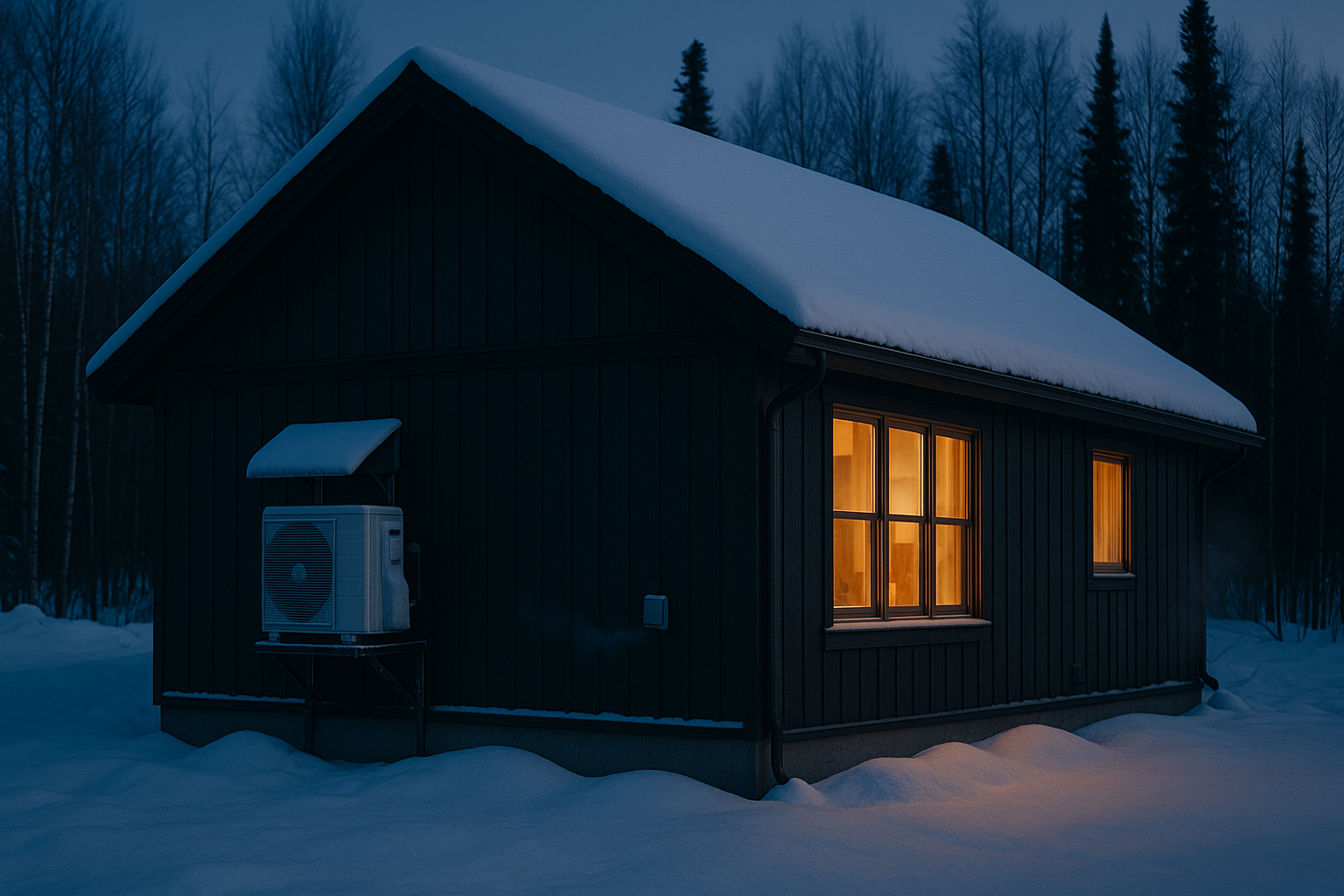
Alaska carries some of the highest residential heating costs in the country, and the cause is structural rather than seasonal. A large share of the housing stock burns delivered fuel oil or propane, and a meaningful portion of it sits in communities that no pipeline and no road reaches.
That makes the Home Electrification and Appliance Rebates program, commonly called HEEHRA, look like an unusually good fit on paper. The federal rebate can cover the entire installed cost of a heat pump for a lower-income household, and the fuel it displaces is among the most expensive in the nation.
Then the design temperature shows up. Equipment qualifies for HEEHRA on the strength of ratings measured at 47°F, 17°F, and — for cold-climate models — 5°F, while Fairbanks designs to roughly forty degrees below zero.
That gap is the entire story of HEEHRA in Alaska, and it does not get resolved by picking a better model off the qualified list. It gets resolved by understanding what the list does and does not tell you.
Verification note. HEEHRA is state-administered, which means Alaska's program design, launch timing, contractor network, and application mechanics are set at the state level rather than federally. Confirm current amounts, income limits, and application status with the administering Alaska agency before committing to any equipment purchase.
What HEEHRA Pays For, And Where The Caps Sit
The rebate amounts are set in federal statute and do not vary state to state, even though administration does. What varies is which measures a state opens first, how the contractor network is credentialed, and how quickly funds move.
The per-measure caps that apply to an Alaska household include but are not limited to the following:
| Measure | Federal cap | Alaska relevance |
|---|---|---|
| Heat pump for space heating and cooling | $8,000 | The headline measure, and the one most affected by design temperature |
| Heat pump water heater | $1,750 | Often the safer first purchase in deep-cold regions, since it sits in conditioned space |
| Electrical panel upgrade | $4,000 | Frequently the binding constraint in older Alaska housing stock |
| Electrical wiring | $2,500 | Covers the branch circuit work a new outdoor unit and backup heat require |
| Insulation, air sealing, and ventilation | $1,600 | Highest return per dollar in a subarctic design climate |
| Heat pump clothes dryer | $840 | Minor load, minor savings |
| Electric stove, cooktop, range, or oven | $840 | Minor load, minor savings |
| Household total | $14,000 | The ceiling across all measures combined |
Note that the $14,000 household ceiling means the measures compete with one another. A household that spends the full $8,000 on a heat pump has roughly $6,000 left for the panel, wiring, and envelope work that heat pump may depend on to perform.
The Income Tiers, And Why Alaska AMI Behaves Oddly
HEEHRA eligibility runs on area median income rather than a flat federal poverty threshold. That distinction matters more in Alaska than almost anywhere else, because Alaska's income distribution and its cost of living are decoupled in ways the AMI formula does not capture.
HEEHRA pays 100% of project cost under 80% AMI and 50% between 80% and 150% AMI, capped at $14,000 per household. Above 150% AMI there is no HEEHRA rebate. HUD sets Alaska AMI by borough or census area.
Alaska has no counties. HUD publishes income limits by borough and by unorganized census area, which means a household's tier can shift substantially across what feels like a short distance on a map.
The North Slope Borough illustrates the problem cleanly. Resource-sector wages pull the borough median upward, which can place a household above the 80% threshold even while it pays some of the highest delivered fuel and electricity prices in the United States.
The reverse case exists too. Several rural census areas carry low medians, which makes the 100%-of-cost tier reachable for a large share of households — and those are precisely the places where installed cost runs highest because labor and equipment have to be barged or flown in.
Before you estimate anything, pull the current HUD income limit for your specific borough or census area at your exact household size. Our breakdown of how HEEHRA income tiers are calculated walks through the AMI math and the household-size adjustments in detail.
Where Alaska's Design Temperatures Actually Land
A design temperature is not the coldest reading your community has ever recorded. The 99% winter design temperature is the outdoor dry-bulb value that ambient conditions stay above for 99% of hours in a typical year, and it is the input a Manual J load calculation is built on.
Alaska's 99% winter design temperatures range from roughly 1°F in Juneau to near -45°F in the Interior. Anchorage sits close to -5°F. Pull your exact station value from ASHRAE climatic design data.
The following approximate ranges are drawn from ASHRAE Fundamentals climatic design conditions and are presented as ranges deliberately, since the 99% and 99.6% values differ and station selection matters. Treat them as orientation, not as a design input.
| Community | Approximate 99% winter design temp | Distance below the 5°F rating point |
|---|---|---|
| Ketchikan | 8°F to 15°F | At or above the rating point |
| Juneau | 0°F to 5°F | Roughly at the rating point |
| Anchorage | -5°F to -10°F | 10 to 15 degrees below |
| Kenai and Soldotna | -8°F to -15°F | 13 to 20 degrees below |
| Palmer and Wasilla | -12°F to -20°F | 17 to 25 degrees below |
| Nome | -25°F to -32°F | 30 to 37 degrees below |
| Bethel | -28°F to -35°F | 33 to 40 degrees below |
| Utqiaġvik | -38°F to -45°F | 43 to 50 degrees below |
| Fairbanks | -40°F to -47°F | 45 to 52 degrees below |
Look at the right-hand column rather than the middle one. In Southeast Alaska the published cold-climate rating describes real operating conditions, and in the Interior it describes weather the equipment will effectively never see.
What A 47°F, 17°F, And 5°F Rating Actually Describes
Air-source heat pumps are rated under AHRI 210/240, which publishes heating capacity and coefficient of performance at 47°F and 17°F outdoor dry-bulb. Seasonal metrics such as HSPF2 are derived from a bin-weighted model tied to a reference climate region, not to your specific location.
AHRI 210/240 publishes heating capacity at 47°F and 17°F. Cold-climate listings extend to 5°F and sometimes -13°F. No standard rating point exists below -13°F, so Interior Alaska performance is simply unpublished.
Cold-climate designations add a low-temperature floor on top of that baseline. The ENERGY STAR residential air-source heat pump specification includes a Cold Climate designation with a minimum rated COP measured at 5°F, and you should confirm the current threshold against the active version of that specification rather than a summary of it.
The more useful document for Alaska is the Northeast Energy Efficiency Partnerships cold-climate air-source heat pump product list. NEEP publishes maximum and rated capacity plus COP at 47°F, 17°F, 5°F, and in many entries -13°F, which is the lowest widely available third-party data point in the residential market.
Nothing standardized exists below -13°F. A Fairbanks household evaluating equipment at a -42°F design temperature is looking at a roughly thirty-degree extrapolation beyond the last published number, and the shape of a compressor's capacity curve in that region is manufacturer-specific rather than predictable.
This is why enhanced vapor injection matters disproportionately here. Our explainer on vapor injection compressor design covers why injected-cycle machines hold capacity further down the curve than single-stage scroll designs, and why that changes the extrapolation risk.
Compressor Lockout And What Happens Below It
Every cold-climate heat pump carries a minimum operating ambient temperature. Below that setpoint the control board stops the compressor entirely, either to protect the refrigerant circuit or because the manufacturer will not warrant operation there.
Most cold-climate heat pumps lock out the compressor between -13°F and -22°F outdoor ambient. Below that point the backup heat source carries 100% of the load, at a COP of 1.0 if that backup is electric resistance.
In Juneau or Ketchikan, lockout is a theoretical concern that may be triggered a handful of hours per decade. In Fairbanks, Bethel, or Nome, lockout describes a meaningful fraction of the heating season, and it arrives precisely when the load is at its maximum.
The practical consequence is that backup capacity in Alaska is not a trim detail. It is the primary heating system for the coldest stretch of the year, and sizing it as an afterthought produces either an undersized system or a service entrance that cannot carry it.
Two decisions govern this. The first is how backup heat is sized and staged, and the second is where the balance point control hands off between compressor and backup.
A dual-fuel configuration deserves specific attention in Alaska. Keeping an existing oil boiler, Toyostove, or propane furnace as the below-lockout heat source avoids both the resistance-heat cost penalty and the panel upgrade that a large electric backup element would force.
The Delivered-Heat Cost Math
The comparison that matters is cost per million BTU actually delivered into the house, not cost per kilowatt-hour or per gallon. Electricity delivers 3,412 BTU per kilowatt-hour multiplied by the operating COP, and fuel delivers its heating value multiplied by combustion efficiency.
At $0.24 per kWh and a COP of 2.0, delivered heat costs about $35 per MMBTU. Electric resistance at the same rate costs about $70. Number one heating oil at $5.00 per gallon and 85% efficiency lands near $44.
The table below is illustrative and uses stated assumptions rather than surveyed Alaska prices. Substitute your own utility rate and your own delivered fuel price before drawing any conclusion, because both vary enormously between the Railbelt and off-road communities.
| Heat source | Assumption | Delivered cost per MMBTU |
|---|---|---|
| Heat pump near 5°F | $0.24/kWh, COP 2.0 | About $35 |
| Heat pump near -13°F | $0.24/kWh, COP 1.5 | About $47 |
| Electric resistance backup | $0.24/kWh, COP 1.0 | About $70 |
| Number one heating oil | $5.00/gal, 85% efficiency, 135,000 BTU/gal | About $44 |
| Propane | $4.00/gal, 90% efficiency, 91,500 BTU/gal | About $49 |
| Rural electricity after PCE credit | $0.45/kWh, COP 2.0 | About $66 |
Read the first and third rows together. The same machine that beats heating oil by roughly twenty percent above its balance point costs sixty percent more than heating oil once the compressor locks out and resistance elements take over.
The last row is the one that governs most off-road communities. Alaska's Power Cost Equalization program reduces residential electricity rates in eligible rural communities, and even after that credit the effective rate can eliminate the heat pump advantage against delivered fuel entirely.
Defrost Is A Coastal Problem, Not An Interior One
Frost accumulates on the outdoor coil when coil surface temperature drops below both the dew point and freezing. That combination is a function of humidity, not of raw cold.
Defrost losses peak roughly between 25°F and 40°F with high humidity, which describes coastal Southeast and Southcentral Alaska. Interior Alaska's deep cold holds very little moisture, so frost accumulation is lower there.
Southeast Alaska sits in the worst possible band for much of the winter. Ketchikan and Sitka spend long stretches in the thirties with high relative humidity, which drives frequent defrost cycles and a real reduction in seasonal efficiency relative to the nameplate rating.
Interior Alaska has the opposite profile. At -30°F the air holds almost no moisture, so a Fairbanks unit that is running at all is running with a comparatively clean coil, and the binding constraint is capacity rather than frost.
This inverts the usual intuition that colder always means worse. Our analysis of defrost cycle losses and how to size around them covers the humidity and temperature bands where the penalty is largest.
Alaska Splits Into Three Distinct Heat Pump Regions
Treating Alaska as a single climate produces bad decisions in both directions. The state contains at least three regimes with different design temperatures, different electricity prices, and different competing fuels.
The distinctions that drive the HEEHRA calculation include:
- Southeast Alaska. Design temperatures near or above 0°F, hydroelectric generation in communities like Juneau, and a housing stock heavily dependent on fuel oil. This is the strongest case in the state for full displacement, and heat pumps are already common there.
- Southcentral Alaska. Design temperatures roughly between -5°F and -20°F across Anchorage, the Kenai, and the Mat-Su. Anchorage's competing fuel is piped Cook Inlet natural gas rather than delivered oil, which is a materially different economic comparison than the rest of the state faces.
- Interior, Western, and North Slope Alaska. Design temperatures from roughly -25°F to below -45°F, high electricity costs, and substantial hours below compressor lockout. Full displacement is generally not the right target, and the realistic use case is shoulder-season and mid-winter operation with a retained fuel-fired backup.
All of these regions can access the same federal rebate at the same statutory caps. What differs is what the equipment purchased with that rebate will actually do across a heating season.
Envelope And Panel Money Often Outperforms Equipment Money
The $1,600 insulation and air sealing measure looks small next to the $8,000 heat pump line. In a design climate of -40°F, that ratio understates its value considerably.
Heating load scales with the difference between indoor and outdoor temperature. At a 110-degree delta, every reduction in envelope leakage and every improvement in assembly R-value returns roughly twice what the same measure returns in a 55-degree-delta climate.
Load reduction also shrinks the equipment you need to buy. A blower door test and targeted air sealing that cut infiltration meaningfully can move a house from a size that requires a large outdoor unit and a panel upgrade to one that does not.
Alaska has a long institutional history here through the state's Building Energy Efficiency Standard and the residential energy rating framework that has supported weatherization and home energy rebate work for years. A current energy rating gives you the load number that every downstream decision depends on, and it is worth having before you shop equipment.
Run the load calculation before you select a model. Our heat pump load and sizing calculator and the companion guide to sizing heat pumps for cold-climate design temperatures both start from design temperature rather than square footage.
Which Agency Administers HEEHRA In Alaska
Alaska's residential energy rebate and weatherization work has historically run through the Alaska Housing Finance Corporation, while the Alaska Energy Authority serves as the state energy office. Which of those entities holds the HEEHRA administration role, and what the current program status is, should be confirmed directly rather than assumed.
There is a second channel that matters specifically in Alaska. The Inflation Reduction Act created a separate home electrification rebate allocation for Indian Tribes administered through the Department of Energy's Office of Indian Energy, distinct from the state formula allocation.
For households in Alaska Native villages, that tribal channel may be the operative program rather than the state one. Tribal housing authorities and regional housing entities are the correct starting point for confirming which allocation applies and what the application path looks like.
Federal tax credits are a separate question from rebates, and their status has changed. Check our current federal tax credit status page and the rebate versus tax credit decision tree before assuming any credit stacks on top of a HEEHRA rebate.
A Decision Rule Indexed To Where You Are
The right next step depends on which phase you are in rather than on which product you like. The following framing maps to the three most common positions Alaska households occupy.
If you are pre-purchase and located in Southeast Alaska, the case for full displacement is strong and the primary open questions are defrost behavior and utility rate structure. Get a current load calculation, then compare NEEP-listed COP at 17°F and 5°F rather than comparing HSPF2 figures.
If you are pre-purchase in Southcentral Alaska, the deciding variable is what you are displacing. Displacing delivered oil or propane produces a very different result than displacing piped natural gas, and the balance point and backup strategy need to be settled before equipment selection, not after.
If you are in the Interior, Western Alaska, or on the North Slope, evaluate the heat pump as a supplement rather than a replacement. Model the fraction of the heating season that falls below your candidate unit's lockout temperature, price that fraction at your actual backup fuel cost, and check whether the heat pump water heater and envelope measures deliver more certain value than the space heating unit does.
In all three cases, verify the HEEHRA measure caps and your AMI tier before you sign anything. The full state-by-state breakdown lives on our HEEHRA program guide hub, and neighboring cold-climate analyses such as the New Hampshire HEEHRA deep dive cover comparable lockout and backup-heat questions at less extreme design temperatures.
Frequently Asked Questions
How much can an Alaska household get from HEEHRA?
The statutory caps are $8,000 for a heat pump, $1,750 for a heat pump water heater, $4,000 for a panel upgrade, $2,500 for wiring, and $1,600 for insulation and air sealing, up to $14,000 per household.
What income limits apply to HEEHRA rebates in Alaska?
Households under 80% of area median income can have 100% of project cost covered, and 80% to 150% AMI covers 50%. Above 150% AMI, HEEHRA does not apply. Alaska AMI is set by HUD per borough or census area.
Do cold-climate heat pumps work at Fairbanks design temperatures?
The Fairbanks 99% winter design temperature runs near -40°F, below the -13°F to -22°F operating floor of most listed cold-climate models. Below that lockout point, backup heat carries the entire load.
Does HEEHRA require an ENERGY STAR or NEEP-listed heat pump?
State programs typically require ENERGY STAR certification, and many add a cold-climate designation. The NEEP ccASHP list publishes capacity and COP at 5°F and -13°F, which the ENERGY STAR label alone does not show.
Can Alaska Native households use a separate tribal rebate program?
The Inflation Reduction Act set aside home electrification rebate funding for Indian Tribes administered through the DOE Office of Indian Energy, separate from the state allocation. Confirm eligibility with your tribal housing authority.
Where This Leaves You
HEEHRA does not adjust its equipment standards for Alaska, and the rating infrastructure the program leans on stops producing data roughly thirty degrees above an Interior design temperature. That is a data problem rather than a disqualification.
Households that treat the qualified-equipment list as a starting filter, then verify low-temperature capacity, lockout setpoint, and backup strategy against their own design temperature and their own energy prices, tend to end up with systems that perform as expected. Households that treat the list as an answer tend not to.
This article is for informational purposes and is not financial, tax, legal, or medical advice. Consult a licensed professional — a CPA, an elder-law attorney, an HVAC contractor, or your state Medicaid office as applicable — before acting.