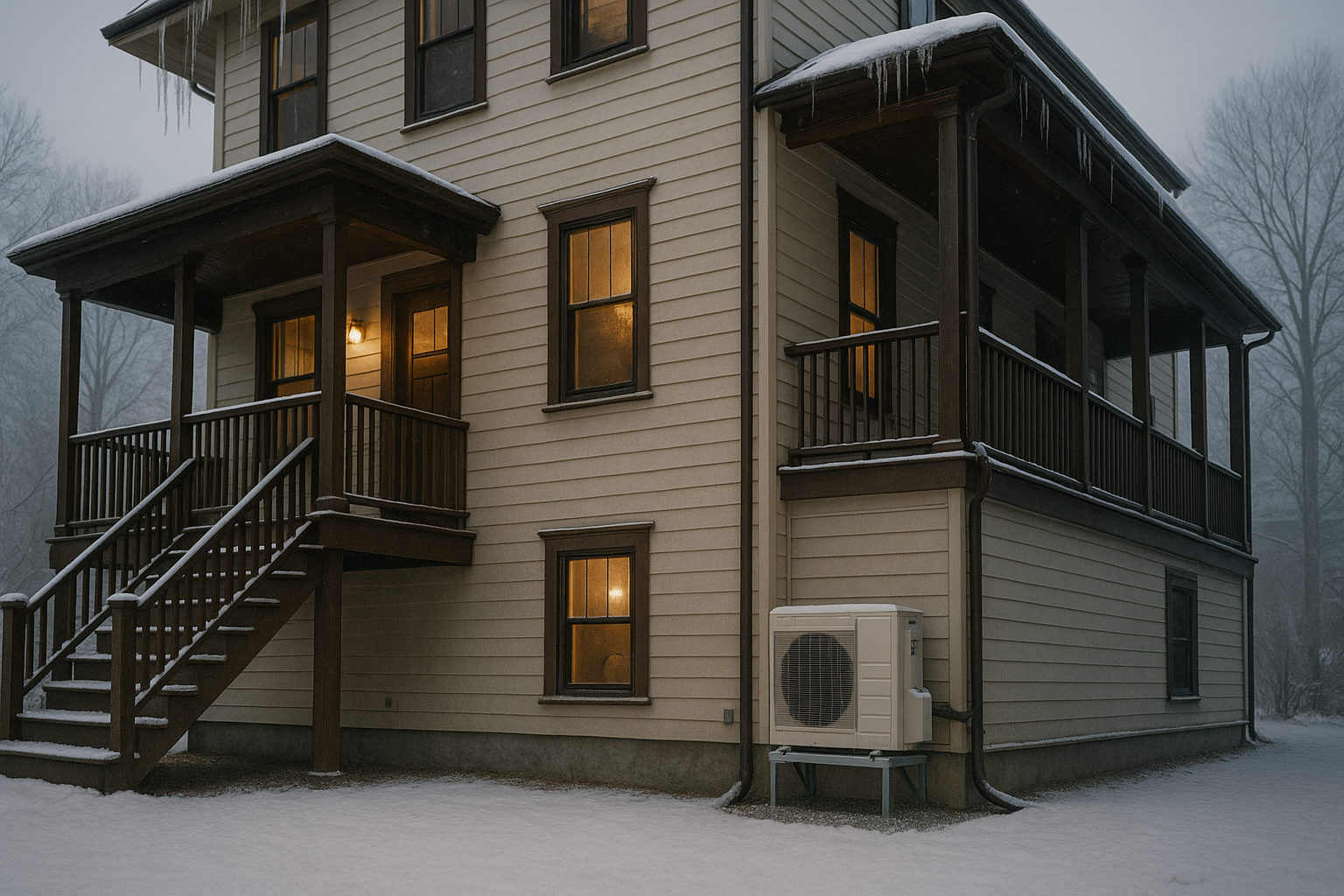
Have you ever walked out on a January morning and found a sheet of ice fused to the bottom of your heat pump's outdoor unit? If you live where temperatures hover around freezing for weeks at a time, you probably have or will.
Most homeowners spend their research time on SEER2, HSPF2, and capacity at 5°F, and those numbers do matter most for sizing. That said, two small resistance heaters, the base pan heater and the crankcase heater, often decide whether that equipment keeps running reliably through a long winter.
What Is A Base Pan Heater?
A base pan heater is a low-wattage electric heating element mounted in, or clipped to, the drain pan at the bottom of the outdoor unit. Its only job is to keep that pan and its drain openings above freezing so water can leave the cabinet.
A base pan heater warms the drain pan beneath the outdoor coil so defrost meltwater drains away. Without it, that water can refreeze in the pan and build ice upward into the coil and fan.
Where does the water come from? Every time a heat pump runs a defrost cycle, it melts the frost off its outdoor coil, and that meltwater drips straight down into the base pan.
In mild weather the water simply drains away. However, when outdoor air stays below freezing after the defrost ends, that water can refreeze in the pan before it escapes — and each defrost cycle adds another layer.
How Ice Lock Develops
The failure pattern is gradual, which is why it catches so many homeowners off guard. The progression typically looks like this:
- Refreeze in the pan. Meltwater freezes around the drain openings, so the next round of meltwater has nowhere to go.
- Ice climbs the coil. Ice builds upward into the bottom rows of the coil, blocking airflow and reducing heating capacity.
- Defrost loses ground. The control keeps triggering defrost cycles, but ice packed at the base never fully melts, so efficiency slides with every cycle.
- Mechanical damage. In severe cases, ice reaches the fan blade or deforms coil fins and tubing. That can mean a broken fan, a refrigerant leak, or both.
All of this can happen while the thermostat indoors reads normally, because backup heat strips quietly pick up the slack. As a result, the first sign of trouble is often a high electric bill rather than a cold house.
When A Base Pan Heater Turns On
Control logic varies by manufacturer, so the installation manual for your specific model is the final word. Keep in mind that most designs fall into one of a few patterns:
- Outdoor-temperature control. The heater energizes when the outdoor sensor reads below a set point, commonly somewhere in the mid-30s °F, and shuts off once conditions warm.
- Defrost-linked control. The heater runs during and for a period after each defrost cycle, when meltwater is actually present in the pan.
- Thermostat-disc control. Some simpler accessory kits use a snap-disc thermostat that powers the heater continuously whenever the pan itself is cold.
Defrost-linked and board-controlled designs generally use the least energy, because they heat only when there is water to move. For that reason, it is worth asking which logic a quoted unit uses, a question that pairs naturally with our guide to defrost cycles and cold-climate sizing.
Which Climates Actually Need One?
Base pan heaters matter most in places that spend long stretches near 32°F, which are not always the places with the coldest record lows. This is because the refreeze problem depends on meltwater, and meltwater depends on frequent defrost cycles in humid, near-freezing air.
Frost forms fastest on an outdoor coil when the air is roughly between the mid-20s and high-30s °F and humidity is high. Accordingly, coastal New England and the Great Lakes snowbelt tend to generate far more defrost water than a dry, bitterly cold morning on the northern Plains.
Base pan heaters matter most in humid regions that spend weeks near freezing, where frequent defrosts make the most meltwater. Dry, deep-cold climates still benefit, since any meltwater refreezes almost instantly.
The table below summarizes how climate pattern shapes the priority of this accessory:
| Climate pattern | Defrost frequency | Base pan heater priority |
|---|---|---|
| Humid, frequent freeze-thaw (coastal Northeast, Great Lakes) | High | Strongly recommended |
| Sustained deep cold, drier air (northern Plains, northern Rockies) | Moderate | Recommended, since meltwater freezes on contact |
| Mild marine winters with occasional hard freezes | Low to moderate | Optional; placement matters more |
| Warm climates with a handful of freezing nights | Low | Usually unnecessary |
Overall, the more hours your home spends between roughly 25°F and 40°F in damp air, the more a base pan heater earns its place. Our analysis of whether a cold-climate heat pump is worth it in your region can help frame how hard your winter will push the equipment.
What Is A Crankcase Heater?
The crankcase heater protects the compressor, which is the most expensive single component in the system. It is a small resistance heater, typically a band wrapped around the lower shell of the compressor or an element inserted into a well, that keeps the oil sump warm while the compressor is idle.
Refrigerant tends to migrate to the coldest part of a system during off cycles. In winter, that is often the compressor sitting outdoors, where refrigerant can condense and dissolve into the lubricating oil.
A crankcase heater warms the compressor's oil sump during off cycles so refrigerant does not condense into the oil. That protects bearings and valves from diluted oil and liquid slugging at startup.
Why Refrigerant Migration Damages Compressors
When a cold compressor starts with liquid refrigerant mixed into its oil, several problems can follow. These include but are not limited to:
- Oil dilution. Refrigerant thins the oil, so bearings and moving surfaces get less protection during the first minutes of operation.
- Foaming. The pressure drop at startup makes dissolved refrigerant boil out of the oil. Foaming oil can be carried out of the compressor instead of staying in the sump where it belongs.
- Liquid slugging. Compressors are designed to compress vapor, not liquid. Liquid entering the compression chamber can damage valves, scroll sets, or other internal parts.
Any single cold start is survivable, but hundreds of them across a long winter add up to wear that shortens compressor life. A crankcase heater keeps the oil a few degrees warmer than the rest of the system, so refrigerant prefers to settle elsewhere.
Inverter Compressors And Winding Heat
Many modern variable-speed heat pumps do not use a separate band heater at all. Instead, the control board sends a small current through the compressor's motor windings while it is stopped, generating heat without turning the motor, a feature often called compressor preheat or winding heat.
Many inverter heat pumps protect the compressor by energizing its motor windings at low power while idle. The goal matches a crankcase heater: keep the oil warm so refrigerant does not settle in it.
The function is the same; only the hardware differs. What's more, because these systems modulate and run long, low-speed cycles, they tend to spend less time fully off in cold weather, which reduces migration risk to begin with.
For more detail on how these compressors behave at low ambient temperatures, see our guide to inverter and scroll compressors.
Energy Cost: What Do These Heaters Add To The Bill?
Both heaters are resistance loads, so their cost is simple arithmetic: watts multiplied by hours, divided by 1,000, equals kilowatt-hours. The ranges below are illustrative, not manufacturer ratings, and your unit's installation manual lists the actual wattage.
| Accessory | Typical wattage (approximate) | When it runs | What drives seasonal use |
|---|---|---|---|
| Base pan heater | Roughly 50–200 W | Near or below freezing, often tied to defrost | Control logic and hours near freezing |
| Crankcase band heater | Roughly 20–75 W | Compressor off in cold ambient air | Whether it is controlled or always on |
| Winding heat (inverter) | Low; varies by model | Compressor off in cold ambient air | Off-cycle hours in cold weather |
For instance, a 100-watt base pan heater that runs 800 hours in a season uses about 80 kWh. At an illustrative rate of $0.20 per kWh, that is roughly $16 for the winter — small compared with a single service call to clear ice or replace a fan motor.
Running cost is usually a few dollars to a few tens of dollars per winter, depending on wattage, hours, and your electric rate. Heaters that run only when needed use far less than always-on designs.
Keep in mind that an always-on crankcase heater is where costs can quietly creep. An older fixed-resistance design powered through an entire shoulder season can use more than a well-controlled base pan heater, which is why control logic matters more than the wattage printed on the label.
Comparing quotes: Ask for wattage and control logic together. A 150-watt heater that runs only after defrost cycles can cost less over a winter than a 60-watt heater that never shuts off below 50°F.
Placement Still Does Most Of The Work
A base pan heater is a backstop rather than a substitute for proper siting. If the outdoor unit sits on a ground pad where snow drifts against the coil, or directly under a roofline that drips, no low-wattage heater will keep up.
Before relying on the heater, it helps to confirm that the installation also covers these basics:
- Elevation above the snow line. A wall bracket or ground stand keeps the base pan above typical snow depth and gives meltwater room to fall away.
- A clear drain path. Meltwater needs somewhere to go below the unit, such as a gravel bed, instead of a solid pad that channels water back under the cabinet.
- Roof and gutter protection. A drip shield, or a location away from eaves, prevents water and falling ice from landing on top of the unit.
- Wind and drift awareness. Orienting the coil away from prevailing winter winds reduces drifting snow and ice packing against the fins.
Our outdoor unit placement guide covers stand heights, clearances, and drainage in more depth. Together, good siting and a properly controlled base pan heater address the ice problem from both directions.
What To Confirm On An Installer's Quote
Accessory heaters are easy to leave off a quote, and they are rarely the line item a salesperson highlights. Therefore, it is worth asking about them directly while you compare bids, ideally alongside the checklist in our guide to what to know before you get installer quotes.
A quote should state whether a base pan heater is factory-installed or an accessory kit listed by part number, how it is controlled, and how the compressor is protected during cold off cycles.
Here's a list of questions worth putting to every installer:
- Factory-installed or accessory? Some cold-climate models include a base pan heater from the factory, while others require a separate kit. If it is a kit, it should appear on the quote by part number.
- What controls the heater? Ask whether it is board-controlled, defrost-linked, or a simple thermostat disc, and at what temperature it activates.
- How is the compressor protected? The answer should be a crankcase band heater or winding heat. The installer should know which one your specific model uses.
- What is the pre-start procedure? Many manufacturers specify that power be applied for a set period, often 12 to 24 hours, before the first cold-weather start so the oil can warm.
- Is the stand height matched to local snow depth? A heater cannot compensate for a unit buried in a drift, so the mounting plan matters as much as the accessory.
- Is it the manufacturer's listed kit? Generic heat tape may not match the unit's wiring, wattage, or control logic. It can also complicate a warranty claim.
If one installer includes these items and another does not, the lower bid may not be the better value. After all, a factory accessory kit is typically a small fraction of the total project, as our breakdown of heat pump installation costs shows.
A note on winter shutdowns: Crankcase and winding heat need power to work, so switching off the outdoor disconnect for long stretches in cold weather removes that protection. If power has been off, many manuals call for re-energizing the unit for several hours before it restarts.
How These Accessories Fit Into Cold-Climate Equipment Selection
Heat pumps on the NEEP Cold Climate Air Source Heat Pump list, or certified under ENERGY STAR's cold-climate criteria, are engineered to deliver meaningful capacity at 5°F. ENERGY STAR's cold-climate designation, for example, requires a coefficient of performance of at least 1.75 at 5°F.
That said, those ratings describe how much heat the unit makes, not how it handles meltwater or cold starts. Accessory questions still need their own answers, even on top-rated equipment.
When you are comparing manufacturers, the accessory details often differ more than the headline specs. Our overview of cold-climate heat pump brands is a useful starting point, and the ElectrifyAtlas heat pump guide covers the full selection process.
Remember that sizing and accessories work together. An undersized unit runs longer, defrosts more often, and leans harder on backup heat, so a proper load calculation from our cold-climate heat pump sizing guide reduces how hard the base pan heater has to work in the first place.
In addition, well-tuned balance point controls keep backup heat from masking an ice problem. If strips engage far more often than expected on a mild, damp day, a blocked base pan is one of the first things worth checking.
Common Questions About Base Pan And Crankcase Heaters
A few questions come up again and again once homeowners start looking closely at their outdoor units. The short answers below cover the most common ones.
Is some frost on the outdoor coil normal in winter?
Yes. Light frost on the coil is expected in cold, humid weather, and the defrost cycle is designed to clear it; the warning sign is thick ice at the base that remains after defrost ends.
Does a base pan heater run in summer?
It should not, because its control keeps it off above the activation set point. If the heater appears to run in warm weather, a failed sensor or thermostat disc is the likely cause and worth a service check.
Does a ductless mini-split outdoor unit need a base pan heater too?
The same physics applies, since mini-split outdoor units defrost and shed meltwater just like central systems. Many cold-climate mini-split lines include or offer one; our mini-split vs. central heat pump comparison covers other differences.
Getting Winter Reliability Right
Base pan heaters and crankcase heaters are inexpensive, low-wattage parts, yet they protect the two failure points that most often sideline a cold-climate heat pump: ice lock and compressor wear. This is why they deserve a line on every quote, a clear answer on control logic, and a mounting plan that gives them a fair chance.
If you are gathering bids now, bring these questions to every installer and compare the answers side by side. The heat pump guide is a good next stop for the rest of the equipment decision.
This article is for informational purposes and is not financial / tax / legal / medical advice. Consult a licensed professional (CPA, elder-law attorney, HVAC contractor, state Medicaid office) before acting.