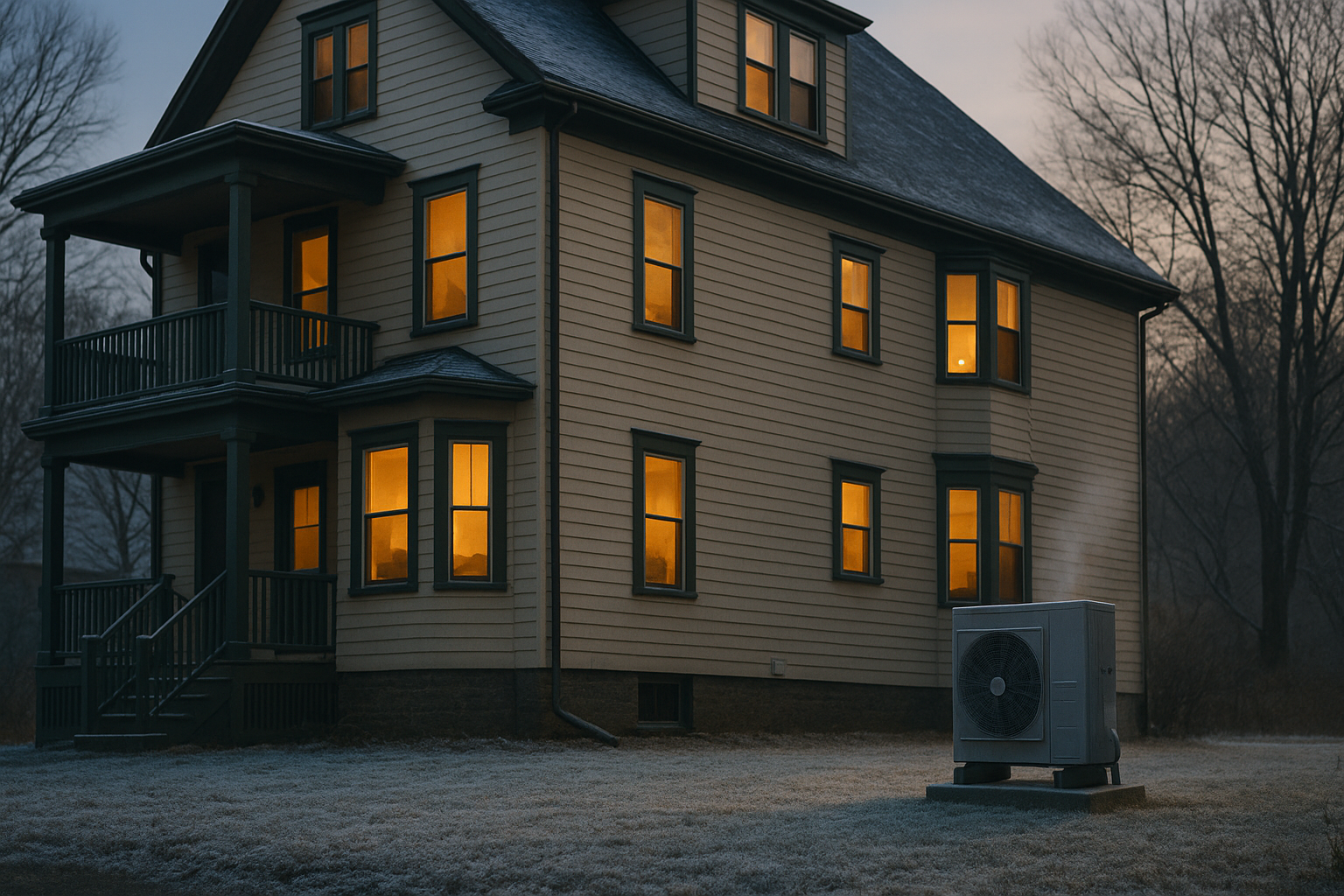
You probably think of a heat pump defrost cycle as something rare, brief, and basically invisible — maybe a quiet hum in the background while your house keeps warming as if nothing happened. However, defrost is actually a deliberate reverse-cycle event during which your outdoor unit becomes the indoor unit for several minutes, pulling heat out of your living space to melt frost off the outdoor coil.
That distinction matters more than almost any other detail in cold-climate sizing. After all, if your contractor ran a Manual J at the 99% design temperature without accounting for defrost-cycle capacity loss, your system is mathematically undersized — even if the AHRI sheet says otherwise.
What is a heat pump defrost cycle? A defrost cycle is a brief reversal of the refrigerant flow — typically 4 to 12 minutes — during which the outdoor coil temporarily becomes the condenser. This melts accumulated frost using heat drawn from the indoor space, while backup heat strips usually engage to offset the temporary loss in heating capacity inside the home.
Why Frost Forms In The First Place
When your heat pump pulls heat from outdoor air, the refrigerant in the outdoor coil sits well below ambient temperature — often 15 to 25°F colder than the air passing over it. Any moisture in that air condenses on the coil surface and, if the coil is below 32°F, freezes.
This is unavoidable physics, not a defect. The question is never whether a heat pump will frost in cold weather, but how often it must defrost and how much capacity you lose each time it does.
The 20–35°F Danger Zone
Counterintuitively, defrost is most aggressive between roughly 20°F and 35°F — not at the coldest temperatures. Frost formation peaks when outdoor air is cold enough to drop the coil below freezing but still warm enough to hold meaningful moisture.
Below about 15°F, the air is genuinely dry, and frost accumulation slows dramatically. This is the dirty secret of cold-climate performance — the worst defrost behavior happens on damp 28°F mornings, not on the brutal 5°F design day.
At what temperature do heat pumps defrost most often? Defrost frequency peaks between 20°F and 35°F outdoor temperature, particularly during humid conditions, fog, freezing rain, or wet snow. In this range, a heat pump may defrost every 30 to 90 minutes. Below 15°F the air carries less moisture, frost forms more slowly, and defrost intervals stretch out considerably.
What Actually Happens During Defrost
Modern variable-speed inverter heat pumps run a four-stage defrost sequence. First, the reversing valve flips, sending hot refrigerant out to the now-frozen outdoor coil.
Second, the outdoor fan stops to keep cold air from blowing across the warming coil. Third, melted frost runs off as liquid water — which is why a properly installed unit sits on a riser with clear pan drainage.
Fourth — and most importantly for sizing — the indoor blower keeps running, but the indoor coil is now cold. To prevent blowing 50°F air at occupants, the system energizes backup heat strips or, in dual-fuel configurations, briefly fires the gas furnace.
Capacity Derate: The Number Your Contractor Probably Didn't Mention
Defrost is not free. The energy used to melt the frost comes partly from the indoor space and partly from the compressor, which means your effective heating capacity drops sharply during the cycle and for several minutes after as the system recovers.
Field studies from NREL and the Center for Energy and Environment consistently show seasonal capacity derates of 8% to 18% in cold-humid climates due to defrost losses. That figure is on top of the standard cold-temperature capacity curve published on the AHRI certificate.
| Outdoor Temp | Typical Defrost Interval | Capacity Loss Per Cycle | Net Seasonal Derate |
|---|---|---|---|
| 32–35°F (humid) | 30–60 min | 10–15% | 12–18% |
| 20–32°F (humid) | 45–90 min | 8–12% | 8–14% |
| 10–20°F | 90–180 min | 6–10% | 4–8% |
| Below 10°F (dry) | 2–6 hours | 5–8% | 2–5% |
Note that ranges vary by manufacturer, refrigerant charge, defrost-control strategy (time-temperature vs demand-based), and outdoor unit elevation above grade. Demand-defrost units — which sense actual coil pressure differential — derate noticeably less than older time-and-temperature controls.
Why This Breaks A Standard Manual J
ACCA Manual J calculates a design heating load at the 99% winter outdoor temperature for your county. Manual S then matches equipment capacity to that load using the AHRI-rated output at that same temperature.
Here's the gap: AHRI capacity ratings are steady-state, measured under controlled lab conditions that do not include defrost cycling. Real-world cold-climate output is roughly 90–95% of AHRI-rated capacity at the design temperature, and as low as 82% in coastal or lake-effect humidity.
Should I oversize a heat pump to compensate for defrost losses? Not exactly — oversizing causes short-cycling, comfort problems, and reduced dehumidification. Instead, size to your Manual J load using the manufacturer's NEEP-listed cold-climate capacity at design temperature, then verify the unit holds at least 90% of design load at 5°F. This builds in defrost margin without true oversizing.
The NEEP Cold Climate Database Is The Honest Source
The Northeast Energy Efficiency Partnerships (NEEP) Cold Climate Air Source Heat Pump (ccASHP) database publishes capacity at 47°F, 17°F, and 5°F for every listed unit. These figures are derived from manufacturer extended performance data and are far more useful for cold-climate sizing than the single-point AHRI rating.
For an honest cold-climate spec, your contractor should pull the NEEP capacity at your county's 99% design temp and apply a defrost-derate factor of roughly 0.92 in dry climates and 0.85 in humid coastal or Great Lakes climates. Anything tighter than that and you will be running on backup heat more than the marketing brochure suggested.
Sizing Margins: How Much Headroom Is Enough
For a properly specified cold-climate heat pump, the working rule is to size such that the unit delivers 100% of design heating load at the 99% winter design temperature, after the defrost derate is applied. This typically means selecting a unit whose AHRI-rated capacity at 17°F is 110–115% of your Manual J design load.
If you live in a humid coastal climate (coastal Maine, Cape Cod, the Pacific Northwest, the Great Lakes shoreline), bump that to 120%. For a deeper walkthrough of capacity selection, see our guide on cold-climate heat pump sizing, which expands on the NEEP-database method.
Quick check for homeowners: Ask your contractor to show you the NEEP ccASHP listing for the proposed unit, the design temperature for your county, and the derated capacity at that temperature. If they cannot produce all three numbers, the bid is not based on cold-climate engineering — it is based on rule-of-thumb tonnage.
Backup Heat: The Other Half Of The Equation
Even a perfectly sized cold-climate unit needs backup heat for two scenarios — defrost cycles and rare polar-vortex events that drop below the 99% design temperature. The question is how much backup, and what kind.
For all-electric homes, NREL field data shows that 5–10 kW of resistance backup is sufficient in most U.S. climate zones if the heat pump is properly sized to NEEP-derated capacity. Dual-fuel configurations — heat pump plus existing gas furnace — handle defrost more gracefully but introduce switchover-temperature decisions that affect operating cost. For the dual-fuel tradeoff, our breakdown of mini-split vs central heat pump covers when backup-heat economics push you one direction or the other.
Variable-Speed Inverters Change The Math
Single-stage and two-stage heat pumps defrost on rigid time-temperature schedules — every 30, 60, or 90 minutes regardless of actual frost load. Variable-speed inverters with demand-defrost controls run on coil pressure differential or refrigerant temperature delta, defrosting only when needed.
The seasonal capacity benefit is meaningful — demand-defrost units typically lose 4–8% to defrost in mixed-humid climates, versus 10–18% for time-and-temperature controls. This is one of the strongest arguments for stepping up to a true cold-climate inverter rather than a budget two-stage unit, even when the rebate dollars look similar.
How Defrost Affects Rebate Calculations
Most state rebate programs — including HEEHRA, NYSERDA Clean Heat, and Mass Save — require NEEP-listed cold-climate units, precisely because the NEEP ratings already capture cold-temperature realities better than AHRI single-point ratings. If your contractor is bidding a non-NEEP unit, you will likely fail the rebate qualification step entirely.
For program-specific qualification thresholds, see our state-by-state coverage of HEEHRA rollout status, the Mass Save heat pump rebates, and our walkthrough of rebate stacking application order for households layering federal, state, and utility incentives.
Definitions And Background Information
How long does a typical defrost cycle last?
4 to 12 minutes for most residential cold-climate heat pumps. Demand-defrost units typically run shorter cycles (4–7 minutes) because they only initiate when frost is actually present, while time-and-temperature controls often run the full programmed duration regardless of need.
Will I feel cold air during defrost?
Properly configured systems engage backup heat strips or dual-fuel furnace during defrost so that supply-air temperature stays above 90°F. If you feel genuinely cold air from your registers during defrost, your backup-heat lockout temperature is set incorrectly or your strips are undersized.
Does defrost happen at the same outdoor temperature where I should size?
No — and this is the central engineering point. Sizing happens at the 99% winter design temperature (often 0–10°F in cold climates), but the most aggressive defrost behavior occurs in the 20–35°F band, which is where a poorly sized system will struggle most despite the milder weather.
Is the federal 25C tax credit still available for heat pumps?
The 25C credit remains active for qualifying heat pumps installed in 2026, with a $2,000 cap for heat pump equipment meeting CEE Tier requirements. For the most recent federal-status changes, see our coverage of what happened to 25C in July 2025 before assuming the figures in older blog posts still apply.
Should I install a wind baffle around my outdoor unit?
In high-snow or wind-driven-rain climates, a properly engineered wind baffle (not a full enclosure, which restricts airflow) can reduce frost accumulation and defrost frequency by 10–20%. Always follow the manufacturer's clearance specifications — restricting airflow causes more capacity loss than frost itself.
The Bottom Line On Defrost And Sizing
Defrost cycles are not a flaw in cold-climate heat pump design — they are a normal, engineered part of how the technology extracts heat from cold air. The flaw is when contractors size equipment as if defrost did not exist.
Ask for the NEEP capacity at your design temperature, apply a 8–15% defrost derate based on your local humidity profile, and verify the system delivers full design load with that derate applied. Do that, and the only time you will think about defrost is when you happen to glance out the window during a damp 28°F morning and notice the outdoor fan has paused for a few minutes.
This article is for informational purposes and is not financial, tax, legal, or medical advice. Consult a licensed HVAC contractor, energy auditor, or your state energy office before acting on rebate or equipment decisions.