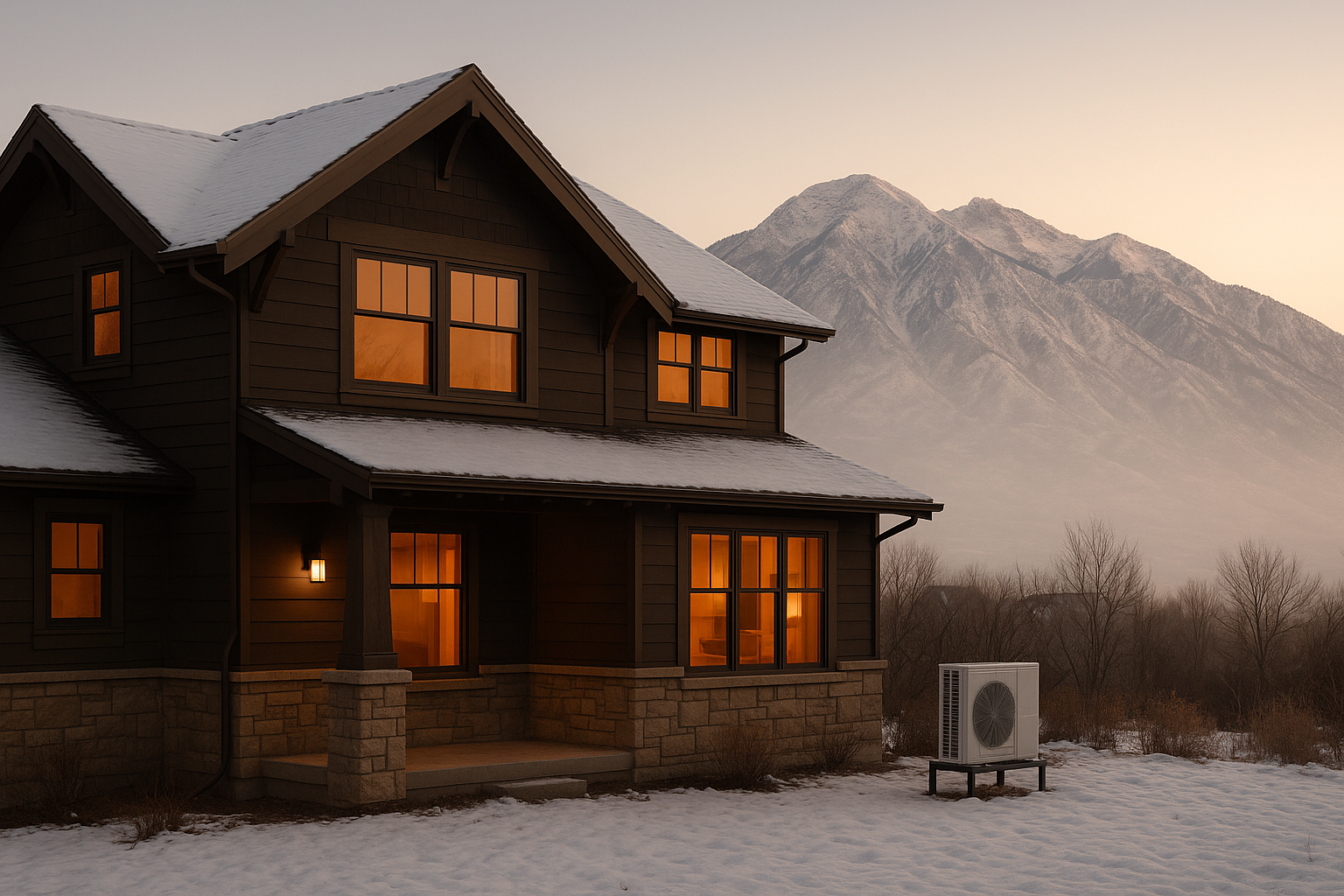
Have you checked what a heat pump is actually rated to deliver at your elevation on the coldest night of a Utah winter? Most rebate guides skip that question, yet it determines whether the equipment you install carries the house and whether it meets the specifications a HEEHRA-funded project is likely to require.
Utah brings together Wasatch Front homes at roughly 4,200 to 4,600 feet, mountain towns well above 6,000 feet, and valley inversions that can hold cold air in place for days. That said, the rebate follows the same federal framework as every other participating state, so the clearest way to read the program is to separate the money from the mechanics.
HEEHRA pays Utah households up to $8,000 toward a heat pump and up to $14,000 in total. The share of project cost it covers depends on household income relative to area median income (AMI).
What Is HEEHRA And Who Runs It In Utah?
HEEHRA, the High-Efficiency Electric Home Rebate Act program created under the Inflation Reduction Act, funds point-of-sale rebates for heat pumps, electrical upgrades, and weatherization in income-qualified households. The U.S. Department of Energy allocates the funding, but each state energy office designs and runs its own program, which is why eligibility details and launch timing differ from state to state.
In Utah, the administering agency is the Utah Office of Energy Development (OED). Keep in mind that program pages, contractor enrollment, and income-verification portals change as a state moves from planning to launch, so check the OED program page and our HEEHRA state-by-state status tracker to confirm where Utah stands before you sign a contract.
The structure itself is consistent across states. Rebates are typically applied at the point of sale through participating contractors or retailers, so the discount shows up on the invoice rather than as a check months later.
The Utah Office of Energy Development administers HEEHRA in Utah. DOE sets the federal caps and income tiers, while the state controls launch timing, contractor enrollment, and how applicants verify income.
Utah HEEHRA Rebate Amounts
Rebate caps are set in federal statute, so they apply in Utah exactly as they do in Georgia, New Mexico, or Rhode Island. Here's how the per-upgrade caps break down:
| Upgrade | Federal cap per household | Utah relevance |
|---|---|---|
| Heat pump for space heating and cooling | $8,000 | Cold-climate capacity and altitude correction matter most here |
| Heat pump water heater | $1,750 | Placement in a garage or unheated basement affects winter performance |
| Electric stove, cooktop, range, or heat pump clothes dryer | $840 each | Often paired with gas-to-electric conversions |
| Electrical load service center (panel) | $4,000 | Common need when backup heat strips are added |
| Electric wiring | $2,500 | New circuits for the condenser, air handler, or appliances |
| Insulation, air sealing, and ventilation | $1,600 | Reduces the design heating load the heat pump must meet |
| Household total | $14,000 | Combined cap across all upgrades |
All of these caps share a single $14,000 household ceiling. As a result, a project that includes a heat pump, a panel upgrade, and new wiring can reach $14,500 in combined line-item caps, and the household ceiling then trims the total.
The insulation and air-sealing line deserves more attention than its modest $1,600 cap suggests. Every BTU per hour removed from the design load is capacity that a heat pump at altitude does not have to supply, which can shift the equipment selection down a size.
Income Limits: How Utah Households Qualify
HEEHRA eligibility is measured against area median income, which HUD publishes by county and household size. Because Utah's AMI varies considerably between counties, two families with identical incomes can fall into different tiers depending on whether they live in Summit County, Salt Lake County, or a rural county further south.
The tiers themselves are federal. Here's how they apply:
| Household income | HEEHRA coverage | Practical note |
|---|---|---|
| Below 80% of AMI | Up to 100% of project cost, within caps | A heat pump project can be fully funded up to $8,000 |
| 80% to 150% of AMI | Up to 50% of project cost, within caps | Half of cost, never more than the line-item cap |
| Above 150% of AMI | Not eligible for HEEHRA | The HOMES performance-based program may still apply |
For a deeper walk-through of how AMI percentages translate into dollar thresholds, see our explainer on HEEHRA income tiers. Households above the HEEHRA ceiling may want to review how HOMES compares with HEEHRA, since the two programs use different eligibility logic.
DOE guidance also permits states to accept enrollment in certain means-tested programs as proof of income, a path often called categorical eligibility. Whether Utah adopts that path, and which programs it accepts, is a program-design decision to confirm with OED.
Utah households under 80% of county AMI can receive up to 100% of project cost; those at 80–150% receive up to 50%. AMI is set by HUD per county and household size, so the dollar thresholds vary across Utah.
Why High-Altitude Design Temperatures Matter
A design temperature is the outdoor condition a heating system is sized to meet, and ACCA Manual J uses the 99% winter value, meaning the temperature a location stays above for 99% of the hours in a typical year. Along the Wasatch Front, those values generally sit in the single digits Fahrenheit, while higher mountain valleys can fall below zero, so pull the exact figure for your location from the Manual J outdoor design tables.
Altitude adds a second variable that most sea-level sizing guides ignore. Air density drops roughly 3% for every 1,000 feet of elevation, which means a fan moving the same cubic feet per minute in Salt Lake City moves only about 85% of the air mass it would at sea level, and a little under 80% at 7,000 feet.
What Thinner Air Does To Heat Pump Output
Heat pumps move heat by moving air across coils, so less air mass translates directly into less heat transferred. The effects include but are not limited to:
- Reduced outdoor coil extraction. The outdoor unit pulls heat from thinner air, which lowers the energy it collects at any given outdoor temperature. The shortfall is largest when outdoor temperatures are already near the design point.
- Lower indoor delivery per CFM. The indoor coil hands heat to less air mass, so the sensible output per cubic foot of supply air falls. Manual J accounts for this with an altitude correction factor applied to the sensible heat equation.
- Higher sensitivity to duct restrictions. Systems that are already short on airflow lose proportionally more at altitude. For that reason, duct static pressure deserves a measurement rather than an assumption on a Utah retrofit.
All of this adds up to a capacity gap that a rule-of-thumb sizing approach will not catch. Manual S equipment selection is meant to close it by matching the corrected load against the manufacturer's extended performance data, and some manufacturers publish altitude correction tables while others do not.
Capacity At 5°F Versus 47°F
Heat pump capacity is usually advertised at 47°F, a mild condition Utah homes rarely need help with in January. The ENERGY STAR cold-climate specification addresses this by requiring that capacity at 5°F be at least 70% of rated capacity at 47°F, along with a coefficient of performance of at least 1.75 at 5°F.
That 5°F test point lands close to many Wasatch Front design temperatures, which makes it a practical screening tool. Our guides to cold-climate heat pump sizing and cold-climate heat pump brands cover how to read extended performance tables line by line.
An Illustrative Sizing Walk-Through
Consider a hypothetical Salt Lake Valley home with a Manual J heating load of 40,000 BTU/hr at its design temperature, a figure used here only to show the arithmetic. A unit rated at 36,000 BTU/hr at 47°F that just meets the cold-climate 70% threshold would deliver about 25,200 BTU/hr at 5°F before any altitude effect is considered.
If the manufacturer's altitude data shows a further reduction, the gap between load and output widens again. That gap gets covered by a larger or more aggressively modulating heat pump, a backup heat strip, or a dual-fuel arrangement, and each option carries different consequences for operating cost and electrical service.
Backup heat strips in particular can push a household toward a panel upgrade. Before choosing that route, it helps to review heat pump panel capacity requirements, since HEEHRA's $4,000 panel line and $2,500 wiring line may cover part of that work.
Inversions, Fog, And Defrost
Utah's winter valley inversions often trap cold, humid air near the ground for extended stretches. Those conditions, hovering below freezing with high humidity, tend to drive frequent defrost cycles, during which the heat pump temporarily stops delivering heat to the house.
Equipment selection and installation details matter here as much as the rating plate. Features such as base pan heaters and careful outdoor unit placement, raised above drifting snow and clear of roof drip lines, help keep defrost meltwater from refreezing around the coil.
Air density falls about 3% per 1,000 feet, so heat pumps at Wasatch Front elevations move roughly 85% of sea-level air mass. Manual J and Manual S include altitude corrections to account for the lost capacity.
What Qualifying Equipment Looks Like In Utah
DOE program requirements tie qualifying heat pumps to ENERGY STAR certification, and states can layer stricter specifications on top. Some states require the cold-climate designation outright, so confirm Utah's final equipment list with OED rather than assuming the federal minimum applies.
Here's how a Utah-ready HEEHRA project typically comes together:
- Certification. The outdoor and indoor combination should appear as a matched system in the ENERGY STAR and AHRI directories. A mismatched coil and condenser can lose both its rating and its rebate eligibility.
- Cold-climate performance data. Extended performance tables should show capacity and COP at 5°F and, ideally, at lower temperatures. These tables are the only reliable way to compare units at Utah design conditions.
- Altitude-corrected selection. A contractor working at elevation should be able to explain how altitude was handled in the load calculation and equipment selection. If the answer is that altitude was not considered, that is useful information.
- Load calculation documentation. Many state HEEHRA programs request or require a load calculation as part of the application. Even where it is optional, a Manual J report protects you against an undersized or oversized system.
- Participating contractor enrollment. Point-of-sale rebates generally flow through contractors enrolled in the state program. Confirming enrollment before work begins avoids a project that cannot be submitted.
Taken together, these checks turn the rebate from a discount on any heat pump into a discount on a heat pump that fits the house. That distinction carries extra weight at elevation, where the gap between advertised and delivered capacity runs wider than it does at sea level.
Where Rocky Mountain Power Incentives Fit
Rocky Mountain Power serves much of Utah and runs its own Wattsmart incentives for qualifying heat pumps and efficiency upgrades. Our Rocky Mountain Power rebates guide covers those utility programs in detail, while this post focuses on the federal HEEHRA layer and the equipment questions altitude raises.
Keep in mind that HEEHRA cannot be combined with HOMES or another federal grant for the same upgrade. Non-federal utility incentives may stack with HEEHRA where both programs permit it, and the order in which you apply can affect what each program pays, which is why our rebate stacking application order guide is worth reviewing first.
On the federal tax side, the residential solar credit expired on December 31, 2025, and state and utility programs now operate on their own terms. For the current status of other federal credits, see our federal tax credits status page.
HEEHRA cannot be combined with HOMES or another federal grant for the same upgrade. Non-federal incentives such as Rocky Mountain Power Wattsmart may stack where both programs allow it.
A Decision Rule By Project Phase
Where you are in the process determines which question matters most. Here's how the priorities shift:
- Pre-purchase. Confirm Utah's program status with OED, find your county AMI tier, and request a Manual J that names the design temperature and altitude used. Compare candidate units at 5°F using extended performance data rather than 47°F ratings.
- Mid-application. Verify that your contractor is enrolled, that the matched system appears in the ENERGY STAR and AHRI directories, and that panel and wiring work are itemized separately. Then check how utility incentives interact with the HEEHRA amount before finalizing.
- Post-installation. Keep the load calculation, equipment model numbers, and rebate documentation together. Watch the first inversion stretch for unusual backup heat runtime, which can signal an airflow or sizing issue worth raising with the installer.
For a broader view of how Utah compares with other participating states, our HEEHRA guide hub collects every state deep dive, including HEEHRA in New Mexico, another high-elevation state. If you'd like to test sizing assumptions before talking to a contractor, the heat pump calculator is a useful starting point.
Before buying, confirm Utah's program status with OED, identify your county AMI tier, and compare heat pumps at 5°F using extended performance data adjusted for your elevation.
Frequently Asked Questions About HEEHRA In Utah
These questions cover the edge cases that come up most often on Utah projects. Each answer reflects federal program rules, so confirm the state-specific details with OED.
Does a dual-fuel system qualify for the HEEHRA heat pump rebate?
The heat pump portion of a dual-fuel system may qualify if it meets the program's certification requirements. Rules on whether the gas furnace side affects eligibility vary by state, so confirm Utah's treatment with OED before committing to that configuration.
Do homes in Park City or other mountain towns need different equipment than Salt Lake City homes?
Homes at higher elevations typically face both colder design temperatures and lower air density. As a result, the same house can need meaningfully more rated capacity in a mountain town than on the valley floor, which is why the Manual J inputs matter more than the rebate amount.
Can renters in Utah benefit from HEEHRA?
HEEHRA allows rebates for rental units where the tenant household meets the income test, though landlord participation and documentation are required. Multifamily buildings can qualify when at least half of their households fall under 150% of AMI.
Does HEEHRA cover a heat pump water heater installed in a cold garage?
The $1,750 heat pump water heater rebate applies to qualifying equipment regardless of location. That said, a garage that drops near freezing in a Utah winter will push the unit toward its resistance element more often, which reduces the efficiency the rebate is meant to deliver.
This article is for informational purposes and is not financial / tax / legal / medical advice. Consult a licensed professional (CPA, elder-law attorney, HVAC contractor, state Medicaid office) before acting.