Did the sunset of the federal clean-energy tax credits close the door on heat-pump incentives in New Mexico? Not for HEEHRA.
New Mexico's Home Electrification and Appliance Rebates are state-administered grant funds, separate from any tax credit, and they continue to put up to $8,000 toward a qualifying heat pump. This guide breaks down the income tiers, the equipment that qualifies, and how the point-of-sale rebate works for the state's high-desert heating and cooling loads.
Many New Mexico homeowners assume that once the federal clean-energy tax credits sunset, every incentive for going electric disappears with them. That is not how HEEHRA works.
The Home Electrification and Appliance Rebates are funded by the Inflation Reduction Act as grants to the states, not as credits claimed on a tax return. Because New Mexico administers the money directly, the program continues to operate even as federal tax credits such as the residential solar ITC have expired.
HEEHRA is a federally funded, state-administered rebate — not a tax credit. New Mexico distributes the money through enrolled contractors, so eligible households get an instant discount instead of waiting to file a return.
What Is HEEHRA, and Why Does New Mexico Run It?
HEEHRA stands for the Home Electrification and Appliance Rebates, sometimes called the High-Efficiency Electric Home Rebate program. It was created under Section 50122 of the Inflation Reduction Act and funded as a block grant to the states.
The U.S. Department of Energy sets the federal framework — the equipment categories, the dollar caps, and the income tiers — while each state energy office designs the actual rollout. In New Mexico, that office is the Energy, Minerals and Natural Resources Department (EMNRD), which was among the earliest in the country to open its program to residents.
Because the program is state-administered, the exact launch timing, contractor network, and verification steps vary from one state to the next. New Mexico's early start means its contractor enrollment and income-verification process have had more time to mature than in states still standing their programs up.
Why the Grant Structure Matters After the Tax-Credit Sunset
The distinction between a grant and a tax credit is not academic. A tax credit only helps a household that owes enough federal tax to absorb it, and it disappears the moment Congress lets it expire.
A grant-funded rebate behaves differently. The money is appropriated and handed to the state, so it keeps flowing until the state exhausts its allocation — regardless of what happens to the tax code in any given year.
This is exactly why HEEHRA remains live in New Mexico while the residential solar ITC has expired at the federal level. Keep in mind that the funds are finite, so an early-launch state like New Mexico is working through an allocation that will not last forever.
How Much Can New Mexico HEEHRA Rebates Cover?
The federal framework caps each category of upgrade and sets a single household maximum of $14,000. The heat pump for space heating and cooling carries the largest single cap, at up to $8,000.
Here is how the per-measure caps stack up under the HEEHRA framework that New Mexico follows.
| Upgrade | Maximum HEEHRA rebate |
|---|---|
| Heat pump (space heating and cooling) | Up to $8,000 |
| Heat pump water heater | Up to $1,750 |
| Electric stove, cooktop, range, or oven | Up to $840 |
| Heat pump clothes dryer | Up to $840 |
| Electrical panel or service upgrade | Up to $4,000 |
| Electrical wiring | Up to $2,500 |
| Insulation, air sealing, and ventilation | Up to $1,600 |
| Household maximum (all upgrades combined) | $14,000 |
These are ceilings, not guaranteed payouts — the rebate cannot exceed the actual project cost, and your income tier determines what share of that cost the program covers. A panel upgrade that comes in at $3,000, for example, is measured against that figure rather than the $4,000 cap.
HEEHRA caps total household rebates at $14,000. The largest single category is the heat pump at up to $8,000, followed by a $4,000 electrical panel upgrade and $1,750 for a heat pump water heater.
What Are the HEEHRA Income Limits in New Mexico?
HEEHRA is means-tested, and eligibility is pinned to your household income relative to the Area Median Income (AMI) for your county. The U.S. Department of Housing and Urban Development publishes the AMI figures, which vary by county and household size.
The framework splits households into three tiers, and New Mexico applies the same thresholds.
| Household income vs. Area Median Income | Share of project cost covered |
|---|---|
| Below 80% of AMI | 100% (up to the per-measure caps) |
| 80% to 150% of AMI | 50% (up to the per-measure caps) |
| Above 150% of AMI | Not eligible for HEEHRA |
For a household below 80% of AMI, that 100% coverage is the headline: a qualifying heat pump can be fully covered up to the $8,000 cap. A household between 80% and 150% of AMI would see roughly half of that same project cost covered.
Because AMI is county-specific, a family in Santa Fe County faces a different dollar threshold than one in Doña Ana or Bernalillo County. Confirm the current HUD AMI figure for your county and household size before assuming a tier, and see our breakdown of how the HEEHRA income tiers work for the underlying mechanics.
Households below 80% of area median income can have 100% of a HEEHRA project covered up to the caps; those between 80% and 150% of AMI get 50%. Above 150% of AMI, HEEHRA does not apply.
What Equipment Qualifies?
The anchor of HEEHRA is the electric heat pump for space heating and cooling, which is why the program sits at the center of home electrification. Qualifying systems generally must meet federal efficiency standards — think SEER2, HSPF2, and ENERGY STAR-tier ratings — and be installed by an enrolled contractor.
The program reaches well beyond the heat pump, though. Eligible upgrades include but are not limited to:
- Heat pumps for space conditioning. Ducted central systems, ductless mini-splits, and dual-fuel configurations all qualify when they meet the efficiency tier.
- Heat pump water heaters. These replace gas or conventional electric tanks and carry their own cap of up to $1,750.
- Electric cooking and laundry. Induction and electric ranges plus heat pump clothes dryers qualify at up to $840 each.
- Enabling electrical work. Panel upgrades, service upgrades, and new wiring are covered so the home can actually support the added loads.
- Envelope improvements. Insulation, air sealing, and ventilation upgrades reduce the load before the equipment is ever sized.
That last category matters more than it appears. Tightening the envelope first lets you specify a smaller, less expensive heat pump, which is why a measured load calculation beats rule-of-thumb sizing every time — our guide to cold-climate heat pump sizing walks through the method.
How Does the Point-of-Sale Rebate Work?
HEEHRA is structured as a point-of-sale rebate, and that feature is what sets it apart from a tax credit. Rather than paying the full invoice and recovering money months later at tax time, an eligible household sees the rebate subtracted from the price at the time of purchase and installation.
In practice, the discount flows through an enrolled contractor or retailer who verifies your income tier and applies the rebate against the project cost. The contractor is then reimbursed by the state, so the household never fronts the rebated amount.
HEEHRA is a point-of-sale discount. An enrolled contractor verifies your income tier and subtracts the rebate from the invoice, then gets reimbursed by New Mexico — so you never front the rebated amount.
This is also why working with a HEEHRA-enrolled contractor is non-negotiable. A skilled installer who is not enrolled in EMNRD's program cannot apply the point-of-sale discount, no matter how well your household qualifies.
Sizing a Heat Pump for New Mexico's High-Desert Loads
New Mexico is not one climate, and that reality shapes how a heat pump should be specified. The high desert swings from genuinely cold winters at elevation to hot, dry summers across the southern basins.
Northern New Mexico — Santa Fe, Taos, Los Alamos — sits at high elevation with design temperatures that fall well below freezing. Homes there need cold-climate heat pumps with adequate low-temperature capacity, and often a right-sized backup heat strategy for the coldest design hours.
Southern New Mexico — Las Cruces and the Mesilla Valley — is cooling-dominated, with long, hot, low-humidity summers. There the priority shifts toward efficient summer performance and correct cooling-load sizing rather than maximizing low-temperature heating output.
For many New Mexico homes, especially additions or rooms with uneven loads, a ductless approach is the cleaner fit. Our guides to mini-split sizing and the mini-split versus central heat pump tradeoff walk through when each makes sense.
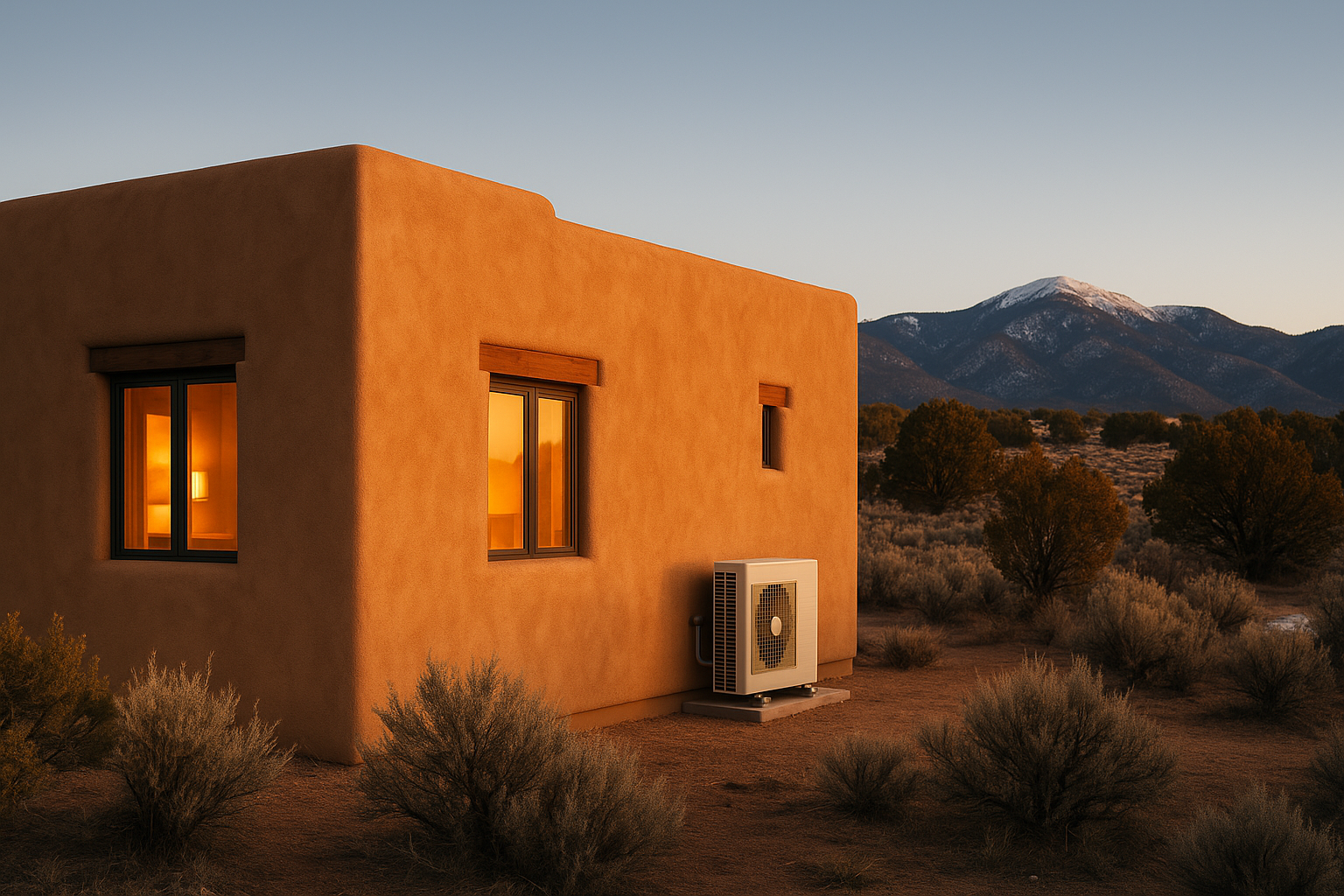
One heat pump serves both loads. Cold-climate models cover northern New Mexico's sub-freezing winters at elevation, while the same equipment delivers efficient cooling for the hot, dry summers in the southern desert.
How HEEHRA Stacks With Other Programs
HEEHRA is a grant, which gives it a different relationship to other incentives than a tax credit has. Households evaluating how rebates and any remaining credits interact should map the order of operations carefully, because a rebate can reduce the cost basis used for another program.
The interaction with the federal 25C credit in particular has shifted as the federal landscape changed, so the value of stacking is not what it was a year ago. Our guide to stacking HEEHRA and 25C and the 25C-versus-HEEHRA decision tree lay out how to sequence them.
To see where New Mexico sits relative to other states' rollouts, the state-by-state HEEHRA status tracker keeps a running view, and the main HEEHRA guide collects the program basics in one place.
A Decision Rule for Where You Are Right Now
If you are below 80% of AMI and facing a failing furnace or air conditioner, HEEHRA covering 100% of a qualifying heat pump up to $8,000 changes the replacement math entirely. At that phase, confirming your county's AMI figure and identifying an enrolled contractor early are what keep the full-coverage option open before equipment fails on the coldest or hottest day.
If you are between 80% and 150% of AMI and planning ahead, the 50% coverage pairs naturally with envelope work — insulate and air-seal first, then size the smaller system the rebate helps fund. And if you are above 150% of AMI, HEEHRA itself will not apply, so the planning question becomes which utility programs and efficiency measures still pencil out.
Frequently Asked Questions
What is the maximum HEEHRA rebate available in New Mexico?
HEEHRA caps total household rebates at $14,000, including up to $8,000 for a heat pump, $1,750 for a heat pump water heater, $840 for an electric range, and $4,000 for an electrical panel upgrade.
Who qualifies for HEEHRA rebates in New Mexico?
Eligibility is income-based. Households below 80% of area median income receive 100% of project costs up to the caps; households at 80–150% of AMI receive 50%. Those above 150% of AMI are not eligible for HEEHRA.
Is the New Mexico HEEHRA rebate applied at the point of sale?
Yes. HEEHRA is designed as a point-of-sale discount, so qualifying households see the rebate subtracted from the invoice rather than waiting to recover it later on a tax return.
Which agency administers HEEHRA in New Mexico?
The New Mexico Energy, Minerals and Natural Resources Department (EMNRD) administers the state's federally funded Home Electrification and Appliance Rebates, including contractor enrollment and income verification.
Does a heat pump work for New Mexico's high-desert climate?
Yes. Cold-climate heat pumps handle northern New Mexico's freezing winters at high elevation, while the same units provide efficient cooling for the hot, dry summers across the southern desert.
This article is for informational purposes and is not financial, tax, legal, or medical advice. Consult a licensed professional — a CPA, a HEEHRA-enrolled HVAC contractor, or the New Mexico Energy, Minerals and Natural Resources Department — before acting.