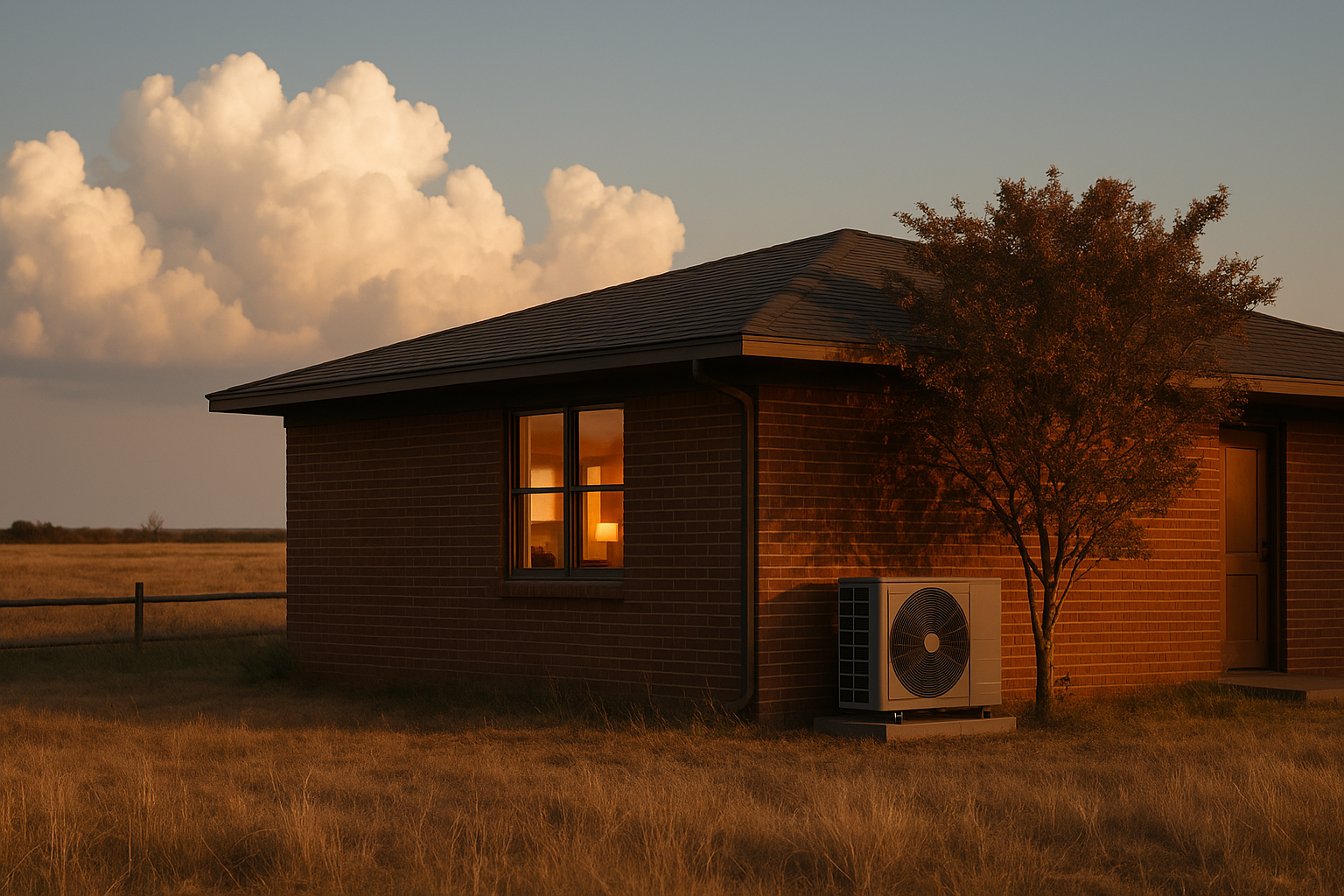
Is a heat pump in Oklahoma a heating purchase or a cooling purchase? If you live anywhere between Guymon and Broken Bow, it is both, and that split shapes which equipment makes sense under the federal Home Electrification and Appliance Rebate program, known as HEEHRA.
HEEHRA was created by the Inflation Reduction Act and is administered state by state, and it can cover up to 100% of a qualifying heat pump installation for lower-income households. That said, the rebate only helps if the program is open in your state, your income falls in an eligible tier, and the equipment you choose meets the federal efficiency bar.
This guide covers Oklahoma's program status, the statutory rebate caps, how area median income (AMI) tiers work across the state's metros and rural counties, and what a cooling-dominant climate with real winter cold means for equipment selection. For the national picture, our HEEHRA guide hub collects every state deep dive in one place.
Where Oklahoma's HEEHRA Program Stands
HEEHRA funds flow from the U.S. Department of Energy (DOE) to each state energy office, which designs and runs its own rebate program within federal rules. In Oklahoma, the State Energy Office sits within the Oklahoma Department of Commerce, which is the agency to watch for application portals, contractor enrollment, and launch dates.
Keep in mind that rollout has been uneven nationally. Some states launched point-of-sale rebates in 2024 and 2025, others remain in planning, and timelines have shifted as federal guidance evolved.
As a result, we do not list an Oklahoma launch date or state allocation figure here until it can be verified against the Department of Commerce's published materials. Our HEEHRA state-by-state status tracker is updated as states move from planning to live rebates.
Oklahoma's HEEHRA program is run by the State Energy Office within the Oklahoma Department of Commerce. Confirm current status, enrolled contractors, and application steps there before signing a contract.
Before you commit to an installation, it helps to put a few status questions directly to the state program or an enrolled contractor. These include:
- Is the program accepting applications? Rebates generally are not retroactive, so equipment installed before a state program opens may not qualify. Ask whether your installation date affects eligibility.
- Is your contractor enrolled? HEEHRA is designed as a point-of-sale rebate, which means the discount typically appears on an enrolled contractor's invoice. A contractor outside the program usually cannot pass the rebate through.
- Which measures are active? Some states phase in equipment categories over time. Confirm that heat pump HVAC, heat pump water heaters, and panel upgrades are all live before scoping a multi-measure project.
Answers to all of these can change from month to month in an early-stage program. Note the date and the source of each answer so you can refer back to it if questions come up later.
Federal statute sets HEEHRA's caps and income tiers, while Oklahoma sets the logistics, including launch timing, contractor enrollment, income verification method, and which measures open first. Treat any Oklahoma-specific detail as provisional until the Department of Commerce publishes it.
HEEHRA Rebate Amounts: The Federal Caps
The dollar limits for HEEHRA are written into federal law (Section 50122 of the Inflation Reduction Act), so they apply in Oklahoma exactly as they do in any other participating state. States can narrow eligibility or add program rules, but they cannot raise the per-measure caps.
The statutory caps break down by equipment category as follows:
| Measure | Maximum HEEHRA rebate |
|---|---|
| Heat pump for space heating and cooling | $8,000 |
| Heat pump water heater | $1,750 |
| Electric load service center (panel) upgrade | $4,000 |
| Electric wiring | $2,500 |
| Insulation, air sealing, and ventilation | $1,600 |
| Electric stove, cooktop, range, or oven | $840 |
| Heat pump clothes dryer | $840 |
| Household maximum, all measures combined | $14,000 |
The $14,000 figure is a household cap that applies across every measure combined. In practice, a heat pump plus a panel upgrade plus a heat pump water heater can reach $13,750, which leaves very little room for anything else.
HEEHRA's federal caps in Oklahoma are $8,000 for a heat pump, $1,750 for a heat pump water heater, $4,000 for a panel upgrade, and $2,500 for wiring. All measures combined cannot exceed $14,000 per household.
If your home would need a panel upgrade to carry a heat pump, our guide to heat pump panel capacity explains when 100-amp service is truly insufficient. Load-management devices and right-sized equipment can sometimes avoid the upgrade altogether, which preserves more of the household cap for other measures.
Income Tiers By Area Median Income
HEEHRA eligibility is based on income, and the tiers are defined relative to area median income instead of a single statewide dollar figure. The tiers work as follows:
- Below 80% of AMI. The rebate can cover up to 100% of project costs, subject to each measure's cap. For a heat pump, that means up to $8,000 of a qualifying installation.
- 80% to 150% of AMI. The rebate covers up to 50% of project costs, again subject to the caps. A $12,000 heat pump installation, for example, would be eligible for up to $6,000.
- Above 150% of AMI. Households in this band are not eligible for HEEHRA. Utility programs may still apply, but the federal 25C tax credit is no longer available for property placed in service after December 31, 2025.
Our HEEHRA income tiers explainer covers how household size moves the threshold. In short, a four-person household and a two-person household in the same county face different dollar limits.
Oklahoma HEEHRA tiers depend on household income relative to your county's AMI. Below 80% qualifies for up to 100% coverage, 80–150% qualifies for up to 50%, and above 150% does not qualify.
Why Oklahoma's AMI Varies By County
Area median income figures are published by HUD for metro areas and counties, so the dollar threshold for 80% or 150% of AMI in the Oklahoma City or Tulsa metros differs from the threshold in a rural county in the southeast or the Panhandle. States set the exact methodology within DOE guidance, so Oklahoma's final income tables should come from the state program itself.
We do not publish Oklahoma dollar thresholds here because they depend on household size, county, and each year's HUD release. Before you assume which tier applies, look up your county's figures through the state program or HUD's income limits data.
How Income Is Verified
DOE guidance allows states to verify income with documentation such as tax returns or pay stubs. It also allows categorical eligibility, which means enrollment in certain assistance programs, such as SNAP, Medicaid, or LIHEAP, can establish low-income status without a separate calculation.
Oklahoma decides which programs count toward categorical eligibility and which documents it accepts. Having your most recent tax return and proof of any program enrollment on hand can shorten the verification step considerably.
What Oklahoma's Climate Split Means For Qualifying Equipment
Most of Oklahoma sits in IECC climate zone 3A, a mixed-humid zone with long, heavy summer cooling loads. The Panhandle extends into zone 4B, where winters are colder, drier, and windier.
What's more, winters across the rest of the state are not uniformly mild. The February 2021 Arctic outbreak pushed temperatures below zero across much of Oklahoma, a reminder that heating capacity at low outdoor temperatures still matters in a cooling-dominant state.
HEEHRA requires ENERGY STAR certified heat pumps. In most of Oklahoma (zone 3A), a standard ENERGY STAR model qualifies and fits the load, while Panhandle homes in zone 4B may benefit from a cold-climate model.
Cooling Season Drives Most of the Load
In central and eastern Oklahoma, the summer design condition often sets the equipment size, because the cooling load exceeds the heating load once the home's envelope is accounted for. This is why SEER2 and EER2 ratings, which measure seasonal and peak-hour cooling efficiency, deserve real attention when you compare quotes.
Humidity control is the second cooling concern. An oversized unit cools the air quickly and shuts off before it removes much moisture, leaving the home cold and clammy — a classic short-cycling problem that variable-speed inverter equipment handles far better.
Winter Performance Still Matters
HSPF2 measures seasonal heating efficiency, and it is the number to compare for winter performance in the zone 3A part of the state. Keep in mind that a heat pump's heating capacity drops as outdoor temperature falls, so it is also worth asking whether the unit still meets the load at your local 99% winter design temperature.
Many Oklahoma installations pair the heat pump with electric backup heat strips, or with a gas furnace in a dual-fuel setup, for the coldest hours. Our guide to heat pump backup heat explains how to size strips so they cover rare extremes without running every winter night.
The Panhandle Is Its Own Case
In Cimarron, Texas, and Beaver counties, heating loads carry more weight, and winter winds increase air infiltration. Cold-climate heat pumps, which hold more of their rated capacity at 5°F, are worth evaluating there.
Our cold-climate heat pump sizing guide covers how to read extended performance data at low temperatures. Note that a cold-climate unit sized for winter can end up oversized for summer, so the cooling side deserves a second look.
Matching Equipment Format To the Home
Equipment format matters as much as efficiency ratings, especially across a state with this much climate range. The common formats compare as follows:
| Format | Best fit in Oklahoma | What to watch |
|---|---|---|
| Ducted central heat pump | Homes with existing ductwork in good condition, most of zone 3A | Duct leakage in hot attics erodes cooling efficiency |
| Ductless mini-split | Additions, older homes without ducts, room-by-room zoning | Line-set length and indoor head placement |
| Cold-climate ducted or ductless | Panhandle and northern homes with higher heating loads | Higher equipment cost and possible summer oversizing |
| Ground-source heat pump | Larger properties with room for loop fields | Installation cost; confirm HEEHRA treatment with the state program |
For a deeper look at the trade-offs, see our comparison of mini-split vs central heat pump systems and our explainer on air-source vs ground-source heat pumps. If you are considering a ductless system, our guide to line-set length limits covers a constraint that often shapes indoor head placement.
Oklahoma's warm climate also suits heat pump water heaters, which pull heat from the surrounding air and work best in spaces that stay within the manufacturer's operating range. Our heat pump water heater guide explains placement, and HEEHRA covers up to $1,750 of the cost.
Size the System Before You Apply
A rebate covers a percentage of cost, and it does nothing to guarantee fit. An oversized heat pump costs more, short-cycles in summer, and struggles with humidity, while an undersized one leans heavily on backup heat in January.
ACCA Manual J is the industry standard for calculating a home's heating and cooling loads room by room. Ask every bidding contractor whether their quote is based on a Manual J calculation, and ask to see the design temperatures they used.
Rule-of-thumb sizing, such as one ton per 500 square feet, ignores insulation levels, window orientation, and air leakage. You can run a preliminary estimate with our heat pump sizing calculator before contractors visit, which gives you a reference point for comparing quotes.
Note that HEEHRA also covers insulation, air sealing, and ventilation up to $1,600. Tightening the envelope before sizing can lower the load and, in some homes, the required equipment capacity, which reduces both upfront cost and summer short-cycling.
Stacking HEEHRA With Other Oklahoma Incentives
HEEHRA rarely stands alone. Oklahoma's investor-owned utilities, including OG&E and Public Service Company of Oklahoma, have historically offered residential efficiency programs, and many rural electric cooperatives across the state run their own.
Federal rules allow HEEHRA to be combined with non-federal incentives such as utility rebates, as long as the combined total does not exceed the project cost. Federal rules also bar using HEEHRA and the HOMES performance-based rebate for the same upgrade.
HEEHRA can stack with Oklahoma utility or co-op rebates as long as total incentives do not exceed project cost. It cannot be combined with the federal HOMES rebate for the same upgrade.
Order matters when stacking incentives. Our rebate stacking application order guide walks through the sequence, and the rebate stacking hub collects program-specific tactics.
On the federal tax side, the 25C Energy Efficient Home Improvement Credit ended for property placed in service after December 31, 2025, and the residential solar credit expired on the same date. Our federal tax credit status page tracks what remains available.
How Oklahoma Compares To Neighboring States
Among the states we cover, Oklahoma's climate puts it closest to Texas and Missouri. North Texas shares Oklahoma's long cooling season, while Missouri's colder winters resemble conditions along Oklahoma's northern tier.
Our deep dives on HEEHRA in Texas and HEEHRA in Missouri can be useful for families near a state line. Equipment logic carries over even when program details differ.
A Decision Rule By Phase
Where you are in the process shapes what to verify next. The questions change by phase:
- Pre-purchase. Confirm the program is open, look up your county's AMI tier, and gather Manual J-based quotes from enrolled contractors. Equipment purchased before the program opens may not qualify.
- Quote comparison. Compare SEER2, EER2, and HSPF2 alongside price, and confirm each quoted model is ENERGY STAR certified. In the Panhandle, you may want to request cold-climate options as well.
- Mid-application. Keep income documents, the contractor's invoice showing the rebate, and the AHRI certificate together. Ask the state program how long verification typically takes.
- Post-install. Keep the commissioning data and warranty registration on file. Future utility or state programs may ask for proof of the installed equipment.
Every phase comes back to the same three checks: the program, the tier, and the equipment. Settling all three before money changes hands is the most reliable way to keep a rebate from falling through.
For more state-by-state coverage, program updates, and sizing resources, return to our HEEHRA guide. After all, a well-sized heat pump paired with the right incentives can serve an Oklahoma home through both its long summers and its occasional hard freezes.
This article is for informational purposes and is not financial / tax / legal / medical advice. Consult a licensed professional (CPA, elder-law attorney, HVAC contractor, state Medicaid office) before acting.