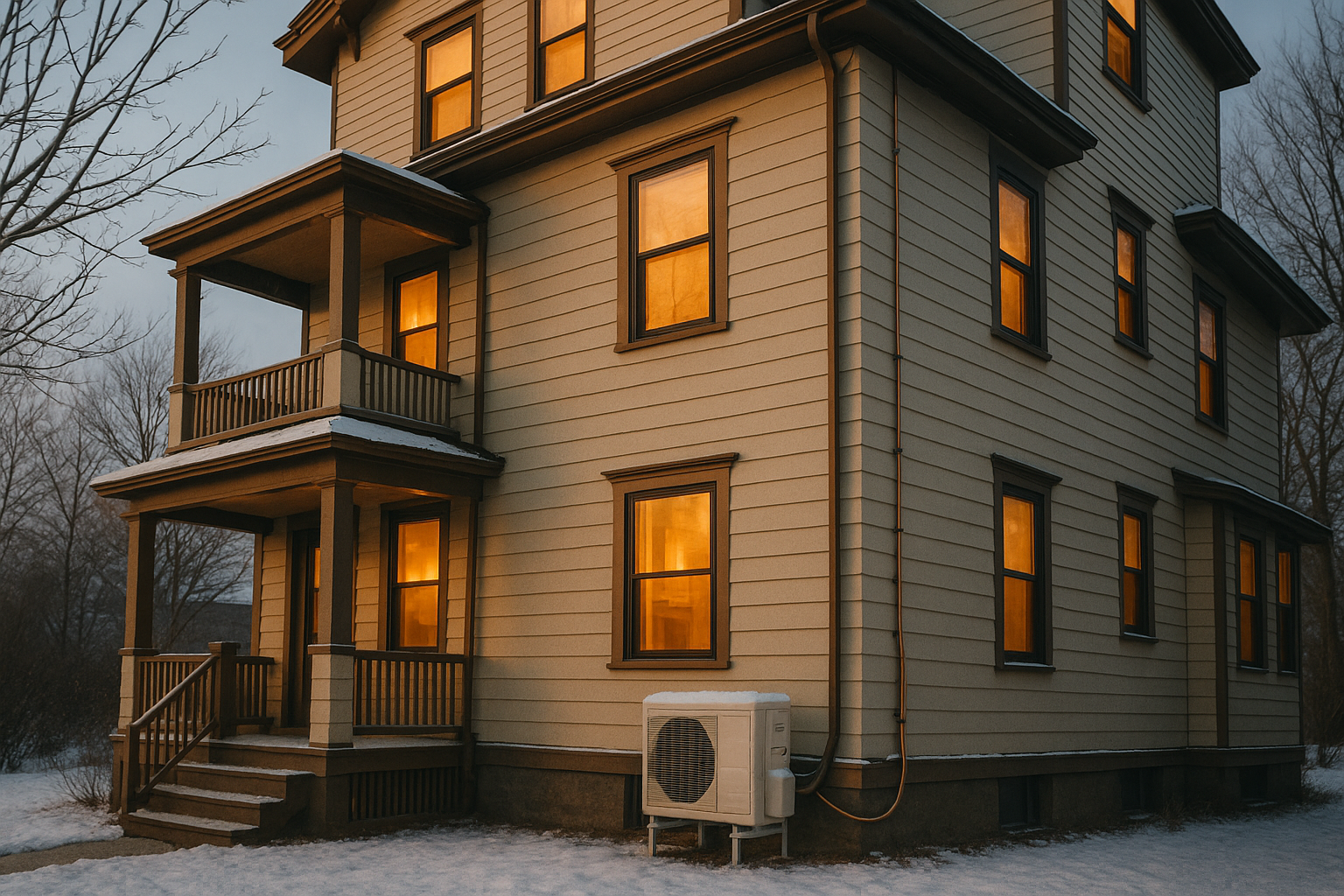
Have you ever been told your heat pump "just can't keep up" in January, even though the load calculation said it would? If the outdoor unit sits forty feet from the indoor coil with two stories of vertical rise between them, the equipment may not be the problem at all.
Refrigerant line sets are the least-documented variable in a retrofit heat pump installation, and they are also one of the few that can quietly erase ten to fifteen percent of rated capacity. Manufacturers publish the limits in the installation manual; the trouble is how rarely anyone opens it before the copper goes in the wall.
Most residential heat pumps are rated at 25 feet of line set with zero lift. Beyond that, capacity derates roughly 1% per additional 25 feet, and exceeding the manufacturer's maximum length or lift voids both performance ratings and warranty coverage.
Why Rated Capacity Assumes A Line Set You Probably Don't Have
Every AHRI-certified performance number you see on a heat pump — the 47°F rating, the 17°F rating, the 5°F maximum capacity that cold-climate buyers actually care about — was measured in a lab under standardized conditions. Part of that standard is a reference line-set length, typically 25 feet with the indoor and outdoor units at the same elevation.
That is not a trivial detail. The AHRI test condition sets the pressure drop, the refrigerant charge, and the oil circulation rate that the published COP and BTU/hr figures depend on.
When your installer runs 65 feet of line set from a basement air handler to a condenser on the far side of the driveway, none of those lab conditions hold anymore. The compressor is now pushing refrigerant through more than twice the reference distance, and the system is carrying substantially more charge than the factory shipped.
What's more, the penalty is not evenly distributed across the operating range. A long line set costs you the least on a mild 45°F day and the most at design temperature, which is precisely when you needed the capacity. This is why long-line problems so often surface as a January complaint after a fall installation that seemed to commission perfectly.
What The Derate Tables Actually Say
Manufacturer derate guidance varies by brand and by refrigerant, but the shape of the curve is consistent. Below is the pattern you will find in the long-line application sections of most residential installation manuals — confirm the exact figures against the manual for your specific model before you rely on them.
| Condition | Typical Capacity Effect | What Drives It |
|---|---|---|
| 25 ft, level (rating point) | 0% — published capacity | AHRI reference condition |
| 50 ft, level | Roughly 1% loss | Suction line pressure drop |
| 75 ft, level | Roughly 2% loss | Cumulative pressure drop plus added charge |
| Outdoor unit 20 ft below indoor | 2–4% loss in heating | Liquid column working against the compressor |
| Outdoor unit 20 ft above indoor | Oil-return risk more than capacity loss | Oil must climb the suction riser |
| Beyond published maximum | Unrated — warranty exposure | No manufacturer data exists |
Notice that the straight-length penalty is modest. A 75-foot level run on a properly sized line set is an engineering inconvenience, not a disaster, and a competent installer handles it with a charge adjustment and possibly a larger suction line.
Vertical lift is the dimension that turns an inconvenience into a failure mode. Elevation change does not just add pressure drop; it changes whether compressor oil can physically return to the crankcase.
Vertical lift matters more than horizontal length. Straight runs cost roughly 1% capacity per 25 extra feet, but elevation change determines whether compressor oil returns at all — an oil-starved compressor fails outright.
Why Oil Return Is The Real Constraint
A small percentage of the compressor's lubricating oil leaves with the refrigerant on every cycle and travels the full loop before returning. In a level 25-foot line set, gravity is neutral and moderate vapor velocity carries the oil home without difficulty.
Raise the outdoor unit above the indoor coil and the oil now has to climb. It does so only if the refrigerant vapor in the suction riser moves fast enough to drag it up the pipe wall — generally on the order of 1,000 to 1,500 feet per minute in a vertical riser, depending on line size and refrigerant.
Here is where modern equipment complicates the picture. A variable-speed inverter compressor spends most of the winter at 30–50% of maximum output, which means suction velocity spends most of the winter well below the design-day value the pipe was sized around.
In other words, a riser that returns oil beautifully during a commissioning test at full load may fail to return oil during the long, mild, low-modulation stretches that make up most of the heating season. The failure is cumulative: oil pools at the bottom of the riser, the crankcase level drops week after week, and the compressor eventually fails from lubrication starvation rather than from any single dramatic event.
Keep in mind that this is the same operating physics that makes modulation so efficient in the first place. The behavior that lets an inverter unit hold a steady 40% output on a 35°F day is exactly the behavior that starves an oversized suction riser.
Trap Placement: Where It Helps And Where It Hurts
The traditional remedy for a tall suction riser is an oil trap — a P-shaped fitting at the base of the riser that collects oil until enough accumulates to be slugged upward. Intermediate traps are then placed every 20 to 25 feet of vertical rise on very tall risers.
That is the conventional refrigeration answer, and on fixed-speed equipment it works. On modern residential heat pumps, it is often the wrong answer, and some manufacturers explicitly prohibit it.
The reason is that a trap holds a volume of oil out of circulation, and on a reversing-valve heat pump, every trap has to work in both directions. In heating mode the suction line is the one that was the liquid line in cooling mode, so a trap designed for one flow direction becomes an obstruction in the other.
Before adding any trap, work through this sequence:
- Read the installation manual first. Several major cold-climate manufacturers prohibit traps entirely on their inverter-driven residential lines and specify line sizing plus maximum lift as the sole oil-return strategy. Adding a trap on those systems is an installation defect, not a fix.
- Correct the line size before adding hardware. An oversized suction line is the most common cause of low vapor velocity, and downsizing the riser is usually more effective than trapping it. A 7/8" riser that should have been 3/4" will not return oil no matter how many traps you install.
- Honor the maximum lift figure as a hard limit. If the manual says 50 feet of lift with the outdoor unit above, that is not a suggestion to be engineered around with creative fittings.
- Place the trap at the base of the riser when one is permitted. The trap belongs immediately at the bottom of the vertical section, formed from short-radius fittings so the trapped volume stays small.
- Add intermediate traps only on risers exceeding roughly 20–25 feet. Each one adds trapped oil volume, so more is not better — they are a response to height, not insurance.
All of these come back to the same principle: traps are a velocity workaround, and velocity problems are better solved with pipe diameter. The trap is what you reach for when the geometry leaves you no other option.
Many inverter-driven cold-climate heat pumps prohibit oil traps outright. On those systems, correct suction line sizing and respecting maximum lift are the only approved oil-return strategy — a trap is an installation defect.
Charge Adjustment: The Step That Gets Skipped
Every foot of line set beyond the factory charge allowance holds refrigerant that has to come from somewhere. Manufacturers publish an additional-charge figure in ounces per foot of liquid line, and it varies with liquid line diameter — a 3/8" liquid line holds substantially more per foot than a 1/4".
On a 60-foot run with a 3/8" liquid line, the added charge can easily exceed a pound of refrigerant. Skip that adjustment and the system runs undercharged, which shows up as low suction pressure, high superheat, reduced capacity, and — in cold weather — more frequent and longer defrost cycles.
Undercharge and long-line derate produce nearly identical symptoms at the thermostat, which is why diagnosis so often goes wrong. The homeowner reports weak heat below 20°F; the technician checks the equipment, finds nothing broken, and concludes the unit was undersized.
This is also the mechanism behind a common false conclusion about backup heat. A system that hands off to resistance strips earlier than expected may have adequate compressor capacity that is simply being throttled by the refrigerant circuit, and the fix is the line set, not a bigger machine or a rewritten balance point control strategy.
How This Interacts With Cold-Climate Performance Claims
Cold-climate heat pumps earn their reputation on the 5°F and −13°F capacity figures published for enhanced-vapor-injection and similar compressor designs. Those figures carry the same 25-foot reference assumption as every other rating.
Because the derate penalty grows as outdoor temperature falls, a long-line installation eats disproportionately into exactly the margin that made the equipment worth its premium. A unit selected for 100% capacity at your design temperature may deliver 88–92% of that on a 70-foot run with 25 feet of lift.
That difference is usually the difference between a system that carries the house and one that leans on backup heat for a third of the winter. If you are working through cold-climate heat pump sizing, treat the line-set derate as part of the selection math rather than as a field problem to be discovered later.
It also affects how you read brand capacity tables. When comparing units in our cold-climate heat pump brand comparison, note that maximum line length and maximum lift vary meaningfully between manufacturers — and on a difficult retrofit geometry, that spec can matter more than a half-point of HSPF2.
Line-set derate grows as outdoor temperature drops. A cold-climate unit rated at 100% capacity at 5°F may deliver 88–92% on a 70-foot run with 25 feet of lift — enough to trigger early backup heat.
Why Retrofits Are Where This Goes Wrong
New construction rarely produces long-line problems, because the mechanical designer places the equipment and the pipe chase together. Retrofits inherit their geometry from a system that was designed around entirely different constraints.
The classic case is a furnace-and-AC replacement in a house where the condenser was placed for noise or aesthetics, and the existing line set is reused because it is already in the wall. Reusing line sets is a separate can of worms — residue from older mineral-oil systems is incompatible with modern POE lubricants — but even a brand-new line set following the old path inherits the old path's length and lift.
Multi-story retrofits are the hardest case. A third-floor air handler with a ground-level condenser can approach or exceed maximum lift before a single foot of horizontal run is counted, and that is before the installer routes around a chimney.
Be aware that the installer is not necessarily hiding anything. Long-line application tables live in an appendix that many field technicians have genuinely never been trained to use, and the manual's maximum figures are easy to read as aspirational rather than binding.
What To Ask Before The Copper Goes In
Line-set geometry is nearly impossible to fix after drywall closes. Everything below costs a conversation before installation and several thousand dollars afterward.
- What is the total equivalent line length for this layout? Equivalent length includes elbows and fittings, not just tape-measure distance, and each 90-degree elbow adds a few feet of equivalent run.
- What is the vertical lift, and in which direction? Outdoor-above-indoor and indoor-above-outdoor have different published maximums on most equipment, and the smaller number governs.
- What does the installation manual list as the maximum for this model? Ask for the page. A contractor who can produce it has read it.
- What is the additional charge in ounces, and will it be weighed in? Weighed-in charge from a scale is verifiable; "charged to superheat" on a long line set in cold weather is not.
- Does this manufacturer permit or prohibit oil traps? The answer should be immediate and specific to the model, not general refrigeration theory.
- What line sizes are specified for this length and lift? Long runs sometimes require upsizing the liquid line, downsizing the suction riser, or both — and the manual usually says which.
Taken together, these six questions separate contractors who work from the manual from contractors who work from habit. That distinction predicts installation quality more reliably than any review score.
Line Sets And The Rest Of The Airside Picture
Refrigerant-side restriction and air-side restriction produce overlapping symptoms, and a system can suffer from both at once. A long line set reduces the refrigerant the coil can move; excessive duct static pressure reduces the air the coil can move, and the thermostat reports the same disappointing result either way.
Metering device behavior is part of this too. An electronic expansion valve tolerates the wider operating envelope of a long line set considerably better than a fixed thermostatic valve, which is one practical reason to weigh EEV versus TXV metering when the geometry is difficult.
Defrost behavior is the third overlap. Reduced refrigerant flow lowers coil temperature and drives more frequent defrost, so a line-set problem can masquerade as a defrost cycle sizing issue for an entire season before anyone measures the actual run.
Weighed-in charge is the verifiable method on long line sets. Manufacturers publish additional charge in ounces per foot of liquid line; a 60-foot 3/8" run can require more than a pound beyond factory charge.
Where Rebate Programs Fit
Most utility and state heat pump incentives — Mass Save, NYSERDA, ConnectedSolutions, Energy Trust of Oregon, Focus on Energy — require installation to manufacturer specification as a condition of the rebate. Some quality-install programs go further and require documented line length, charge method, and commissioning data.
That documentation requirement is an underappreciated benefit. A program that makes the contractor record the equivalent length and the weighed charge is a program that has quietly made the long-line conversation mandatory.
It matters financially as well. If a line-set violation is later identified as the cause of a failure, warranty denial can leave a homeowner holding a compressor replacement on a system whose rebate paperwork is long since closed — a scenario worth weighing alongside the numbers in our heat pump installation cost breakdown and the program structures in the HEEHRA state rebate guide.
The Practical Decision Rule
If your planned installation stays within roughly 50 feet of equivalent length and under 20 feet of lift, line-set geometry is a minor charge-adjustment item and nothing more. Confirm the additional charge is weighed in, and move on.
Between 50 and 100 feet of equivalent length, or with lift over 20 feet, ask for the manufacturer's long-line application table and a stated line-size specification before work begins. This is the band where good installers and habitual installers diverge.
Above the published maximum, the honest options are relocating the outdoor unit, splitting the load into multiple systems with shorter runs, or selecting different equipment with a longer published limit. Exceeding the maximum is not a judgment call — it is an unrated installation.
You may want to consider running the geometry check before you finalize equipment selection rather than after, since maximum line length and lift are selection criteria in their own right. The heat pump selection guide is a reasonable place to start that comparison, and the heat pump load calculator will tell you how much capacity margin you actually have to spend on a derate.
Frequently Asked Questions
Can I reuse my existing line set for a new heat pump?
Sometimes, but it requires verification rather than assumption. Line sets from older mineral-oil systems can leave residue incompatible with modern POE lubricants, and the existing diameters may not match what the new equipment specifies for your length and lift. A reused line set also inherits the original path's geometry, which may have been acceptable for an AC-only system and marginal for a heat pump.
How do I measure equivalent length versus actual length?
Actual length is the tape measure; equivalent length adds a fitting allowance for every direction change. Each long-radius 90-degree elbow typically adds a couple of feet of equivalent run, and a path with eight elbows can add meaningfully to the total. Manufacturer long-line tables specify equivalent length, so the fitting count belongs in the calculation.
Does a mini-split have the same line-set limits as a ducted system?
Mini-splits have limits, but the numbers differ and are often more generous per head. Single-zone units commonly publish maximums in the 50 to 100 foot range with lift allowances of 20 to 40 feet, while multi-zone systems add a total-combined-length limit across all branches. The branch-box geometry introduces its own constraints, so the manual governs.
What symptoms suggest a line-set problem rather than undersized equipment?
The tell is a system that performs acceptably in mild weather and disproportionately poorly at design temperature, with high superheat and low suction pressure at the service ports. Undersized equipment underperforms more proportionally across the range. Documented equivalent length and lift, compared against the manual, settle it quickly.
Will a longer line set increase my electricity use even when it works?
Yes, modestly. The compressor works against additional pressure drop and runs longer to deliver the same heat, so seasonal efficiency drops somewhat even when capacity remains adequate. The larger operating cost usually comes indirectly, through earlier and more frequent backup heat operation on cold days.
This article is for informational purposes and is not financial, tax, legal, or medical advice. Consult a licensed professional — a CPA, an elder-law attorney, a qualified HVAC contractor, or your state energy office — before acting on any program, incentive, or installation decision described here.