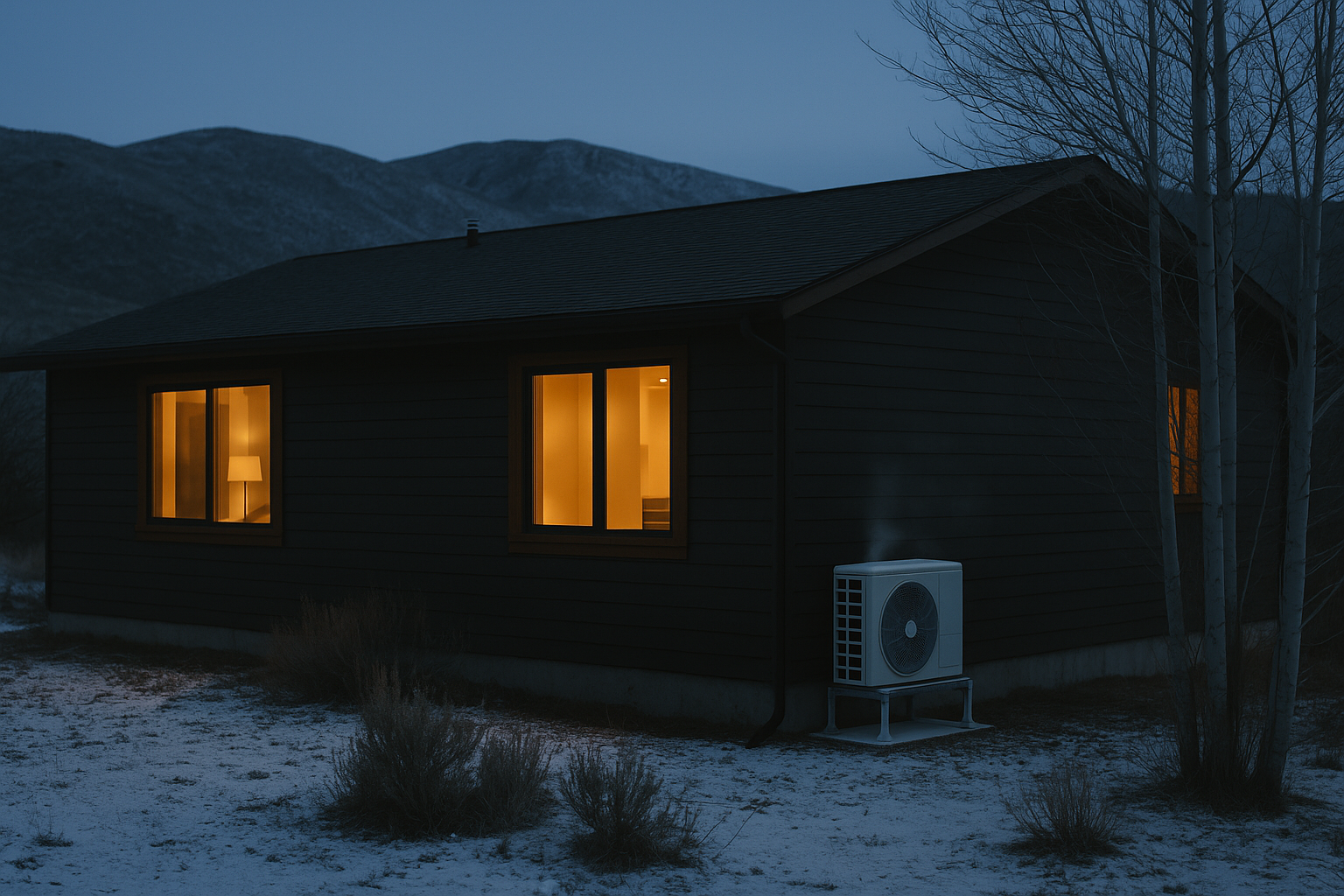
Do you know the winter design temperature for the county you live in? If you are pricing a heat pump in Idaho, that single number shapes which equipment qualifies for a rebate — and whether the system holds your house through a February cold snap — more than anything printed on a manufacturer's brochure.
HEEHRA, the Home Electrification and Appliance Rebate program funded through the Inflation Reduction Act, puts as much as $14,000 per household in play, with up to $8,000 of that aimed at a qualifying heat pump. However, the program is administered state by state, and Idaho's mix of high-desert elevation, mountain design temperatures, and a sharply split area median income map makes the qualifying math less obvious here than most national rebate summaries let on.
HEEHRA in Idaho caps at $14,000 per household, including up to $8,000 toward a heat pump. Households under 80% of county area median income can have 100% of project cost covered, while 80% to 150% AMI covers 50%.
What HEEHRA Actually Covers
The federal statute sets per-measure caps that every state program has to work within, and no state administrator can raise them. Idaho's implementation runs through the Governor's Office of Energy and Mineral Resources, the designated state energy office, and distributes funds against those same federal ceilings.
The measure caps that matter most to a household replacing a furnace or an electric-resistance system include but are not limited to the following:
| Measure | Federal HEEHRA cap | Idaho relevance |
|---|---|---|
| Heat pump (space heating and cooling) | $8,000 | Highest-value line item; drives equipment selection |
| Heat pump water heater | $1,750 | Garage installs need an ambient temperature check |
| Electrical panel upgrade | $4,000 | Common on pre-1990 100-amp services |
| Electric wiring | $2,500 | Branch circuits for the outdoor unit and air handler |
| Insulation, air sealing, and ventilation | $1,600 | Often the cheapest load reduction available |
| Heat pump clothes dryer | $840 | Counts against the same household total |
| Electric stove, cooktop, range, or oven | $840 | Requires panel capacity to support it |
| Household maximum, all measures combined | $14,000 | Shared ceiling across the whole project |
Keep in mind that these caps are ceilings rather than payouts. What a household actually receives depends on the income tier and the invoiced project cost, so the $8,000 heat pump line is the most a program can pay rather than a figure any Idaho household should assume.
Note that the $14,000 household maximum is shared across every measure. A panel upgrade, a heat pump water heater, and a ducted heat pump can consume the full allowance quickly, which is why the sequencing of measures deserves attention before the first invoice is written.
The water heater line carries an Idaho-specific wrinkle worth flagging. Heat pump water heaters pull heat from the surrounding air, and an unconditioned garage in Idaho Falls or McCall sits well below the ambient range where the compressor operates efficiently, which pushes the unit into resistance mode for much of the winter — our overview of heat pump water heater placement covers the ambient thresholds in detail.
For a broader walkthrough of how the measure list fits together at the federal level, the HEEHRA program guide covers the statutory structure that every state administrator inherits.
The Two Income Lines: 80% And 150% Of Area Median Income
HEEHRA sorts households into three buckets, and the boundaries are drawn against HUD area median income figures for the household's county and household size. Below 80% of AMI, the program can cover 100% of eligible project cost up to the measure caps; between 80% and 150% of AMI, coverage falls to 50% of project cost.
Above 150% of AMI, a household sits outside HEEHRA entirely. That line is where most of the Idaho confusion starts, because the AMI figure behind it is not a statewide number.
HEEHRA uses HUD area median income for your county and household size, not a statewide figure. Under 80% AMI covers 100% of project cost, 80% to 150% AMI covers 50%, and above 150% AMI is ineligible.
Household size moves the threshold more than most homeowners expect. HUD's family-size adjustments set the one-person limit at roughly 70% of the four-person figure and the two-person limit at roughly 80%, so a retired couple and a family of five in the same county are measured against noticeably different dollar lines.
For a full breakdown of how the two tiers interact with coverage percentages and the measure caps, see our explainer on HEEHRA income tiers. The tier you land in changes the effective price of identical equipment by thousands of dollars.
Why Idaho's AMI Map Splits Between Boise And Everywhere Else
HUD publishes income limits by metropolitan statistical area for metro counties and by individual county for non-metro areas. The Boise City metro area covers Ada, Boise, Canyon, Gem, and Owyhee counties, which means a household in a small Owyhee County town is measured against the same metro income base as a household in a west Boise subdivision.
Meanwhile, non-metro counties such as Shoshone, Clearwater, Lemhi, and Custer are measured against their own county medians. As a result, the same household income can land comfortably below 80% of AMI inside the Boise metro and above that line in a rural county where the median is lower.
This produces an outcome that regularly surprises applicants. A Boise-area household earning a solidly middle-class income may reach the 100%-coverage tier because the metro median is high, while a rural household earning less may land in the 50% tier because its county median is low.
Boise's HEEHRA income limits come from the five-county Boise City metro figure, while rural counties use their own lower medians. The same income can clear 80% AMI in one Idaho county and miss it in another.
Verify before you budget. HUD republishes income limits annually, and both the 80% and 150% lines move with them. Pull the current limit for your county and household size from the HUD income limits table rather than relying on a contractor's estimate or a national rebate roundup.
Idaho is not unusual in carrying a metro-versus-rural split, though the geographic spread is wider here than in most states. Households near the eastern border may find it useful to compare how a neighboring program handles the same thresholds, and our Montana HEEHRA breakdown walks through a similar rural-median problem.
Design Temperature Is The Second Gate
Once the income tier is settled, the question becomes which equipment will both qualify and perform. That answer is driven by the 99% winter design temperature, the outdoor temperature your location stays above for 99% of the hours in a typical year, which is the figure ACCA Manual J uses to size a heating system.
Idaho's design temperatures span a remarkable range for one state, largely because elevation runs from roughly 1,400 feet in the Lewiston valley to well above 5,000 feet in the mountain towns. The approximate figures below illustrate that spread and should be confirmed against the ASHRAE tables your contractor's Manual J software actually uses:
| Location | Approximate elevation | Approximate 99% winter design temp |
|---|---|---|
| Lewiston | 1,440 ft | 15°F to 18°F |
| Coeur d'Alene | 2,180 ft | 5°F to 10°F |
| Boise | 2,840 ft | 10°F to 13°F |
| Twin Falls | 3,750 ft | 3°F to 8°F |
| Pocatello | 4,450 ft | 0°F to 5°F |
| Idaho Falls | 4,730 ft | -6°F to -1°F |
| McCall | 5,020 ft | -10°F to -5°F |
Note that the 99.6% design column, which some contractors prefer for critical loads, runs several degrees colder than the 99% column at every one of these locations. Keep in mind that a system sized to Boise conditions will be meaningfully undersized in Idaho Falls, even though both households apply to the same state program under the same federal caps.
Idaho's 99% winter design temperature runs roughly 15°F in Lewiston, 10°F to 13°F in Boise, and near -6°F in Idaho Falls. Manual J sizes to your local figure, never to a statewide average.
All of this matters for rebates because equipment that satisfies a Boise load at 12°F may deliver far less than its nameplate capacity at Idaho Falls conditions. Our guide to cold-climate heat pump sizing covers how to read a manufacturer's extended capacity table instead of the nominal tonnage printed on the box.
What Qualifying Equipment Means At Idaho Design Conditions
DOE requires HEEHRA-funded appliances to be ENERGY STAR certified where an ENERGY STAR specification exists. For air-source heat pumps, though, baseline certification reflects performance at standard rating conditions, and it does not by itself tell you what the unit produces at 5°F or below.
The distinction that most rebate pages skip is the ENERGY STAR Cold Climate designation, a separate tier inside the same specification. Cold Climate models are evaluated on low-temperature performance, and the associated product listings report capacity and coefficient of performance at 5°F rather than only at the 47°F rating point.
ENERGY STAR certification qualifies equipment for HEEHRA, but the Cold Climate designation is the tier that publishes capacity and COP at 5°F. In most Idaho counties, that low-temperature data is the number that matters.
Specifications worth requesting in writing before signing an Idaho installation contract include but are not limited to:
- Rated capacity at your design temperature. Ask for BTU/hr output at the 99% design temperature for your county, not at 47°F. A nominal three-ton unit may deliver well under 36,000 BTU/hr at 0°F depending on the compressor and control strategy.
- COP at 5°F. This is the efficiency figure that drives winter operating cost, and it separates genuine cold-climate models from standard ones far more clearly than SEER2 does.
- HSPF2 and SEER2 from the AHRI certificate. Published ratings apply to a matched indoor and outdoor combination, so the certificate must name both model numbers actually being installed.
- Compressor technology. Variable-speed inverter compressors modulate rather than short-cycling, which matters through Idaho's long shoulder seasons; some cold-climate lines add vapor injection to hold capacity at low ambient temperatures.
- Defrost strategy. Demand-defrost controls run fewer unnecessary cycles than timed defrost, which affects both winter comfort and measured seasonal efficiency.
Taken together, these five data points tell you whether a proposed system is a true cold-climate machine or a mild-climate unit carrying a rebate-friendly certification. For a comparison of manufacturers that publish credible low-ambient data, see our roundup of cold-climate heat pump brands, and our technical breakdown of vapor-injection heat pumps explains the mechanism that holds capacity as outdoor temperatures fall.
Elevation Changes The Capacity Math
Air density falls with altitude, and Idaho has a great deal of altitude. At roughly 4,700 feet in Idaho Falls, air density sits near 84% of sea-level density, and above 5,000 feet in the mountain towns it drops toward 80%.
This matters because manufacturer capacity tables and the standard sensible-heat formula are referenced to sea-level conditions. The same measured airflow in cubic feet per minute moves less mass at elevation, so sensible capacity per CFM falls roughly in proportion to the density ratio.
ACCA Manual J and Manual S both include altitude correction factors for exactly this reason, and a contractor who skips them produces a load calculation that reads cleanly and sizes incorrectly. Of course, the same correction applies to duct design, external static pressure, and the airflow the blower can realistically deliver.
At Idaho Falls elevation, air density runs near 84% of sea level, so sensible capacity per CFM drops proportionally. ACCA Manual J and Manual S carry altitude corrections that a sea-level calculation misses.
If you want to sanity-check a contractor's numbers before the bid meeting, our heat pump sizing calculator walks through the inputs a Manual J actually consumes, including design temperature, envelope assumptions, and infiltration.
Backup Heat, Balance Point, And Idaho Utility Rates
Every cold-climate heat pump has a balance point, the outdoor temperature at which its output equals the building's heat loss. Below that temperature something else has to make up the difference, and how that handoff is configured determines a large share of the winter bill.
Electric resistance strips are the common default, and they are also the most expensive way to heat a house in Idaho. Staged strips with an outdoor thermostat lockout, or a dual-fuel configuration paired with an existing gas furnace, generally keep operating cost far lower than a single-stage strip that energizes on any call for supplemental heat.
Our articles on balance point controls and heat pump backup heat cover the control strategies in detail. What's more, sizing decisions and defrost cycle behavior interact directly with how often the backup stage fires during a cold snap.
On the rate side, Idaho has historically carried residential electricity prices below the national average, largely a function of the region's substantial hydroelectric generation, and EIA state electricity data is the place to confirm the current figure. That rate environment improves heat pump economics relative to states where a kilowatt-hour costs half again as much.
Utility incentives sit alongside HEEHRA rather than inside it. Idaho Power, Avista across the northern panhandle, and Rocky Mountain Power in eastern Idaho each run their own residential efficiency programs with their own qualifying equipment tiers, and those tiers do not always match the federal ENERGY STAR requirement.
Stacking, Sequencing, And The Federal Credit Question
Homeowners frequently ask whether HEEHRA can be combined with the federal 25C energy efficient home improvement credit. The interaction matters because a rebate generally reduces the amount treated as paid for the property, which in turn reduces the basis any credit is calculated against.
Federal credit availability has moved across recent legislative cycles, so confirming current status before building a financial plan is worth the ten minutes it takes. Our federal tax credit status page tracks where things stand, and our guide to stacking HEEHRA with 25C covers the sequencing question in full.
Sequencing applies inside HEEHRA as well. Because the $14,000 household ceiling is shared, envelope work such as insulation and air sealing completed before the load calculation can shrink the required equipment size, which sometimes lowers total project cost by more than the insulation rebate itself is worth.
Questions Worth Putting To An Idaho Contractor
Contractor selection carries more weight in Idaho than in milder states, because a sizing error that would be merely inefficient at 25°F becomes a comfort failure at -5°F. Here is a list of the questions worth asking before you sign:
- Which design temperature did you use? The answer should be a specific figure tied to your county or the nearest ASHRAE station, not a regional rule of thumb or a square-footage shortcut.
- May I see the Manual J output? A room-by-room load calculation built on your actual envelope inputs is a deliverable you can request, and the altitude correction should be visible inside it.
- What is the balance point of this system in my house? A contractor who cannot state it has probably not modeled the backup heat operating cost either.
- Is this model on the ENERGY STAR Cold Climate list? Ask for the listing itself, along with the AHRI certificate covering the matched indoor and outdoor combination.
- How is auxiliary heat staged and locked out? Staging thresholds and outdoor lockout settings belong in the commissioning documentation rather than sitting at factory defaults.
A contractor who answers all five without hesitation is demonstrating the same modeling discipline the rebate paperwork will eventually ask for. Documentation requested up front is considerably easier to obtain than documentation requested after the equipment is installed.
Frequently Asked Questions
How much can an Idaho household receive from HEEHRA?
The federal ceiling is $14,000 per household across all measures, with up to $8,000 of that available for a qualifying heat pump. Households below 80% of area median income can have 100% of eligible project cost covered up to those caps, and households between 80% and 150% of AMI can have 50% covered.
Which Idaho counties use the Boise metro income limit?
The Boise City metropolitan statistical area covers Ada, Boise, Canyon, Gem, and Owyhee counties, and all five are measured against the same metro income base. Non-metro counties use their own county-level HUD figures, which generally run lower.
Does a standard ENERGY STAR heat pump qualify in Idaho?
ENERGY STAR certification is the federal qualification requirement, so a standard certified model can be eligible. That said, in counties where design temperatures approach or fall below 0°F, the ENERGY STAR Cold Climate designation is the tier that publishes capacity and COP at 5°F, which is the performance data a sizing decision actually depends on.
Can HEEHRA be combined with Idaho Power or Avista rebates?
Utility efficiency programs run independently of the federal rebate and generally stack with it, though each utility sets its own qualifying equipment tiers and paperwork. Confirm that combined incentives do not exceed total project cost, since program rules commonly prohibit paying more than the invoiced amount.
Why does elevation matter for heat pump sizing in Idaho?
Manufacturer capacity tables are referenced to sea-level air density. At roughly 4,700 feet, density sits near 84% of sea level, so the same airflow carries less heat and Manual J and Manual S altitude corrections have to be applied or the system will be undersized on paper and in practice.
Where To Start
The practical sequence in Idaho runs in a specific order: confirm your county's HUD income limit for your household size, pull the 99% winter design temperature for your location, then evaluate equipment against that temperature rather than against nominal tonnage. Program status, application windows, and contractor requirements are worth confirming directly with the Idaho Governor's Office of Energy and Mineral Resources, since state rollout timelines vary.
From there, the HEEHRA program guide and the heat pump sizing calculator will take you through the numbers before a contractor puts a proposal in front of you.
This article is for informational purposes and is not financial, tax, or legal advice. Consult a licensed professional (CPA, HVAC contractor, or the Idaho Governor's Office of Energy and Mineral Resources) before acting.