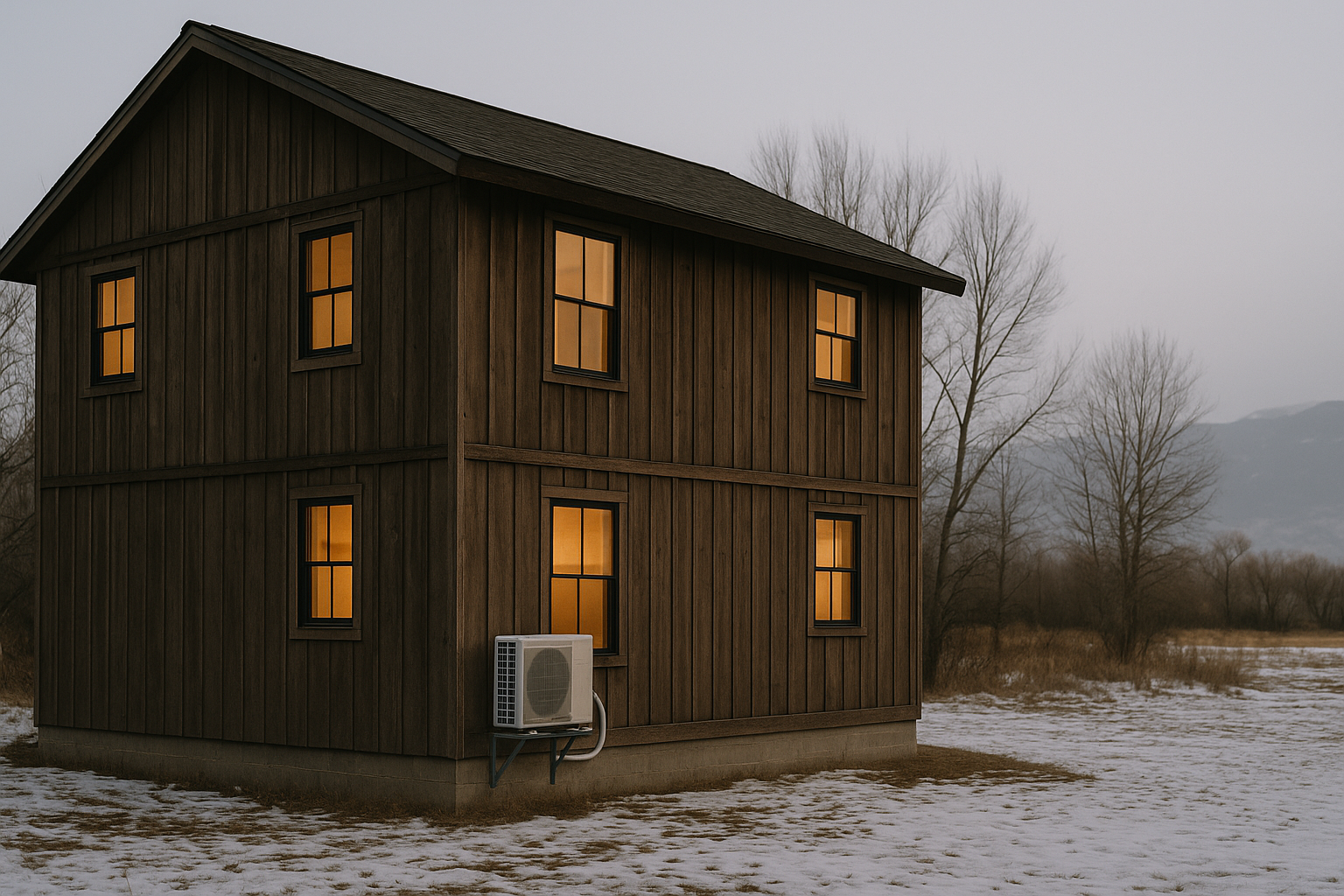
Do you know whether the home you rent in Montana qualifies for a federally funded heat pump rebate? If you are one of the roughly one in three Montana households that rents — a share consistent with U.S. Census Bureau American Community Survey estimates — the honest answer is probably no.
HEEHRA, the High-Efficiency Electric Home Rebate program authorized under Section 50122 of the Inflation Reduction Act, was drafted with renters and multifamily buildings explicitly in scope. What it was not drafted with is a plain-language checklist telling a tenant what to hand a landlord, which is where most Montana renter households stall.
This guide walks the rebate caps, the county-level income thresholds that sort applicants into tiers, and the owner-consent documentation path that decides whether a renter-occupied home can participate at all. Keep in mind that HEEHRA is state-administered, so federal statute sets the ceiling while the Montana program office sets the process.
Renters can qualify for HEEHRA in Montana, but the property owner must consent in writing because the rebate attaches to installed equipment. Income eligibility is measured on the tenant household, not the owner.
What HEEHRA Actually Pays In Montana
The dollar figures below come from federal statute rather than a Montana-specific schedule, and they function as ceilings instead of guarantees. A state program can pay less per measure or exhaust its allocation, but it cannot pay more than the federal cap.
Coverage percentage is where income enters the calculation. Households below 80% of area median income are eligible for 100% of project cost up to each cap, while households between 80% and 150% of AMI are eligible for up to 50%.
| Measure | Federal cap | Under 80% AMI | 80–150% AMI |
|---|---|---|---|
| Air-source heat pump (space heating and cooling) | $8,000 | 100% of cost | Up to 50% of cost |
| Heat pump water heater | $1,750 | 100% of cost | Up to 50% of cost |
| Electric stove, cooktop, range, or oven | $840 | 100% of cost | Up to 50% of cost |
| Heat pump clothes dryer | $840 | 100% of cost | Up to 50% of cost |
| Electrical panel or service upgrade | $4,000 | 100% of cost | Up to 50% of cost |
| Electric wiring | $2,500 | 100% of cost | Up to 50% of cost |
| Insulation, air sealing, and ventilation | $1,600 | 100% of cost | Up to 50% of cost |
| Household total | $14,000 | — | — |
All of these caps stack inside a single household ceiling of $14,000. A tenant who replaces a failing electric furnace with a cold-climate heat pump and adds a service upgrade can reach $12,000 of that ceiling on two line items alone.
HEEHRA caps at $14,000 per household. Federal ceilings include $8,000 for a heat pump, $1,750 for a heat pump water heater, $4,000 for a panel upgrade, and $1,600 for insulation and air sealing.
How Montana's Rollout Differs From Early-Launch States
Montana's state energy office sits inside the Department of Environmental Quality, and the state has moved more deliberately on home energy rebates than early-launch states such as New York, New Mexico, and Colorado. That timing gap matters in a practical way: equipment purchased before a program's official start date is frequently ineligible, no matter how well the project would otherwise score.
Accordingly, confirm the current application window and the approved-contractor list directly with the administering agency before you commit to anything. Our HEEHRA program guide tracks the structure common to every state, and state-by-state coverage like the Alaska HEEHRA rollout shows how widely launch timing and cold-climate program design vary.
Verify before you buy. HEEHRA is administered by states, not by the IRS, and there is no universal national portal. A quote, a purchase order, or a completed install that predates the program window is generally not eligible for retroactive credit.
HEEHRA is administered by the state, not the IRS. Confirm the current application window and approved-contractor list with the Montana Department of Environmental Quality before purchasing equipment.
Income Tiers: Montana Reads AMI By County, Not Statewide
HEEHRA eligibility is expressed as a percentage of area median income, and area median income is published county by county by the U.S. Department of Housing and Urban Development. Montana's county spread is wide enough that any statewide figure would misclassify a meaningful share of applicants.
Gallatin County, anchored by Bozeman, carries one of the highest median household incomes in the state, while several eastern and reservation-adjacent counties sit well below it. The same household income can fall under the 80% line in one Montana county and above it in another, which moves coverage from 100% of project cost to 50%.
Household size is the second axis, and it is easy to overlook. HUD limits scale with the number of people in a household, so a four-person renter household and a one-person renter household in the same building can land in different tiers on identical per-person income.
Montana sets HEEHRA income tiers using HUD area median income by county and household size. Under 80% AMI covers 100% of project cost, 80–150% AMI covers up to 50%, and above 150% AMI is not eligible.
For the mechanics of how the two tiers behave once you are inside them, including what partial coverage does to a multi-measure project, see our breakdown of HEEHRA income tiers. Many states also accept categorical eligibility through programs like LIHEAP or SNAP as a shortcut into the under-80% tier, which spares applicants a pay-stub review.
Do Renters Qualify For HEEHRA In Montana?
Yes, in principle, and the federal statute does not restrict rebates to owner-occupied homes. The practical constraint is physical rather than legal: HEEHRA pays for equipment that gets bolted to a building someone else owns.
That single fact drives everything downstream. The rebate follows the equipment, the equipment becomes a fixture of the property, and no state program authorizes a fixture install without documented owner consent.
Income, meanwhile, is measured on the household that actually lives there. In fact, a tenant household below 80% AMI unlocks the 100% tier even when the building owner's income is far higher, which is precisely the outcome the statute was written to produce.
The Landlord-Tenant Documentation Path
This is the part most state guides skip, and it is where renter applications quietly die. Here is the documentation chain a Montana renter-occupied project generally has to assemble, in roughly the order it tends to be requested:
- Written owner consent. A signed authorization from the property owner or managing agent permitting the specific measures, naming the equipment class, and acknowledging that the installed system stays with the property. Verbal approval from a property manager is rarely sufficient for a program file.
- Owner identity and tax documentation. Programs typically need the legal owner of record rather than a mailing address, plus a completed W-9 when any funds route to the owner instead of directly to the contractor.
- Tenant income verification. Recent pay stubs, a prior-year tax return, or proof of categorical eligibility through an assistance program that the state accepts in place of a full income review.
- Current lease documentation. A lease establishing that the applicant household occupies the unit as a primary residence, with enough remaining term to satisfy any occupancy condition the program attaches.
- Approved contractor. An installer on the state's participating list, since HEEHRA is generally delivered as a point-of-sale discount through the contractor rather than reimbursed to the household after the fact.
- Tenant-protection acknowledgment. Some programs attach rent-increase restrictions or tenant-protection language for a defined period after install, and the owner has to sign that separately.
All of these add up to one gate: the owner has to be willing to sign. A tenant with airtight income qualification and no landlord signature has no application at all.
What's more, the pitch to an owner is genuinely favorable and worth putting in writing. The property receives capital equipment at little or no cost to the owner, the asset remains with the building, and the tenant absorbs the coordination work.
A Montana renter's HEEHRA file generally needs written owner consent, tenant income verification, a current lease, and an approved contractor. Owner consent is the step that most often blocks the application.
Multifamily Buildings Follow A Different Rule
Duplexes, fourplexes, and larger apartment properties can qualify through the building rather than unit by unit. The statute directs that a multifamily building in which at least half of residents are low-income households be treated at the higher subsidy tier for qualifying work.
That is the pathway for central equipment: a shared water heating plant, a building-wide panel and service upgrade, or envelope air sealing across a common roof assembly. Be aware that states differ on how they verify a building's income mix, so confirm the exact resident-share threshold and the acceptable documentation format with the Montana program office.
Multifamily buildings qualify through the building rather than unit by unit. When at least half of residents are low-income households, the statute directs the higher subsidy tier for qualifying work.
Owners of small Montana rentals — the two-to-four-unit stock common in Missoula, Billings, and Great Falls — often sit awkwardly between the single-family and multifamily tracks. Ask the program office which track your property falls under before gathering tenant income documentation, because the verification burden differs sharply between them.
Equipment Selection Under Montana Design Temperatures
Montana is one of the harder heat pump climates in the country, and a rebate that funds the wrong equipment is a poor outcome regardless of the discount. Winter 99% design temperatures across the state run from roughly -5°F in the warmer western valleys to below -20°F in the northeast and along the Hi-Line.
That range puts most of Montana squarely in cold-climate heat pump territory, meaning variable-speed inverter equipment with published capacity at 5°F and below rather than a nameplate rating taken at 47°F. Ask any contractor for the AHRI-certified extended capacity tables instead of a manufacturer marketing sheet.
Sizing should come from an ACCA Manual J load calculation on the actual unit, using its real envelope, window area, and infiltration rate, not a square-foot rule of thumb. Our guide to cold-climate heat pump sizing walks the load-calculation logic, and the heat pump backup heat discussion covers what happens below the balance point.
Renters carry one structural advantage and one structural disadvantage here. Retrofit constraints often push rental projects toward ductless mini-splits, which are simpler to permit and less invasive to install; the disadvantage is that a tenant usually cannot authorize the insulation and air sealing work the load calculation assumes.
Stacking HEEHRA With Utility And Federal Programs
NorthWestern Energy serves most of western and central Montana, Montana-Dakota Utilities covers part of the east, and rural electric cooperatives fill much of the remainder. Several western Montana cooperatives purchase wholesale power from the Bonneville Power Administration and pass through BPA-funded efficiency incentives, which is a separate money stream from HEEHRA.
Utility incentives generally stack with HEEHRA because they draw on ratepayer or wholesale-supplier funds rather than the same federal allocation. What does not stack cleanly is the IRA's other home energy rebate program, which cannot be combined with HEEHRA on an identical piece of equipment.
Federal tax credits interact differently again. A rebate reduces the project's cost basis first, and any credit then applies only to what the household actually paid out of pocket — see our HEEHRA and 25C stacking breakdown, and confirm current eligibility on the federal tax credit status page before assuming a credit is available for the 2026 tax year.
Note on federal solar. The federal residential solar investment tax credit expired on December 31, 2025. State and utility solar programs continue in some jurisdictions, but the federal credit does not apply to systems placed in service after that date.
A Decision Rule Indexed To Your Phase
The right next step depends less on rebate math than on where you already are in the process. Here is how the decision tends to break down:
- Before the landlord conversation. Pull your county's HUD income limit for your household size and establish your tier first, because a fully covered project is a far easier ask than one requiring 50% owner contribution.
- Landlord willing, program not yet open. Get the consent letter signed and dated anyway and hold it, since owner cooperation is the scarce input and consent is easier to obtain when nothing is urgent.
- Equipment already failing. Weigh a bridge repair against waiting for the program window, given that equipment installed before a program opens is usually ineligible for retroactive credit.
- Owner of a small Montana rental. Ask the program office whether your property is scored as single-family or multifamily before you collect tenant income documentation, because the answer changes the entire verification burden.
None of the above is a recommendation to act on a particular timeline. It is a map of which question to answer next, and the decision remains yours in consultation with the program office and a licensed contractor.
Common Questions About HEEHRA In Montana
The questions below come up most often from Montana renters and small-rental owners working through eligibility for the first time.
How much can a Montana household receive from HEEHRA?
Federal statute caps HEEHRA at $14,000 per household, with sub-caps of $8,000 for a heat pump, $1,750 for a heat pump water heater, $840 each for an electric range and a heat pump dryer, $4,000 for a panel upgrade, $2,500 for wiring, and $1,600 for insulation and air sealing.
Does a landlord's income affect a renter's HEEHRA eligibility?
No. The tier is set by the income of the household occupying the unit, measured against county area median income and adjusted for household size. The owner's finances are irrelevant to the coverage percentage, though the owner still has to authorize the work.
What happens to the equipment when a tenant moves out?
The installed system is a fixture and stays with the property. That is why owner consent forms typically ask the owner to acknowledge ownership of the equipment in advance, and why some programs attach tenant-protection or rent-increase conditions for a defined period afterward.
Can a Montana fourplex apply as a multifamily building?
It depends on how the state program classifies small properties, and states draw that line differently. Confirm the classification with the Montana Department of Environmental Quality before assembling paperwork, because the single-family and multifamily tracks demand different income verification.
Will a rebate cover a cold-climate heat pump in eastern Montana?
The rebate covers qualifying equipment, but adequate capacity at design temperature is an engineering question, not a program question. With design temperatures below -20°F in parts of the state, ask for AHRI-certified capacity at 5°F and a Manual J load calculation.
Where To Go From Here
Montana's rebate structure rewards households that arrive with documentation already assembled, and renters carry the heaviest paperwork load of any group HEEHRA covers. Establish your county AMI tier, secure written owner consent, and verify the current program window with the Montana Department of Environmental Quality before scheduling any equipment.
To compare Montana against other state rollouts, start at our HEEHRA state guide hub, or work the federal-versus-state question first with the 25C versus HEEHRA decision tree.
This article is for informational purposes and is not financial, tax, or legal advice. Consult a licensed professional (CPA, HVAC contractor, or your state energy office) before acting.