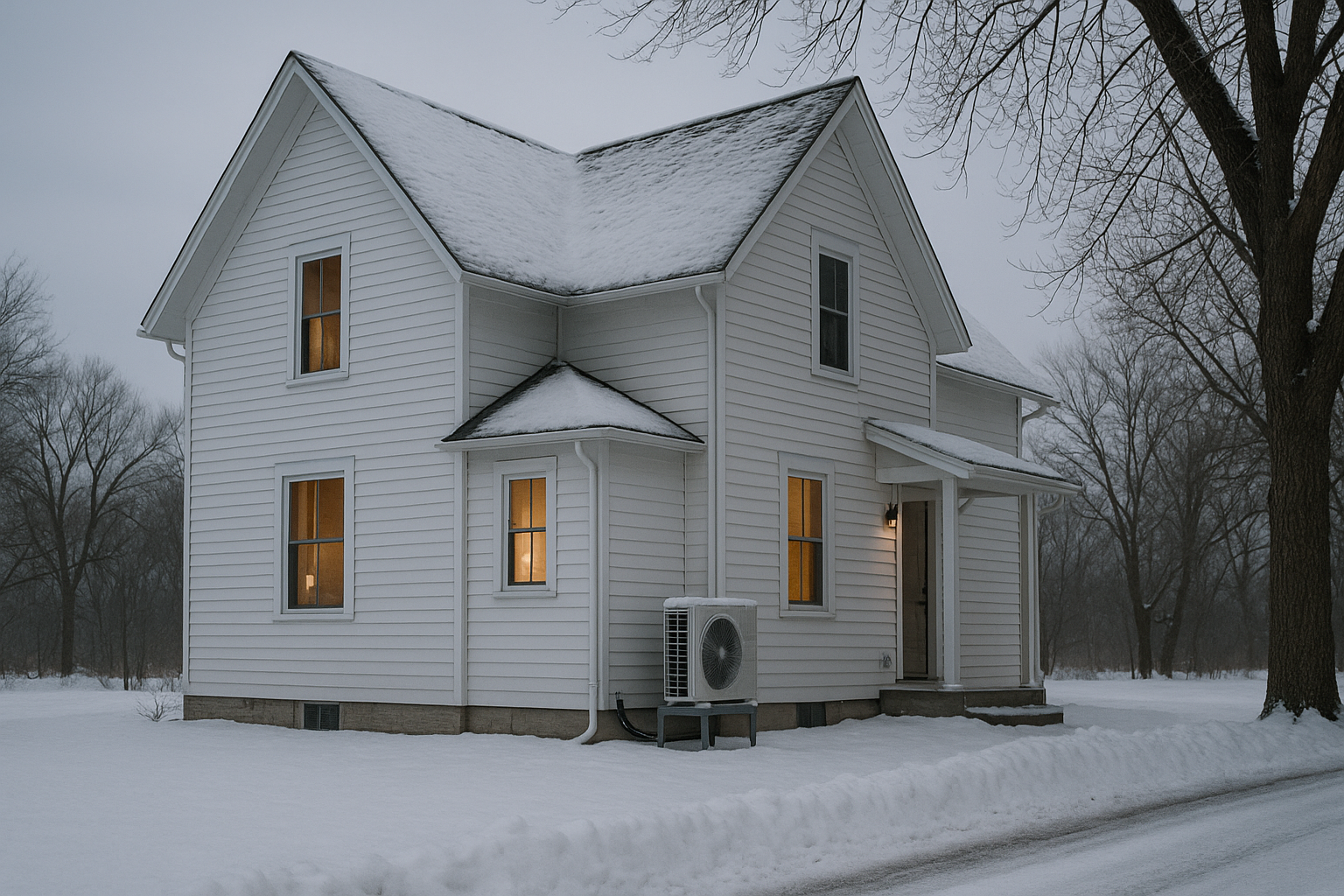
Do you know which state's rebate catalog you were reading when you priced your heat pump? If the utility bill in your inbox says Xcel Energy, that single question decides whether the number you wrote down applies to your house at all.
Xcel Energy delivers electricity across eight states, and the logo on the bill looks identical in Minneapolis and in Denver. The rebate program behind that logo is built separately in each state, filed with a different commission, and governed by a different statute.
That difference is structural rather than cosmetic. Minnesota layers a cold-climate performance tier and a fuel-switching test on top of the basic equipment rebate, and neither one appears on the Colorado residential heat pump pages that dominate search results.
Xcel Energy is one utility with two rebate books. Minnesota's residential heat pump rebates run under the state's ECO Act and MPUC-approved plans, while Colorado's run under CPUC-approved DSM and Clean Heat filings.
Why One Utility Runs Two Rebate Books
Utility efficiency programs are not designed by the utility acting alone. Each state's program is a regulatory filing — a plan the utility proposes, a commission reviews, and a statute constrains.
In Minnesota, the governing framework is the Energy Conservation and Optimization Act of 2021, which replaced the older Conservation Improvement Program structure. The Minnesota Public Utilities Commission approves the resulting plans, with the Minnesota Department of Commerce overseeing the conservation and fuel-switching provisions.
In Colorado, Xcel's affiliate operates under Demand Side Management plans and Clean Heat Plan filings reviewed by the Colorado Public Utilities Commission. Colorado also stacks statewide incentives — including a state income tax credit and a sales-and-use tax exemption for qualifying heat pump equipment — that have no Minnesota analogue.
A common shortcut assumes the split exists because Xcel sells gas in one state and not the other. That reading does not hold: Xcel is a combination electric-and-gas utility in both Minnesota and Colorado, and the real divergence comes from the statutes and commission orders sitting above each program.
What Minnesota's Cold-Climate Qualification Tiers Actually Ask For
Minnesota's upper rebate tier is a performance gate, and it is verified from documents rather than from a brochure claim. Cold-climate territories generally reference the Northeast Energy Efficiency Partnerships (NEEP) Cold Climate Air Source Heat Pump Product List, which publishes rated capacity and efficiency at 47°F, 17°F, and 5°F.
Those low-ambient rows carry the whole argument. A unit that looks strong at 47°F can shed a substantial share of its rated capacity by 5°F, and a Minnesota program is effectively purchasing the 5°F number rather than the nameplate.
The qualification checks a cold-climate tier typically applies include but are not limited to:
- Listed system, not listed outdoor unit. The listing applies to a specific combination of outdoor unit, indoor coil or air handler, and control. Swapping the coil to whatever is on the truck can drop an otherwise qualifying job to a lower tier.
- Matched AHRI certificate. Program reviewers ask for the AHRI reference number that certifies the installed combination under AHRI 210/240-2023. A certificate that does not match the serial numbers on site is the single most common paperwork failure.
- Documented low-ambient capacity. Cold-climate tiers look for published capacity retention at low outdoor temperatures, which is the number that determines how much of your winter load the compressor actually carries.
- Rated efficiency floors. SEER2 and HSPF2 minimums set the entry threshold, and higher tiers generally require variable-speed or inverter-driven modulation rather than single-stage operation.
- Controls and integration. Where a fossil backup remains, programs increasingly want a control strategy — a defined switchover point, lockout logic, or an outdoor reset — documented as part of the install.
- Participating contractor of record. Most tiers require a licensed contractor enrolled in the program, and self-installed equipment is frequently excluded outright.
All of these come down to one idea: the program is buying verified cold-weather output, and the paperwork is how it verifies. If you are still selecting equipment, the cold-climate heat pump brands that hold capacity at low ambient is the right place to narrow the list before a contractor narrows it for you.
Minnesota's cold-climate tier keys off listed performance, not marketing. Expect a NEEP-listed system, an AHRI certificate matching the exact outdoor unit, indoor coil, and control, plus documented capacity at low ambient.
The Gas-Offset Rule That Trips Up Colorado Readers
Here is where Colorado guidance does the most damage in a Minnesota home. Under Minnesota's ECO Act, a utility-funded project that moves a home from gas heating to electric heating is treated as efficient fuel switching, which is a different statutory category than ordinary conservation.
Fuel-switching improvements carry their own tests under Minnesota Statutes 216B.241 — tests oriented around net source energy consumed on a fuel-neutral basis, statewide greenhouse gas emissions, societal cost-effectiveness, and the effect on the utility's system load factor. Those tests shape which projects a Minnesota program can fund and at what level.
The practical consequence is that your existing heating fuel changes your rebate path. A home replacing electric resistance heat is a straightforward efficiency measure; a home displacing a gas furnace enters the fuel-switching framework, where the rebate often depends on how much gas load the project actually removes.
That is why Minnesota tiers frequently split along lines Colorado pages never mention — full displacement versus hybrid retention, whole-home versus partial-load coverage, and what backup fuel remains after the install. A homeowner who budgets from a Colorado page and then discovers a hybrid classification is looking at a materially different number.
The gas-offset question decides your tier. Minnesota's ECO Act permits utility-funded fuel switching only when a project passes statutory efficiency and emissions tests, so what you remove — and what you keep as backup — moves the rebate.
Dual Fuel Is A Rate, Not Only An Equipment Choice
Minnesota has an infrastructure layer that Colorado guidance simply does not carry: controlled-load electric heating service. Xcel's Minnesota dual fuel offering is an interruptible electric heating rate, and it requires a utility-installed load-control device along with a backup heat source capable of carrying the home when service is curtailed.
That requirement reaches straight into equipment selection. If the utility can interrupt your compressor during a cold snap, your backup is not a comfort nicety — it is the design assumption the rate is built on, which is exactly the territory covered in how to size heat pump backup heat.
Colorado's residential picture has moved in a different direction, toward time-of-use pricing as the standard residential structure. Time-of-use rewards shifting load within a day; interruptible dual fuel rewards surrendering control of a load during peak events, and those two designs produce different economics for the same equipment.
Control strategy is where the two states diverge in daily operation. Setting a switchover point on a Minnesota dual fuel system is a different exercise than optimizing around a Colorado peak window, and balance point controls and switchover logic covers the mechanics in detail.
Dual fuel is a rate structure, not only an equipment choice. Xcel Minnesota's interruptible electric heating service requires a utility load-control device and a backup source that can carry the home during curtailment.
Minnesota Versus Colorado At A Glance
The comparison below summarizes the structural differences that most often surprise homeowners moving between the two states' guidance. Treat it as a map of what to verify, not as a substitute for the current program documents.
| Dimension | Xcel Minnesota | Xcel Colorado |
|---|---|---|
| Governing framework | ECO Act of 2021, Minn. Stat. 216B.241 | DSM plans and Clean Heat Plan filings |
| Approving regulator | Minnesota PUC, with Dept. of Commerce oversight | Colorado PUC |
| Cold-climate gate | Performance tier tied to low-ambient listed capacity | Efficiency thresholds without the same cold-climate emphasis |
| Gas displacement | Reviewed as efficient fuel switching under statutory tests | Addressed through Clean Heat and beneficial electrification policy |
| Rate interaction | Interruptible dual fuel service with load control | Time-of-use oriented residential pricing |
| State-level layer | Home Energy Rebates via Dept. of Commerce | State tax credit and sales-and-use tax exemption |
| Where to verify | Xcel Minnesota residential rebate catalog | Xcel Colorado residential rebate catalog |
Read down the Minnesota column and the pattern is consistent — more gates, more documentation, and more interaction with how the home is heated today. That is the cost of a program built for a climate where the equipment has to perform far below zero.
How The Minnesota Stack Layers
A Minnesota heat pump project can touch three separate funding layers, and they are administered by three different bodies. Keeping them straight is what prevents a disqualification after the equipment is already on the pad.
The utility layer is the Xcel Minnesota residential rebate, filed and approved as described above. The state layer is Minnesota's Home Energy Rebates, administered by the Minnesota Department of Commerce, which carries its own income tiers, eligibility rules, and participating-contractor requirements.
The federal layer sits on top, and it is the layer that has moved most in recent years. Before you build a budget around a federal number, confirm current status on the federal tax credit status hub and work through the 25C versus HEEHRA decision tree rather than assuming an older article still holds.
Sequencing is the operational risk. Utility and state programs commonly require pre-approval before installation, and an install completed first can forfeit both — the mechanics of ordering these layers correctly are covered in stacking HEEHRA with the federal credit and in the broader rebate stacking guide.
Verify in this order: Xcel's current Minnesota residential rebate catalog, then the Minnesota Department of Commerce rebate portal, then federal status. Program years close and tiers change mid-cycle.
Where Colorado Guidance Goes Wrong In A Minnesota House
Beyond the paperwork, the physics differ. At the 99% ACCA Manual J winter design condition, Minneapolis sits near -12°F while Denver sits near 1°F — a gap of roughly thirteen degrees at the design point that drives everything downstream.
Thirteen degrees changes required capacity, backup sizing, defrost behavior, and the number of hours per season the compressor operates below its rated envelope. A system sized from Front Range assumptions can be structurally undersized for a St. Paul January even when the model number is identical.
Sizing is therefore the first place to spend effort, and the cold-climate heat pump sizing walkthrough and the load calculation tool both start from design temperature rather than from square footage. Rule-of-thumb tonnage is where cold-climate projects most often go sideways.
Design temperature is why Colorado numbers mislead. Minneapolis sits near -12°F at the 99% ACCA Manual J winter design condition while Denver sits near 1°F, which shifts capacity, backup sizing, and payback.
Two secondary effects follow from the same gap and are worth checking before a contract is signed.
Defrost frequency rises in a humid upper-midwest winter, which affects delivered capacity and the runtime your backup has to cover — see defrost cycle sizing. Electrical service is the other constraint, since larger backup elements can push an older panel past its limit, a scenario mapped out in heat pump panel capacity planning.
Regional neighbors are a better comparison set than Colorado on nearly every dimension. Wisconsin's Focus on Energy rebate structure shares Minnesota's cold-climate emphasis and offers a more useful benchmark for what an upper-midwest program expects.
A Verification Sequence Indexed To Your Phase
Where you are in the process determines what to check next. Keep in mind that program documents govern, and that a contractor's recollection of last year's tiers is not a source.
- Pre-purchase. Pull the current Xcel Minnesota residential rebate catalog and confirm the tier definitions, the required efficiency ratings, and whether your existing heating fuel places the project in the fuel-switching category.
- Bid review. Ask for the AHRI certificate number for the exact proposed combination and confirm the model appears on the cold-climate product list as a system, not as a bare outdoor unit.
- Before signing. Confirm pre-approval is on file for both the utility rebate and any Minnesota Department of Commerce program, and confirm the contractor is enrolled in each one you intend to use.
- Rate decision. Determine whether dual fuel service fits your household and, if so, what backup capacity and control device the rate requires.
- Post-install. Retain the invoice, the AHRI certificate, the commissioning documentation, and the load calculation, since program audits generally request all four.
Working the sequence in that order keeps the expensive decisions reversible for as long as possible. It also surfaces a tier mismatch while the equipment order can still be changed.
Common Questions About Xcel Minnesota Heat Pump Rebates
What is the ECO Act and why does it affect heat pump rebates?
Minnesota's 2021 Energy Conservation and Optimization Act replaced the older CIP framework and allowed utilities to fund efficient fuel switching, provided a project passes statutory efficiency and greenhouse-gas tests.
Does a NEEP cold-climate listing guarantee I get the higher tier?
Not by itself. Programs generally verify the AHRI certificate for your exact outdoor unit, indoor coil, and control combination, so a listed outdoor unit paired with an unmatched coil can fall to a lower tier.
How does Xcel Minnesota's dual fuel rate change my heat pump plan?
Dual fuel is an interruptible electric heating rate requiring a utility load-control device and a backup heat source able to carry the home during curtailment events, which affects both equipment and control strategy.
Can I stack a Xcel Minnesota rebate with state Home Energy Rebates?
Often yes, though sequencing matters. Minnesota's Home Energy Rebates run through the Department of Commerce, and both programs typically require pre-approval and a participating contractor before installation begins.
Why does Minneapolis design temperature matter for rebate payback?
Minneapolis sits near -12°F at the 99% winter design condition versus roughly 1°F in Denver, so Minnesota systems need more low-ambient capacity and backup planning, which shifts installed cost and payback.
Working The Minnesota Numbers
The useful takeaway is procedural. Confirm the state whose catalog you are reading, confirm the tier your existing heating fuel places you in, and confirm the AHRI certificate matches the system a contractor actually proposes to install.
From there, the heat pump selection guide and the load calculation tool will get you to a defensible size and a realistic budget before a deposit changes hands.
This article is for informational purposes and is not financial, tax, legal, or medical advice. Consult a licensed professional — a CPA, an elder-law attorney, an HVAC contractor, or your state Medicaid office — before acting.