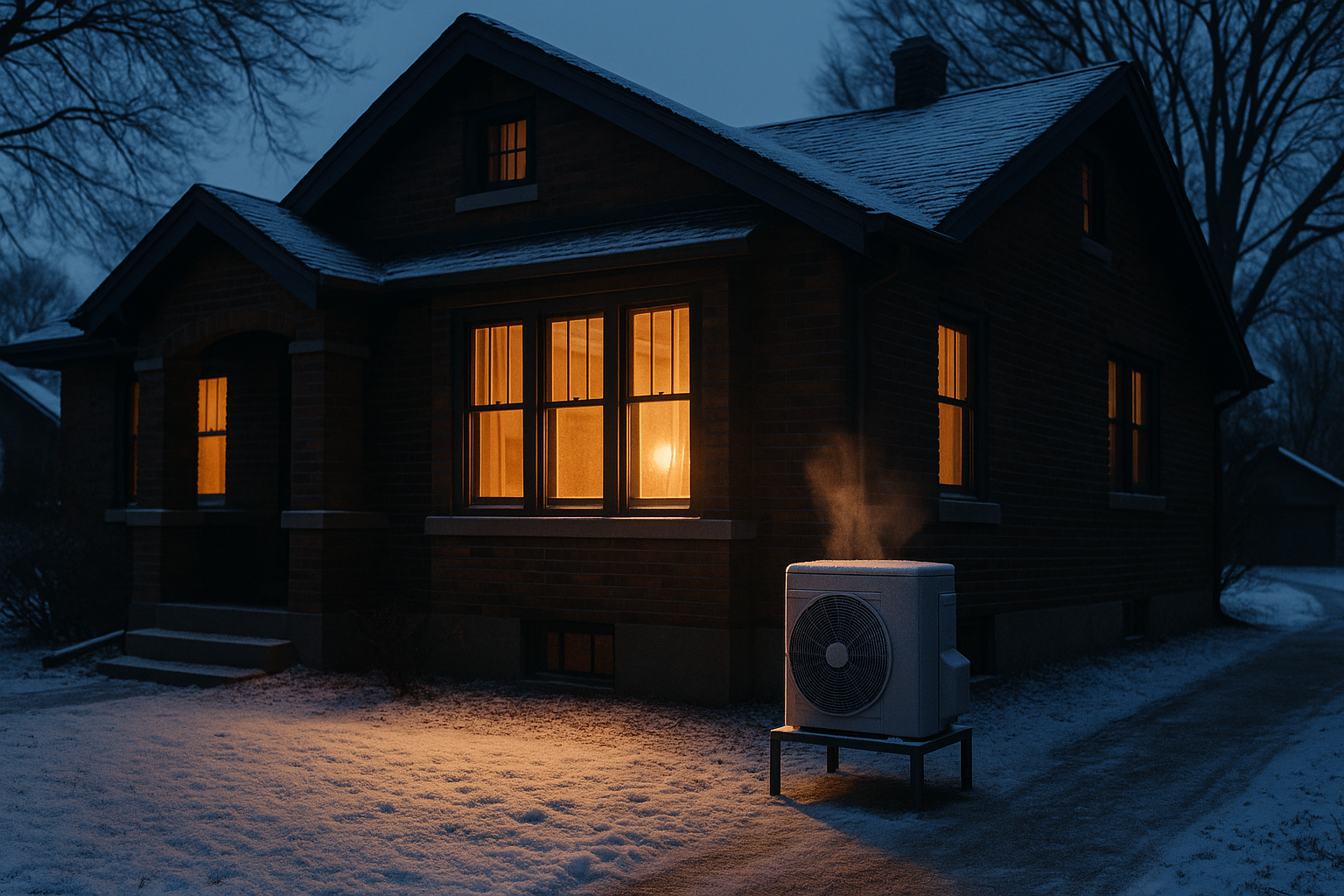
Wisconsin pays for residential efficiency incentives out of one statewide pool rather than out of dozens of separate utility budgets. Under 2005 Wisconsin Act 141, investor-owned utilities contribute 1.2 percent of annual operating revenues into a fund the Public Service Commission of Wisconsin directs, and that fund is what a homeowner meets under the name Focus on Energy.
Roughly 100 Wisconsin utilities participate, including every major investor-owned electric and gas provider plus most municipal utilities and electric cooperatives. The result is that the heat pump rebate available in Green Bay is the same rebate available in Eau Claire, and the qualifying paperwork is identical in both places.
That is a meaningfully different structure from the investor-owned programs covered elsewhere on this site. Each utility in those states writes its own tiers, funds its own budget, and maintains its own contractor roster, which is why ComEd's Illinois heat pump rebates and DTE's Michigan rebate structure read nothing like each other.
Focus on Energy is Wisconsin's single statewide efficiency program, funded by roughly 100 participating utilities under 2005 Wisconsin Act 141. Heat pump rebate tiers and contractor rules are identical statewide.
What Focus On Energy Actually Is
Focus on Energy operates as a ratepayer-funded portfolio administered on the Commission's behalf by a contracted program administrator. That administrator designs the measure list, sets the incentive amounts, and manages the contractor network.
Because the administrator answers to the Commission rather than to a single utility's rate case, the measure list is revised on a program-year cycle instead of whenever a utility files new tariffs. Keep in mind that this makes the calendar predictable and the amounts less so — the catalog can change between the day you collect a quote and the day the equipment is installed.
Your utility bill is still where the money originates. What changes is that the incentive is not administered by the company sending you that bill, so calling your utility's customer service line about a heat pump rebate usually routes you back to Focus on Energy anyway.
Which Wisconsin Utilities Participate
All six of Wisconsin's investor-owned utilities participate as a matter of statute, covering territory served by We Energies, Wisconsin Public Service, Alliant Energy, Madison Gas and Electric, Xcel Energy, and Superior Water, Light and Power. Between them they reach the large majority of Wisconsin households.
Municipal utilities and electric cooperatives participate voluntarily, and most of them do. This is the one place where geography still matters: if your electricity comes from a municipal utility or co-op that has opted out, the statewide rebate is unavailable to you even though a neighbor two miles away qualifies.
Be aware that participation is checked at the account level rather than the address level. Verify your specific electric and natural gas accounts against the participating-utility list before assuming the incentive is in play.
Participation is verified per utility account, not per address. Wisconsin's six investor-owned utilities participate by statute, while municipal utilities and co-ops opt in voluntarily — check electric and gas separately.
What The Program Covers On The Heat Pump Side
The residential measure list has consistently included ducted air-source heat pumps, ductless mini-split systems, ground-source (geothermal) heat pumps, and heat pump water heaters. Envelope work such as insulation and air sealing sits in the same catalog, which matters because the two are usually priced together in a serious retrofit.
Incentive amounts are published per program year rather than fixed in statute, and they have moved in both directions across recent cycles. Treat any dollar figure printed on a contractor's proposal as unverified until you have matched it against the current residential rebate catalog published by the program itself.
Verify before you sign. Rebate amounts are deliberately not quoted on this page, because Focus on Energy revises its residential catalog on a program-year cycle and a stale figure is worse than no figure at all.
Pull the current amount from the program's own rebate catalog in writing, and confirm the exact equipment model appears on the qualifying list on the same day you sign the contract.
There is also an income-qualified track that delivers deeper subsidies to eligible households through a separate application path with its own documentation requirements. If your household income sits near the threshold, resolve that track first — it is generally more generous than the standard rebate and is not always additive to it.
Geothermal And Water Heating
Ground-source heat pumps sit in a different incentive tier than air-source equipment, reflecting both the higher installed cost and the loop-field work. If you are weighing the two, our comparison of air-source versus ground-source heat pumps covers the payback math and the site conditions that make a loop field practical.
Heat pump water heaters are among the cheapest measures in the catalog and the ones most often left on the table. They are also the measure most likely to interact with a panel upgrade you are already planning for space heating, which is worth sequencing together rather than a year apart.
The Trade Ally Requirement Is The Real Difference
The requirement that trips up most Wisconsin homeowners is procedural. A large share of Focus on Energy incentives require the work to be performed by a contractor registered in the program's Trade Ally network.
Registration functions as an administrative credential rather than a quality rating. It confirms that the contractor has agreed to program terms, carries required insurance, and knows how to submit the paperwork that gets a rebate processed.
In practice, a non-registered contractor cannot file the claim on your behalf, and in most cases you cannot file it yourself after the fact. A homeowner who signs with an excellent installer who happens not to be registered has usually forfeited the incentive at the moment of signature.
What Registration Verifies
Trade Ally status confirms a specific and limited set of things, including but not limited to:
- Program agreement. The contractor has signed the participation terms and is authorized to submit rebate applications for a customer.
- Insurance and licensing on file. The program holds current documentation, which functions as a floor rather than a differentiator.
- Paperwork fluency. The contractor has processed claims before and knows which invoice fields and AHRI documentation the administrator requires.
- Category-specific scope. Registration is measure-specific, so a Trade Ally registered for insulation is not automatically registered for HVAC.
All of the above adds up to an administrative credential rather than a technical one. Registration tells you the claim will be filed correctly; it tells you very little about whether the system will be sized correctly.
What Registration Does Not Verify
Trade Ally status does not confirm that a contractor performs a room-by-room ACCA Manual J load calculation, measures duct static pressure, or sets a defensible balance point for backup heat. Those variables determine whether the installed system actually performs in a Wisconsin January.
Ask for the Manual J output as a deliverable rather than as a talking point. Our guidance on cold-climate heat pump sizing and on duct static pressure measurement covers what a defensible calculation looks like, and the heat pump load calculator gives you an independent sanity check before the proposal arrives.
Most Focus on Energy heat pump rebates require a registered Trade Ally contractor to submit the claim. Registration confirms program paperwork and insurance on file, not Manual J sizing or duct testing.
How Qualifying Tiers Work
Focus on Energy qualifies equipment on rated efficiency, and for heat pumps that means SEER2 and HSPF2 thresholds published per program year rather than a fixed brand list. The rating that counts belongs to the matched outdoor-indoor combination, not to the outdoor unit alone.
This is where AHRI certification does the work. The administrator verifies the AHRI reference number for the specific coil-and-condenser pairing, so a high-rated condenser matched to an older existing indoor coil can fall below the qualifying tier even when the box on the pad is the right box.
Cold-climate tiers add a second layer. Programs that recognize cold-climate performance typically look for rated capacity retention at 5°F, which is the metric separating a nominally efficient heat pump from one that will carry load in northern Wisconsin.
Our review of cold-climate heat pump brands walks through which product families publish capacity at 5°F and how to read the extended ratings table. Keep in mind that a model can clear the federal credit's efficiency tier and still miss a state program's cold-climate tier, or the reverse.
Stacking Focus On Energy With Federal Programs
Three funding sources can touch the same Wisconsin heat pump project, and they interact in a fixed order. Getting the order wrong rarely disqualifies you, but it changes the number on the last line.
| Program | Administered by | Form | Interaction rule |
|---|---|---|---|
| Focus on Energy | PSC of Wisconsin, statewide | Post-install rebate | Reduces cost basis before any tax credit is calculated |
| HEAR (federal IRA rebates) | Wisconsin Office of Energy Innovation | Income-tiered, purchase-price reduction | Treated as a price reduction, not as taxable income |
| 25C federal credit | IRS, claimed on your return | Nonrefundable tax credit | Applies to net cost after rebates; availability varies by placed-in-service year |
The mechanic that surprises people is basis reduction. A utility-funded conservation rebate is excluded from gross income under Internal Revenue Code Section 136, and the flip side of that exclusion is that the rebate comes off the expenditure before you calculate a percentage-based credit.
IRA-funded rebates work the same way by design, because the statute treats a HEAR rebate as a reduction in purchase price rather than as income. The federal credit is therefore calculated on what you actually paid out of pocket, not on the sticker price of the system.
HEAR's household caps are set federally: up to $8,000 toward a qualifying heat pump, $1,750 toward a heat pump water heater, $4,000 toward an electrical panel upgrade, and $14,000 across all measures combined. Eligibility runs on area median income, with a full-cost tier below 80% AMI and a 50%-of-cost tier from 80% to 150% AMI.
Wisconsin's federal home energy rebates are administered by the Office of Energy Innovation inside the Public Service Commission, a separate application track from the Focus on Energy catalog even though both sit under the same commission. Our state-by-state HEEHRA guide and the walkthrough on stacking HEEHRA rebates with the 25C credit cover that sequencing in detail.
On the federal credit itself, 25C has historically been worth 30% of qualified cost with a $2,000 annual cap specific to heat pumps, alongside a separate $1,200 cap for envelope measures. Note that for property placed in service after December 31, 2024, the claim requires a manufacturer-issued product identification number, so the model's PIN belongs in your file next to the invoice.
Federal availability is the moving part. Check the current-year position on our federal tax credit status page before building a payback model around it, and remember that the residential solar credit under Section 25D expired on December 31, 2025 — state and utility solar programs continuing does not mean the federal credit continued.
Rebates reduce cost basis before a tax credit is calculated. A Focus on Energy rebate and a federal HEAR rebate both come off the purchase price first, and the credit percentage applies to what you actually paid.
Wisconsin Design Temperatures Change The Sizing Answer
Wisconsin spans a wide design-temperature range for a single-program state. ACCA Manual J procedures use the 99% winter design temperature, which runs near 0°F along the Lake Michigan shore, roughly -6°F to -9°F through Madison and Green Bay, and below -13°F in the northwest and far north.
A rebate tier that is uniform statewide therefore sits on top of a load calculation that is anything but. The same qualifying model can be a whole-home solution in Milwaukee and a shoulder-season machine in Ashland.
This is why the backup heat decision belongs in the proposal rather than on the punch list. Our coverage of heat pump backup heat strategy and balance point controls lays out how to set the switchover point so strip heat behaves as an insurance policy rather than as the primary heat source.
Panel capacity is the other Wisconsin-specific constraint, particularly in Milwaukee and Madison housing stock still running 100-amp services. Read heat pump panel capacity requirements before assuming the electrical work is a line item rather than a project of its own.
Wisconsin's 99% winter design temperature ranges from near 0°F on the lakeshore to below -13°F in the northwest. One statewide rebate tier does not produce one statewide sizing answer.
How And When The Rebate Is Paid
Focus on Energy incentives are generally post-installation rebates rather than instant discounts at the point of sale. The contractor typically submits after the job is complete, and payment is issued to the customer of record on the utility account.
Plan the cash flow accordingly, because you finance or pay the full installed cost and then wait weeks for the rebate to arrive. Processing windows vary by measure and by season, and the fourth quarter is consistently the busiest submission period of the year.
Note that eligibility generally follows the installation date and the catalog in effect at that time, not the date you signed the contract. If a program-year transition falls between contract and install, ask the contractor in writing which catalog will govern the claim.
Steps To Take Before You Sign
The sequence below is ordered to protect the incentive rather than to speed up the purchase. Here's a list of the steps worth taking, in order:
- Confirm utility participation. Check both your electric and natural gas accounts against the participating-utility list, since a co-op or municipal electric account can behave differently from your gas account.
- Screen for the income-qualified track. If your household sits near the AMI thresholds, resolve that path before pricing the standard rebate, because the two tracks are not always additive.
- Verify Trade Ally registration for the right category. Ask for the contractor's registration and confirm it covers HVAC, not only insulation or water heating.
- Get the AHRI reference number in writing. The certificate for the matched indoor-outdoor pairing is what the administrator verifies, and mismatches are the most common source of denied claims.
- Require the Manual J. Ask for the room-by-room output along with the design temperature used, then compare it against an independent estimate before accepting a tonnage.
- Pull the current rebate amount yourself. Save the catalog page on the day you sign so you have documentation of the amount in effect at contract date.
All of these steps exist because the common failure modes here are administrative rather than mechanical. Claims are denied far more often for a mismatched AHRI number or a non-registered installer than for equipment that underperforms in the field.
How Wisconsin Compares To Its Neighbors
Wisconsin's statewide model produces less variance and less depth than the utility-by-utility model next door. Michigan homeowners see materially different offers depending on whether they are served by DTE or Consumers Energy, which is why we cover Consumers Energy heat pump rebates as a separate program entirely.
The tradeoff is worth naming plainly. A statewide program means fewer surprises and one set of rules to learn, and it also means a Wisconsin homeowner has no second utility program to stack on top of the first, which remains a real option in some multi-utility states.
What's more, that structure makes the federal layer proportionally more important in Wisconsin than in states where two utility programs can be combined. Sequencing on our rebate stacking guide is therefore the highest-leverage thing to get right on a Wisconsin project.
Common Questions About Focus On Energy Heat Pump Rebates
These are the questions that surface most often once a Wisconsin homeowner has a proposal in hand:
Do I need a Focus on Energy Trade Ally contractor to get a rebate?
Most Focus on Energy HVAC incentives require a registered Trade Ally to submit the claim on your behalf. Registration is category-specific, so confirm the contractor is registered for HVAC rather than only for insulation or water heating.
A non-registered installer generally cannot file the claim, and self-filing after the fact is usually not an option.
Are municipal utility and electric co-op customers eligible in Wisconsin?
Wisconsin's six investor-owned utilities participate under 2005 Wisconsin Act 141. Municipal utilities and electric cooperatives opt in voluntarily, and while most participate, some do not.
Verify your specific electric and natural gas accounts against the participating-utility list, because the two can be served by different providers with different participation status.
Why do heat pump rebate claims get denied over AHRI numbers?
Qualifying efficiency is rated on the matched indoor-outdoor pairing rather than on the condenser alone. A high-rated outdoor unit paired with an older existing coil can fall below the qualifying tier.
The AHRI reference number on the claim has to correspond to the system as actually installed, which is why it belongs in the proposal before work begins.
What are the federal HEAR rebate caps for a heat pump project?
HEAR caps are federal and uniform across states: up to $8,000 for a qualifying heat pump, $1,750 for a heat pump water heater, $4,000 for an electrical panel upgrade, and $14,000 per household across all measures.
Households below 80% of area median income qualify for the full-cost tier, and households from 80% to 150% AMI qualify at 50% of project cost.
How much does Wisconsin's winter design temperature vary by region?
ACCA Manual J uses the 99% winter design temperature, which runs near 0°F along the Lake Michigan shore, roughly -6°F to -9°F near Madison and Green Bay, and below -13°F in the northwest and far north.
One statewide rebate tier therefore covers loads that differ by well over ten degrees of design temperature, which is why the load calculation cannot be inherited from a neighbor's project.
Where To Go From Here
Wisconsin's single-program structure removes the hardest part of rebate research, which is working out which of a dozen utility offers applies to your address. What it leaves behind is a narrower and more technical job: confirming Trade Ally registration, verifying the AHRI match, and sizing the system against a design temperature that swings more than thirteen degrees across the state.
Work that sequence before committing, and start with an independent load estimate from our heat pump sizing calculator so you can read a contractor's tonnage recommendation with some idea of what the correct answer looks like.
This article is for informational purposes and is not financial, tax, or legal advice. Consult a licensed professional — a CPA or tax advisor, a licensed HVAC contractor, or your state energy office — before acting.