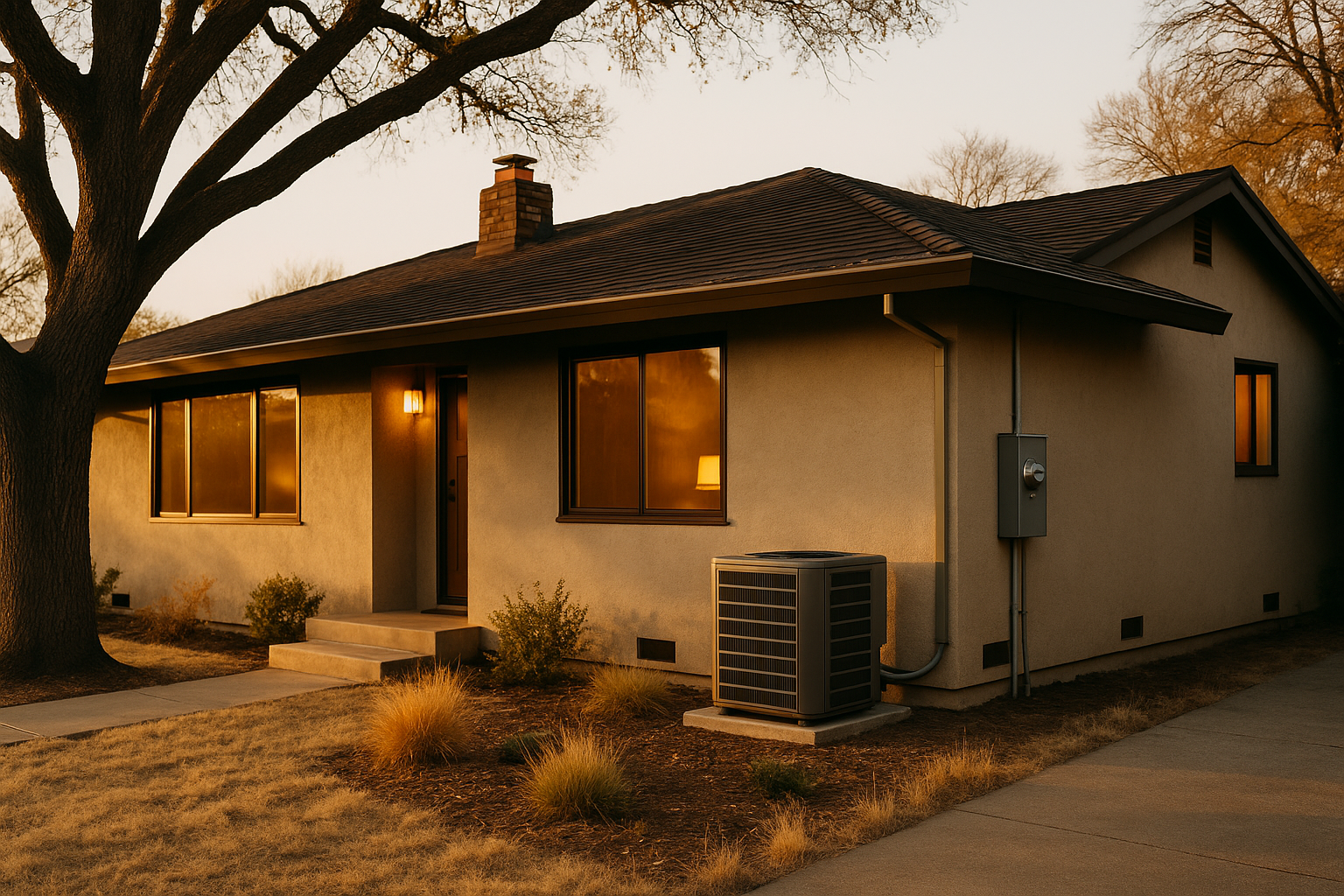
SMUD serves roughly 650,000 customer accounts across about 900 square miles of Sacramento County, which makes it one of the largest community-owned electric utilities in the United States. It is also the reason a Sacramento homeowner researching heat pump incentives keeps landing on guidance written for somebody else's meter.
Most California electrification coverage assumes PG&E, Southern California Edison, or SDG&E, because those three investor-owned utilities carry the majority of the state's residential accounts and run programs approved through the California Public Utilities Commission. SMUD sits outside that structure entirely, and the consequences reach every part of a project — the rebate amount, the qualifying equipment list, the contractor requirement, and the electrical work.
SMUD is a publicly owned utility governed by an elected board, not the CPUC. Its heat pump rebate amounts, equipment lists, and panel adders are set locally, so statewide California guidance often does not apply.
Why A Publicly Owned Utility Sets Different Rebate Rules
SMUD was formed by local voters and is governed by a seven-member board elected by ward, with rates and program budgets adopted in public board meetings. That governance model is the origin of nearly every difference you will notice between a SMUD rebate and an investor-owned utility rebate.
Investor-owned utility programs are shaped inside CPUC proceedings that set budgets, approved measure lists, and cost-effectiveness tests on a multi-year cycle. SMUD's programs are approved on a local budget calendar instead, so terms can be revised, expanded, or paused considerably faster than a CPUC-jurisdictional program can be.
What's more, the funding sources differ in a way that matters at the application stage. Several statewide California incentives — TECH Clean California most notably — are financed by gas ratepayer surcharges authorized under SB 1477, which means eligibility follows the gas corporation serving the address rather than the electric utility.
This is where Sacramento becomes genuinely unusual. SMUD delivers electricity only, while natural gas across most of Sacramento County is delivered by PG&E, so a single household is frequently a SMUD electric customer and a PG&E gas customer at the same time.
Accordingly, gas-ratepayer-funded statewide programs are not automatically off the table just because the electric bill carries a SMUD logo. Be aware that this is exactly the detail a contractor working primarily in one territory tends to get wrong, so confirming eligibility against both accounts is worth the phone call.
Program amounts, tiers, and qualifying equipment lists at a publicly owned utility can change on a board or administrative timeline rather than a regulatory one. Any figure published in an article — including the ranges described here — should be checked against SMUD's current residential rebate catalog and the terms in force on the date your contract is signed.
What SMUD's Residential Electrification Rebates Actually Cover
SMUD's residential incentive catalog is organized around whole-building electrification rather than around single appliance swaps, which is the first structural difference a homeowner runs into. The measures that carry meaningful money include but are not limited to:
- Whole-home gas-to-electric HVAC conversion. The headline measure, and the one with the largest published incentive. It is written as a fuel-substitution measure, which means the incentive is tied to removing gas heating from the home rather than simply installing a more efficient air conditioner.
- Heat pump water heaters. Treated as a separate measure with its own incentive and its own equipment list, typically keyed to Uniform Energy Factor tiers and, on many programs, to grid-connected or CTA-2045 communication capability. The heat pump water heater sizing and selection guide covers the first-hour rating math that decides whether a 50-gallon or 65-gallon unit fits the household.
- Electrical panel and service upgrades. Offered as an adder attached to a qualifying electrification measure rather than as a standalone rebate, which is the single most common reason homeowners leave it on the table.
- Induction cooking and electric dryers. Smaller amounts, but they raise the total when bundled into the same project rather than spread across separate years.
- Smart thermostats and load management. Controls incentives that also feed SMUD's demand response programs, which matter more than usual on a time-of-day rate. Control strategy interacts directly with equipment selection, as the balance point and staging controls breakdown lays out.
- Income-qualified enhanced tiers. A separate track with higher amounts and, in some cases, direct-install delivery rather than reimbursement.
Published amounts for the whole-home HVAC conversion have historically sat in the four-figure range, with the water heater and panel adders stacking on top of it. Treat that as an estimated range and verify the current figure, because a publicly owned utility can revise a program budget mid-year without a regulatory proceeding.
SMUD's largest residential HVAC incentives are fuel-substitution tiers: the gas furnace has to come out and be documented as decommissioned. A heat pump added alongside a working furnace usually earns a smaller rebate.
The Equipment Requirements That Disqualify Ordinary Quotes
A quote can be perfectly good HVAC work and still fail the rebate paperwork, which is the failure mode that costs Sacramento homeowners the most money. The requirements that most often break an otherwise sound project include:
- AHRI matched-system certification. Eligibility is checked against the certified rating for the specific outdoor unit, indoor coil, and air handler combination, not the marketing rating printed on the condenser brochure. A substituted coil is enough to drop a system below tier.
- SEER2 and HSPF2 minimums. The qualifying lists are keyed to the current test procedure, and the higher incentive tiers generally require variable-speed inverter equipment rather than single-stage.
- Participating contractor status. Rebates are typically processed through a contractor registered with SMUD, and registration after the fact does not retroactively qualify completed work.
- Permits and HERS verification. California Title 24 requires third-party HERS rater verification of duct leakage, refrigerant charge, and airflow on altered systems, and the certificate of compliance is part of the rebate file.
- Decommissioning documentation. Fuel-substitution tiers require evidence that the gas furnace was removed and the gas line capped, not merely disconnected.
All of these are verified after installation, when the leverage to fix them is gone. Asking for the AHRI certificate number and the contractor's SMUD registration before signing costs nothing and settles both questions in a single email.
Rebate eligibility is verified against the AHRI certificate for the exact indoor-outdoor combination installed, not the outdoor unit's brochure rating. A mismatched coil can drop a system below the qualifying SEER2 or HSPF2 tier.
The Panel-Upgrade Adder Sacramento Homeowners Miss
Sacramento's housing stock skews heavily toward postwar and 1960s–1970s subdivisions, which means a large share of the county sits on 100-amp services with fully populated panels. The reflexive assumption is that electrification requires a 200-amp upgrade, and that assumption is wrong often enough to be worth testing.
NEC 220.87 permits the load on an existing dwelling to be calculated from measured demand — 125% of the highest 15-minute demand recorded over the previous year — rather than from a nameplate summation. Here SMUD holds a structural advantage over investor-owned territory, because the utility that pays the rebate is also the utility holding the interval data from your meter.
NEC 220.87 allows an existing dwelling's service load to be sized from 125% of the highest 15-minute demand in the past year. SMUD already holds that interval data from your meter.
Where the measured calculation still comes up short, the 2023 NEC recognizes energy management systems under Article 750 that limit total load, along with circuit-splitting devices and meter-socket adapters that add a 240-volt circuit without adding panel spaces. A variable-speed heat pump plus a load-managed water heater frequently fits inside an existing 100-amp service once the arithmetic is done properly.
When the upgrade is genuinely needed, the sequencing matters more than the amount. The adder attaches to an electrification measure, so a homeowner who replaces the panel as a standalone project in the spring and installs the heat pump in the fall has usually separated the two in a way that forfeits the adder.
There is a second, quieter advantage. Because SMUD is both the incentive administrator and the utility performing the service drop and meter work, the panel upgrade moves through one queue instead of being coordinated across a rebate program and an unrelated interconnection department.
Sizing For Climate Zone 12 Changes The Heat Pump Math
Sacramento falls in California Climate Zone 12, with a 99% winter design temperature in the neighborhood of 30°F and a 1% summer design dry bulb close to 100°F. Verify the figures for your nearest weather station, because the difference between Executive Airport and a foothill address is not trivial.
The practical result is that Sacramento is a cooling-dominant load, which inverts the sizing problem most heat pump content is written to solve. Where a cold-climate heat pump sizing exercise wrestles with heating capacity falling off at design temperature, a Manual J for a Sacramento house is driven by the summer peak, and the heating capacity arrives as a byproduct.
Sacramento's load is cooling-dominant, so Manual J sizing is driven by the roughly 100°F summer design day. Heating capacity follows, which is why large resistance backup strips are rarely justified here.
That has a direct financial consequence on the panel question. An oversized resistance backup heat strip drives the branch circuit ampacity, the breaker, and ultimately the service calculation, so specifying 15 kW of strip heat for a climate with a 30°F design temperature can manufacture a panel upgrade that the house never needed.
Keep in mind that the strip is sized for the gap between heat pump output and load at design conditions, not for reassurance. The backup heat sizing walkthrough covers how to calculate that gap, and running the load through the heat pump load calculator before the contractor visit gives you an independent number to compare against the quote.
Rule-of-thumb sizing at 400 to 600 square feet per ton remains common in Sacramento and remains a mistake. Oversized equipment short-cycles, swings comfort, and — on a variable-speed system whose efficiency depends on sustained part-load modulation — gives back much of the performance the rebate tier was paying for.
How SMUD Incentives Line Up Against The Statewide Programs
The most useful way to hold the landscape in mind is by administrator, because that determines both eligibility and the order in which applications are filed. Here is how the major channels compare for a Sacramento address:
| Program | Administered by | Applies in SMUD territory? | What to verify |
|---|---|---|---|
| SMUD residential electrification rebates | SMUD, publicly owned, elected board | Yes — the primary channel | Current catalog amounts, tier requirements, registered contractor list |
| TECH Clean California | Statewide, CPUC gas-ratepayer funded under SB 1477 | Tied to the gas account, which in Sacramento is PG&E | Whether a midstream discount is already embedded in the quote |
| HEEHRA / Home Electrification and Appliance Rebates | California Energy Commission | Income-qualified, rollout varies by administrator | Income tier, approved measure list, current availability |
| Equitable Building Decarbonization direct install | California Energy Commission | Income-qualified, no-cost direct install where offered | Whether Sacramento County is in the active service area |
| Federal 25C efficiency credit | IRS | Status has shifted — confirm before assuming | Placed-in-service date rules and current statutory status |
The stacking rules are where projects most often go sideways. Federal HEEHRA dollars generally cannot be combined with other federal funds for the same measure, while utility and state incentives usually stack with each other up to the total project cost — a distinction worked through in detail in the HEEHRA and 25C stacking guide and the 25C versus HEEHRA decision tree.
Utility and state incentives generally stack with each other up to the project cost, while federal HEEHRA dollars cannot be combined with other federal funds for the same measure. Confirm the order of application.
Note that the federal picture has moved recently enough that a cached article is a poor source, and the residential solar investment tax credit expired on December 31, 2025 regardless of what a solar quote may still claim. The federal tax credit status page tracks what remains available, and the rebate stacking guide covers how the layers combine once you know which ones apply.
For readers comparing across territories, the structural pattern here is not unique to Sacramento so much as unusually pronounced. Utility-run programs elsewhere show the same administrator-driven variation, as the ComEd rebate breakdown and the Eversource program guide illustrate from very different regulatory starting points.
The Rate Schedule Does More Work Than The Rebate
A rebate is collected once; the rate applies for every hour of the equipment's 15-to-20-year life. On that basis, SMUD's rate structure is arguably the larger factor in a Sacramento electrification decision.
SMUD's published residential rates have run substantially below PG&E's for years, and the gap is wide enough to change whether a gas-to-heat-pump conversion reduces or raises an annual energy bill. Compare the current schedules directly rather than relying on a statewide average, since California's spread between utilities is unusually large.
The default residential rate is time-of-day, with the peak window running weekday afternoons into the early evening and pricing highest in the summer months. That structure rewards equipment and controls capable of shifting load, which is why the thermostat and modulation questions carry real money in Sacramento rather than being a comfort preference.
A variable-speed system that pre-cools through the shoulder hours and coasts through the peak window behaves very differently on the bill than a single-stage unit that runs flat out at 6 p.m. This is one of the few places where a higher rebate tier and a lower operating cost point at the same equipment choice.
What To Confirm Before Signing A Sacramento Heat Pump Quote
Most of the value in a SMUD project is captured or lost before any equipment is ordered. Here is a list of the items worth settling in writing first:
- Your utility of record. Not every Sacramento-area address is SMUD — Roseville Electric and other neighboring providers serve portions of the region, and PG&E serves parts of Placer and Yolo counties.
- The current rebate catalog. Pull the live program terms rather than a contractor's printed sheet, and note the effective dates.
- A Manual J, not a rule of thumb. Request the actual load calculation with the design temperatures used, and compare the tonnage against an independent estimate.
- The AHRI certificate number. For the exact matched system being installed, checked against the qualifying equipment list before the order is placed.
- A 220.87 load calculation on the existing service. Before accepting a panel upgrade as a given, particularly on a 100-amp service in a mid-century home.
- Contractor registration status. Confirmed with SMUD directly rather than taken on assurance.
- Decommissioning and permit documentation. Including HERS certificates, since the fuel-substitution tier depends on them.
Working through that list turns a rebate application from a post-installation scramble into a set of decisions made while you still hold leverage. It also surfaces the panel-adder sequencing question early, which is the difference that most often separates a good Sacramento project from an expensive one.
Frequently Asked Questions
The questions below come up most often from homeowners comparing SMUD's program against the statewide California guidance they found first.
Is SMUD regulated by the California Public Utilities Commission?
No. SMUD is a publicly owned utility governed by a seven-member board elected by ward, so its rates and rebate programs are adopted locally rather than through the CPUC proceedings that shape PG&E, Southern California Edison, and SDG&E programs.
Can a SMUD customer access TECH Clean California incentives?
TECH Clean California is funded by CPUC-jurisdictional gas ratepayer surcharges under SB 1477, so eligibility tracks the gas corporation serving the address. Natural gas in most of Sacramento County is delivered by PG&E, which is why confirming with both utilities is worthwhile.
Does installing a heat pump require a 200-amp panel upgrade?
Frequently not. NEC 220.87 allows an existing dwelling's load to be calculated from 125% of the highest 15-minute demand over the prior year, and Article 750 energy management systems can hold the calculated load inside an existing service.
Why does the gas furnace have to be removed for the largest rebate?
The top SMUD HVAC tier is written as a fuel-substitution measure, so the incentive is tied to eliminating gas heating rather than to installing efficient cooling. Dual-fuel setups that retain a working furnace generally fall to a lower tier.
How should a Sacramento heat pump be sized?
Through an ACCA Manual J using Climate Zone 12 design conditions — roughly 30°F in winter and near 100°F in summer — followed by Manual S equipment selection. The cooling load governs, and backup heat strips should be sized to the design-day gap rather than by habit.
Where To Go From Here With A Sacramento Project
Sacramento homeowners have a genuinely favorable set of conditions: a local utility with its own incentive budget, low electric rates relative to the rest of California, a mild winter design temperature, and a single entity handling both the rebate and the service upgrade. The complication is that almost none of the California electrification content in general circulation is written for that combination.
If you are early in the process, running the load through the heat pump sizing calculator before soliciting quotes gives you a number to check the contractor against. If the question is which incentive layers apply and in what order, the rebate stacking guide and the HEEHRA program guide map the state and federal side that sits on top of the SMUD rebate.
This article is for informational purposes and is not financial, tax, legal, or medical advice. Consult a licensed professional — a CPA, a licensed HVAC contractor, or SMUD's residential program staff — and verify all current program terms and amounts before acting.