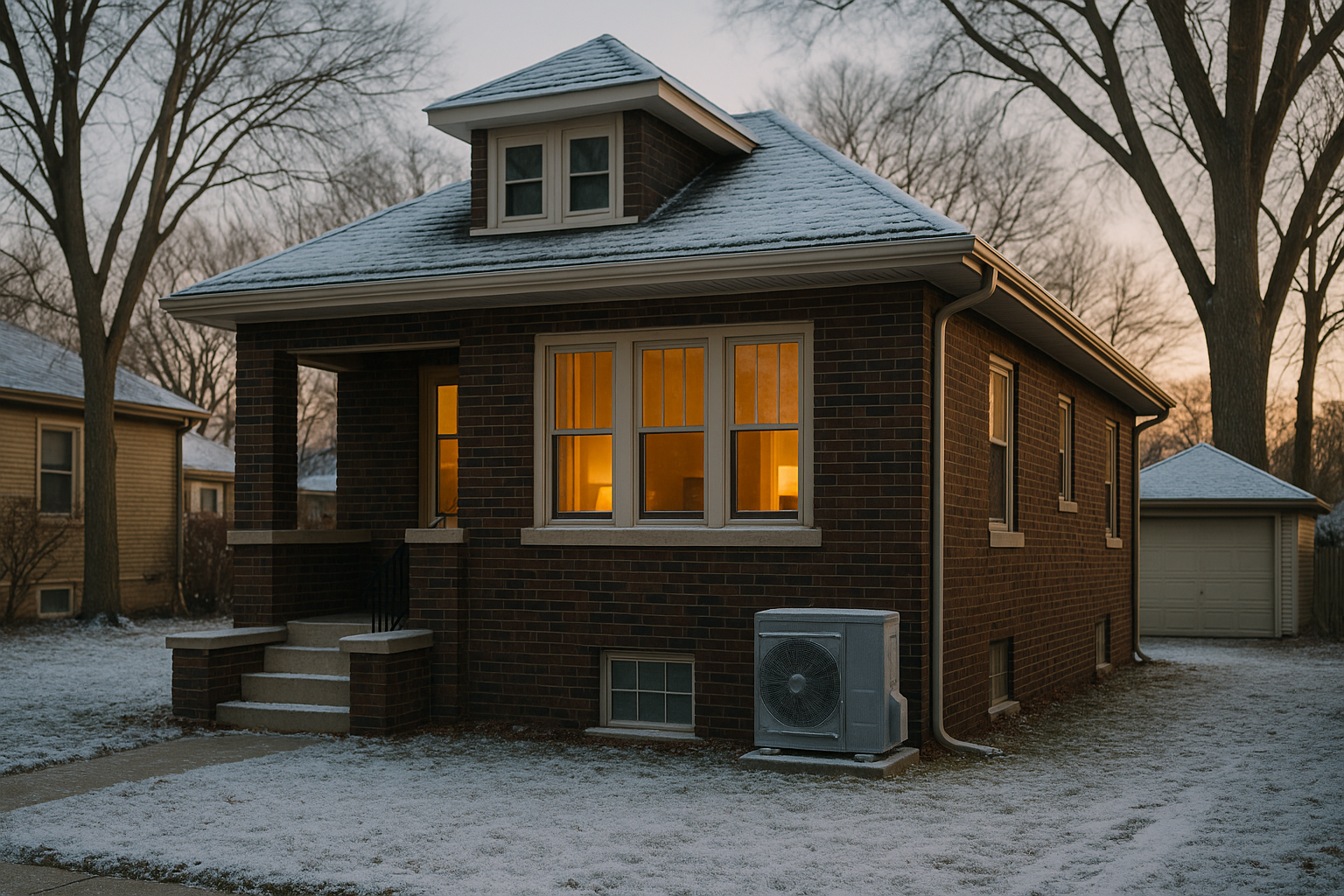
You probably picture heat-pump incentives as a two-layer stack — the federal 25C tax credit on top, a HEEHRA point-of-sale rebate underneath. However, in ComEd's northern Illinois territory there is a third layer that most homeowners never claim, and it is paid by the utility itself.
ComEd's energy-efficiency rebates sit alongside anything Washington or Springfield administers, not inside them. They are funded through Illinois ratepayer dollars under the state's clean-energy law, and they follow their own rules for what qualifies and how you collect.
ComEd pays heat-pump rebates separately from HEEHRA and the federal 25C credit. Its energy-efficiency program — funded under Illinois's CEJA law and delivered through participating contractors — issues per-system incentives tied to SEER2 and HSPF2 efficiency tiers. Because it is a utility subsidy, it stacks with HEEHRA but reduces your 25C cost basis.
Where ComEd's Rebates Come From
ComEd does not fund these rebates out of goodwill — it runs them because Illinois law requires it. The Future Energy Jobs Act of 2016 and the Climate and Equitable Jobs Act (CEJA) of 2021 mandate that ComEd hit aggressive energy-savings targets, with the multi-year program plans approved by the Illinois Commerce Commission.
That funding source matters for a practical reason. Because the money is collected from ratepayers and administered by a regulated utility — not appropriated by Congress — a ComEd rebate is legally a utility subsidy, which is exactly why it stacks differently than HEEHRA does.
The program is delivered largely through participating contractors. In most cases the installer verifies eligibility, applies the discount, and submits the paperwork — so your choice of contractor determines whether the rebate ever reaches you.
What ComEd Actually Pays For
ComEd's heating-and-cooling rebates cover the three heat-pump categories that matter to a retrofitting homeowner. These are ducted (central) air-source heat pumps, ductless mini-split heat pumps, and heat-pump water heaters.
Each category is tied to an efficiency tier rather than a single flat amount. A higher-SEER2, higher-HSPF2 system earns a larger rebate, and income-eligible customers qualify for materially higher incentives through ComEd's income-eligible pathway.
ComEd's heat-pump rebates are structured by efficiency tier and equipment type, not a single flat number. Recent program years have grouped incentives into ducted air-source, ductless mini-split, and heat-pump water-heater categories, with income-eligible customers qualifying for larger rebates. Always confirm current-year per-unit amounts on ComEd's Energy Efficiency Program page before budgeting.
The table below illustrates how ComEd structures its schedule — it is a map of the categories and tiers, not a current price list. Per-unit dollar amounts shift every program year, so confirm the live figures on ComEd's Energy Efficiency Program page before you size a budget around them.
| Equipment type | Efficiency basis | Rebate structure | Notes |
|---|---|---|---|
| Ducted (central) air-source heat pump | SEER2 / HSPF2 tiered | Per qualifying system, scaling with the efficiency tier | Income-eligible track pays significantly more |
| Ductless mini-split heat pump | HSPF2 tiered, AHRI-matched | Per outdoor unit or per system | Multi-zone systems may rebate per head |
| Heat-pump water heater | ENERGY STAR / UEF | Flat per-unit rebate | Claimable independently of space heating |
Note that the income-eligible track is the one most often left on the table. Households that qualify can see rebates several times larger than the standard residential amount, and that pathway frequently pairs with HEEHRA's own income tiers.
How ComEd Stacks With HEEHRA and 25C
Yes — a ComEd rebate can stack with both Illinois HEEHRA and the 25C tax credit on the same heat pump. The conflict is not eligibility but accounting: utility rebates reduce the cost basis used to calculate your 25C credit, so the same dollar cannot be subsidized twice across both programs.
Start with the good news — these three programs are designed to coexist on a single project. HEEHRA is a state-administered, point-of-sale rebate funded by the Inflation Reduction Act; the 25C credit is a federal income-tax credit; ComEd's rebate is a utility subsidy. Three different funding sources, three different mechanisms.
The general rule is that HEEHRA cannot be combined with another federally funded rebate for the same cost, but it can be combined with state and utility programs like ComEd's. For the full sequencing logic, see our guide to rebate stacking and application order.
Illinois's HEEHRA rollout has its own timeline and income brackets, which we break down separately. Read our Illinois HEEHRA rebate guide to confirm where your household lands before you assume both programs apply.
The Double-Dip Trap — Where the Conflict Actually Lives
The double-dip trap is the 25C basis reduction. Under IRC §136, a utility energy-conservation subsidy like ComEd's rebate is subtracted from your equipment cost before you compute the federal credit. Claiming 25C on the gross, pre-rebate price overstates the credit and invites an IRS adjustment.
The conflict between ComEd and 25C is not about whether you qualify for both — you do. It is about which dollar figure you run the federal credit against.
Here is the part contractors rarely explain correctly. The conflict between ComEd and 25C is not eligibility — you can claim both — it is the accounting that follows.
Under Internal Revenue Code §136, an energy-conservation subsidy provided by a public utility is excluded from your gross income. The trade-off is that the subsidized dollars are subtracted from your equipment cost before you calculate the 25C credit.
In plain terms: if a heat pump costs $8,000 and ComEd pays a $500 rebate (an illustrative example, not a quoted ComEd amount), your 25C credit is computed on $7,500 — not the full $8,000. Claiming the credit on the gross, pre-rebate price overstates it and risks a correction.
The same basis-reduction logic applies to HEEHRA dollars used toward the same cost. This is the single most common stacking error we see, and it is why application order and clean documentation matter so much.
One more timing wrinkle deserves a flag. The 25C credit's availability changed in 2025, and your install date determines whether it applies at all — read what happened to 25C in July 2025 before you assume the federal layer is still on the table.
Efficiency Requirements — What Qualifies
ComEd ties rebates to AHRI-certified SEER2 and HSPF2 thresholds, not the marketing number on the box. The system must appear on an AHRI certificate matching the exact indoor and outdoor units installed and clear ComEd's published tier. A mismatched pairing can fall below the rated efficiency and disqualify the rebate.
ComEd ties its rebates to AHRI-certified performance, not the headline figure on the equipment carton. The system must appear on an AHRI certificate matching the specific indoor and outdoor units installed, and it must clear ComEd's published SEER2 and HSPF2 thresholds for the tier you are claiming.
This is where contractor skepticism pays off. A nominally high-efficiency outdoor unit paired with the wrong air handler can fall below the rated SEER2 once AHRI-matched — disqualifying a rebate the contractor may have already promised you.
For cold-climate performance specifically, the HSPF2 rating and the system's rated capacity at low outdoor temperatures matter more than the SEER2 cooling number. ComEd territory sees sub-zero design temperatures, so size and select for the heating load — our cold-climate heat pump sizing guide walks through the math.
Heat-Pump Water Heaters — A Separate, Easy Win
ComEd's heat-pump water-heater rebate is a distinct incentive from the space-heating rebates, and it is one of the simplest to claim. A qualifying ENERGY STAR heat-pump water heater can earn a rebate on its own, independent of whether you install a space-heating heat pump.
If you are electrifying in phases, this is often the lowest-friction first step. See our breakdown of heat-pump water heaters for sizing, first-hour-rating, and placement considerations before you buy.
How to Claim a ComEd Heat-Pump Rebate
Claim a ComEd heat-pump rebate through a participating contractor in most cases. The installer verifies the AHRI-matched system meets ComEd's SEER2 and HSPF2 thresholds, then submits the rebate — often as an instant invoice discount or a post-install online application. Keep the AHRI certificate and the itemized invoice.
The cleanest path is to confirm participation before signing anything. Ask whether the contractor is enrolled in ComEd's Energy Efficiency Program, and whether the rebate will arrive as an instant invoice discount or a post-install online submission.
Then protect your paper trail. Keep the AHRI certificate, the itemized invoice showing equipment model numbers, and any rebate confirmation — these are the same documents your tax preparer needs to compute a correct, basis-reduced 25C credit.
Here is a list of the steps to keep the three layers from colliding:
- Verify the AHRI match first. Confirm the exact indoor and outdoor combination clears ComEd's SEER2 and HSPF2 tier before installation, not after.
- Apply the utility rebate at the point of sale. Let ComEd's subsidy reduce the documented equipment cost on the invoice itself.
- Layer HEEHRA per Illinois rules. Confirm income eligibility and that HEEHRA is not covering the same cost as another federal rebate.
- Compute 25C on the net basis. Subtract utility and rebate dollars before applying the federal percentage to the remaining cost.
Done in that order, ComEd, HEEHRA, and 25C reinforce each other instead of triggering a clawback. Out of order, the most common casualty is an overstated tax credit you later have to repay.
Putting the Three Layers Together
For a northern-Illinois homeowner, the decision rule is straightforward. Treat ComEd's rebate as the foundation you collect at purchase, HEEHRA as the income-qualified layer on top, and 25C as the year-end credit computed on whatever cost remains after both.
The sequencing — not the eligibility — is what separates a clean three-layer stack from an IRS correction letter. If you map ComEd's rebate against the full rebate stacking guide, you capture every available dollar without double-counting any of them.
Frequently Asked Questions
Does ComEd offer heat pump rebates in 2026?
ComEd runs ongoing energy-efficiency heat-pump rebates mandated under Illinois's CEJA law and approved in multi-year plans by the Illinois Commerce Commission. The categories — ducted air-source, ductless mini-split, and heat-pump water heaters — persist year to year, but per-unit dollar amounts and efficiency tiers are reset each program year. Confirm the current-year schedule on ComEd's Energy Efficiency Program page before budgeting.
Can I combine a ComEd rebate with Illinois HEEHRA?
Yes. ComEd's rebate is a utility subsidy and HEEHRA is a state-administered, IRA-funded rebate, so they come from different sources and can apply to the same heat pump. The restriction is that HEEHRA cannot be combined with another federally funded rebate for the same cost — utility programs like ComEd's are explicitly allowed. Confirm your Illinois HEEHRA income tier before assuming both apply.
Does a ComEd rebate reduce my 25C federal tax credit?
Yes — indirectly. Under IRC §136, a public-utility energy-conservation subsidy is excluded from income and subtracted from your equipment cost before you compute the 25C credit. If ComEd pays $500 toward an $8,000 heat pump, your 25C credit is calculated on $7,500. Claiming the credit on the gross price overstates it and risks an IRS adjustment.
What efficiency does a heat pump need for a ComEd rebate?
ComEd ties rebates to AHRI-certified SEER2 and HSPF2 thresholds, with higher tiers earning larger incentives. The system must appear on an AHRI certificate that matches the exact indoor and outdoor units installed — a mismatched pairing can fall below the rated efficiency and disqualify the rebate. For cold northern-Illinois winters, weight HSPF2 and low-temperature capacity over the SEER2 cooling number.
Is the ComEd heat pump water heater rebate separate?
Yes. ComEd's heat-pump water-heater rebate is a distinct incentive from its space-heating rebates and can be claimed on its own. A qualifying ENERGY STAR heat-pump water heater earns its rebate whether or not you also install a space-heating heat pump, which makes it a low-friction first step for phased electrification.
ComEd's rebate is the layer most northern-Illinois homeowners leave unclaimed — and the one that quietly reshapes your federal credit. Map it against the full stacking sequence, document every dollar, and the three programs pay you the most they legally can.
This article is for informational purposes and is not financial, tax, legal, or medical advice. Confirm current rebate amounts with ComEd and consult a licensed professional — a CPA, tax preparer, or qualified HVAC contractor — before acting.