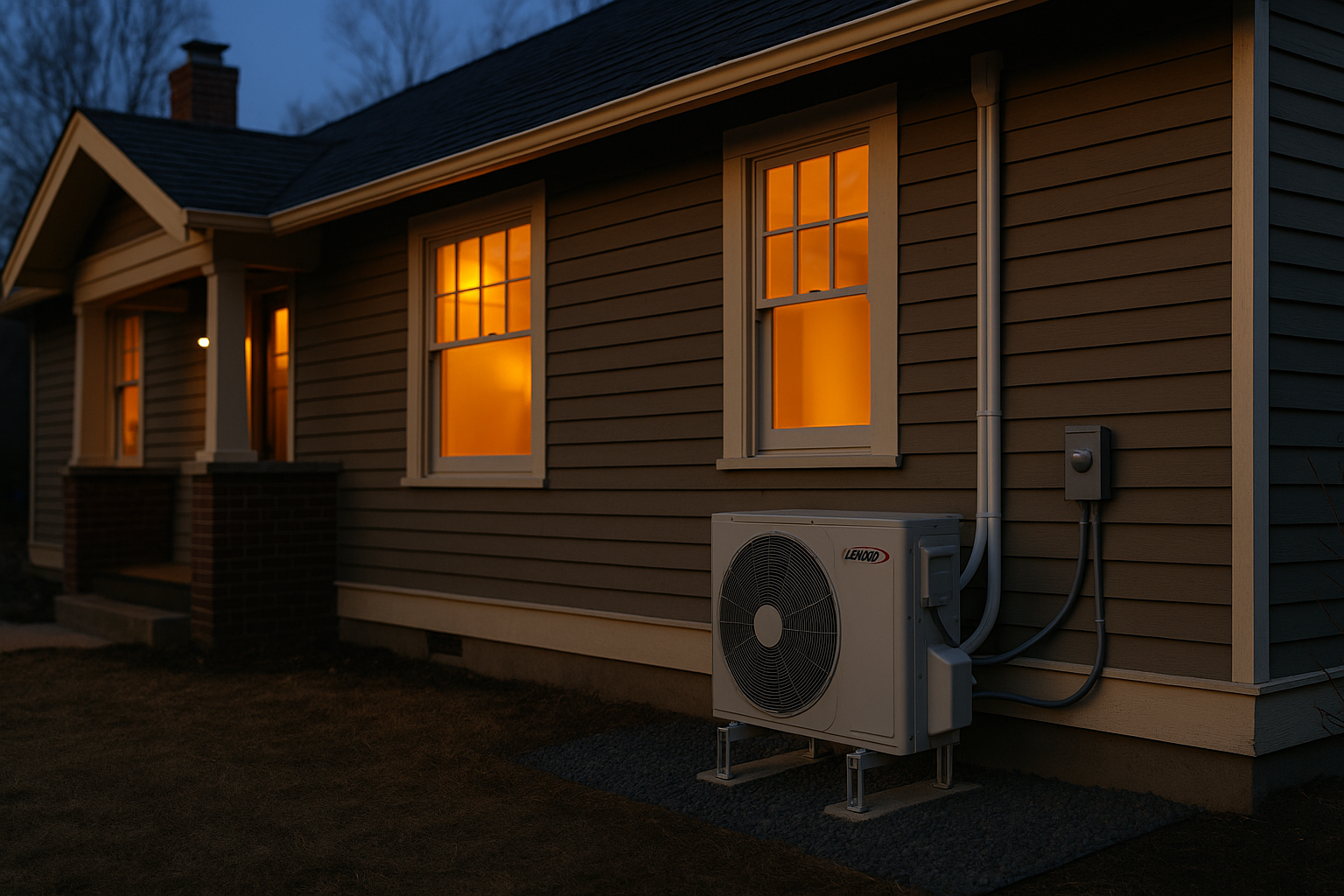
Homeowners collecting bids on a ductless system in 2026 routinely see the same house priced across a spread of several thousand dollars, and very little of that spread is explained by the equipment printed on the quote. Most of it lives in three line items that rarely get a row of their own: how many indoor heads the crew has to hang, how much refrigerant line and control wire has to reach them, and whether the electrical panel has room for the outdoor unit.
What follows is a line-item breakdown of what a mini-split installation is actually made of — equipment, per-head labor, line set, condensate, and electrical — followed by what the number looks like after the rebate stack that is genuinely available this year. Every dollar figure below is an estimated planning range built from typical bid structures rather than a quote, and the only numbers that govern your project are the three local bids you put side by side.
How much does a mini-split cost to install in 2026?
A single-zone mini-split typically installs for $4,000 to $7,500, and each additional indoor head adds roughly $1,500 to $3,000. Line-set length and electrical work drive more bid-to-bid variance than equipment brand does.
What A Mini-Split Bid Is Actually Made Of
A ductless quote is a bundle of six cost centers, and contractors weight them differently depending on how they price labor and how much of the work their own crew self-performs. Reading a bid well means knowing which bucket a given dollar belongs to, because only some of those buckets are negotiable and only some of them draw from a separate rebate line.
The categories that appear on essentially every ductless project include but are not limited to:
- Equipment. The outdoor condensing unit, the indoor heads or cassettes, and any branch box or distribution box on a multi-zone system. This is the portion your AHRI certificate covers and the portion most rebate programs measure efficiency against.
- Per-head labor. Mounting the wall bracket, coring the exterior wall, hanging and leveling the head, and commissioning it. Each head is its own small project regardless of how many share a condenser.
- Line set and penetrations. Refrigerant tubing, insulation, low-voltage interconnect cable, line-hide covering, wall sleeves, and flashing at every pass-through.
- Condensate management. A gravity drain where geometry allows, a condensate pump where it does not, plus tubing, traps, and terminations.
- Electrical. A dedicated 240V circuit, a disconnect at the condenser, the whip, and any panel work required to make room for that circuit.
- Permits, commissioning, and documentation. Mechanical and electrical permits, evacuation and charge verification, and the AHRI certificate and itemized invoice your rebate application will ask for.
All of these add up to one installed number, but rebate programs do not treat them as one number. HEEHRA in particular carries a distinct electrical panel line separate from its heat pump line, which means the way your contractor itemizes the invoice can change how much of the project a program is willing to cover.
Single-Zone Pricing: The Cleanest Number In The Category
A single-zone system — one outdoor condenser, one indoor head — is the most consistently priced configuration in ductless, because the scope barely varies from house to house. Typical installed bids for a 9,000 to 18,000 BTU/hr wall-mounted single zone land somewhere between roughly $4,000 and $7,500.
The low end of that band reflects a short line set on an accessible exterior wall with a spare 240V breaker already in the panel. The high end reflects a cold-climate inverter unit, a long or concealed line run, and new circuit work back to a panel that needed rearranging.
Head style moves the number as much as capacity does. Ceiling cassettes and low-static ducted air handlers commonly price several hundred to well over a thousand dollars above a wall-mounted head, because they require ceiling framing, a plenum, or a short duct run.
Floor-mounted consoles usually sit between the two, and they are worth pricing in older homes where usable wall space above furniture is scarce. Keep in mind that the efficiency tier is its own premium: a cold-climate model engineered to hold rated capacity down near 5°F carries a meaningful equipment cost over a baseline unit, and that premium is frequently what qualifies the project for the top rebate tier in the first place.
What Each Additional Head Actually Costs
How much does each additional mini-split head cost?
Each added indoor head runs roughly $1,500 to $3,000 installed. Equipment cost per head falls as zones increase, but line set, wall penetration, condensate routing, and commissioning labor stay close to constant per head.
This is where per-head arithmetic misleads people. The marginal head is cheaper than the average head, because the second through fifth zones share one condenser, one refrigerant circuit, and one electrical feed — yet the labor attached to each head barely moves.
The ranges below are illustrative planning bands for a wall-mounted configuration, not quotes, and they assume no panel upgrade is required:
| Configuration | Typical installed range | Implied cost per head | What moves the number |
|---|---|---|---|
| Single zone | $4,000 – $7,500 | $4,000 – $7,500 | Line-set length, spare breaker, cold-climate tier |
| Two zone | $7,000 – $12,000 | $3,500 – $6,000 | Branch box, second penetration, second condensate path |
| Three zone | $10,000 – $16,500 | $3,300 – $5,500 | Long runs to remote rooms, line-hide on multiple elevations |
| Four to five zone | $14,000 – $25,000 | $3,000 – $5,000 | Panel capacity, condenser siting, part-load turndown limits |
The practical takeaway is that zone count is the single largest lever on your total, and it is the lever most often set by habit rather than by load. Rooms that are already comfortable, rarely occupied, or thermally coupled to an adjacent zone frequently do not need their own head, and our per-zone mini-split sizing guide walks through how to test that room by room before you commit to a fifth port.
Why Multi-Zone Pricing Does Not Scale Linearly
A multi-zone condenser is a different machine from a single-zone condenser, and the difference shows up in both the invoice and the utility bill. Multi-port outdoor units route refrigerant through a branch box or built-in distribution manifold with electronic expansion valves metering each circuit, which adds hardware, adds commissioning time, and adds one more component that can fail.
The efficiency consequence matters more than most bids acknowledge. Multi-zone systems generally carry lower SEER2 and HSPF2 ratings than their single-zone equivalents, because the outdoor compressor cannot modulate below a certain minimum output, and when only one small head is calling, that minimum can exceed the load.
The result is short-cycling at part load — the condition where a system that looks correctly sized on paper runs in inefficient bursts through the shoulder seasons. That said, multi-zone is usually still the cheaper install, because one condenser, one pad, one disconnect, and one circuit serve the whole house.
The honest comparison is capital cost against operating cost, and it turns on how many zones will actually run simultaneously. Note that AHRI certifies multi-zone performance for a specific combination of outdoor unit and indoor heads, so a rating you found online is meaningless unless it matches the exact combination on your quote — a detail that matters because rebate programs verify against that certificate, not against the brochure.
Line-Set Length Is Its Own Line Item
Does line-set length change the price of a mini-split?
Yes. Most manufacturers factory-charge the condenser for roughly 25 feet of line set, so longer runs add pipe, insulation, cover, and a measured refrigerant top-off — commonly $8 to $20 per additional foot installed.
Line set is the quiet variable that separates two otherwise identical bids on the same house. Manufacturers ship the outdoor unit pre-charged for a nominal length — often about 25 feet, though the figure ranges from roughly 15 to 50 feet depending on the product line — and every foot beyond that requires additional refrigerant calculated from the manufacturer's own table.
That top-off is typically a fraction of an ounce per additional foot, which sounds trivial until it is multiplied across four heads on a three-story house. What is not trivial is the labor: brazed copper with a nitrogen purge, flare connections torqued to spec, insulation continuous through every penetration, and an evacuation deep enough to pull residual moisture out of the circuit.
Two physical limits are worth confirming before you sign. Manufacturers publish a maximum equivalent line length and a maximum vertical separation between the condenser and each head, and capacity derates measurably as you approach those ceilings.
A condenser placed on the far side of the house because it looked tidier can cost you both dollars and delivered BTU/hr. Line-hide covering is the last variable, running a few dollars per linear foot in material but considerably more in labor when it has to track a painted brick elevation cleanly.
Condensate Handling: Gravity Drain Or Pump
Every indoor head produces condensate in cooling mode, and the cheapest outcome is a gravity drain that exits through the same wall penetration as the line set. When the head sits below grade, above a finished ceiling, or on an interior wall with no downhill path, the crew installs a condensate pump instead.
A pump adds hardware, a small power feed, and a discharge line that has to terminate somewhere legal. Budget a few hundred dollars per pumped head, and be aware that condensate pumps are among the more common service calls on ductless systems, which is a maintenance cost rather than an installation cost but belongs in the same decision.
Head placement therefore has a price tag attached, not just a comfort consequence. A head positioned two feet along the same wall can convert a pumped drain into a gravity drain and remove a failure point permanently.
The Electrical Add-Ons That Move A Bid The Most
Do I need an electrical panel upgrade for a mini-split?
Not always. A single-zone condenser generally needs one dedicated 240V circuit at 15A to 30A, and a NEC 220.83 or 220.87 load calculation often finds existing capacity. When it does not, panel upgrades typically add $2,000 to $4,500.
Circuit, Disconnect, And Whip
Every outdoor unit needs a dedicated 240V branch circuit sized to the nameplate maximum overcurrent protection, plus a disconnecting means within sight of the equipment and a short liquid-tight whip from disconnect to unit. On a straightforward run of thirty or forty feet from an accessible panel, that package commonly lands somewhere in the $600 to $1,500 range.
Indoor heads on most ductless systems are powered from the outdoor unit through the interconnect cable rather than from their own circuits, which is one of the reasons a multi-zone system is electrically cheaper than several single-zone systems. Confirm this on your specific model, because a handful of product lines power the indoor units separately.
When A Panel Upgrade Is Genuinely Required
This is the line item that turns a $9,000 bid into a $13,000 bid, and it is also the one most often asserted without evidence. A contractor should be demonstrating panel capacity with a written load calculation under NEC 220.83 for an existing dwelling, or under NEC 220.87 using twelve months of metered maximum demand data, rather than counting empty breaker slots.
The 220.87 method is worth asking for by name, because it uses what your house actually draws instead of a summed nameplate worst case, and it frequently shows headroom that the standard method does not. Where capacity is genuinely short, a service upgrade from 100A to 200A typically runs $2,000 to $4,500 and can climb well past that when the utility has to replace the service drop, relocate the meter, or trench a new lateral.
Before accepting that number, ask about the middle path. Meter-collar adapters, feeder tap boxes, and listed circuit-sharing or load-management devices can add a heat pump circuit to an existing 100A service for a fraction of a full upgrade, and they are accepted in a growing number of jurisdictions.
Be aware that any of these depends on local authority-having-jurisdiction acceptance and on the specific product being listed for the application. It is a question worth putting to every bidder rather than a decision to make on your own.
Sizing Drives Your Bill More Than Brand Does
The most expensive mistake in ductless is not choosing the wrong manufacturer; it is buying capacity the house never asked for. A room-by-room ACCA Manual J load calculation is the only defensible basis for zone count and per-head capacity, and the square-footage rules of thumb still in wide circulation routinely oversize ductless systems by thirty to fifty percent.
Oversizing costs you twice. You pay for tonnage and heads you did not need at purchase, and then you pay again in comfort and efficiency, because an oversized inverter cannot modulate down far enough to run the long, low-output cycles that make ductless efficient in the first place.
If you are in a climate where design temperature is well below freezing, the sizing conversation also has to cover low-temperature capacity and defrost behavior rather than nominal tonnage alone. Our cold-climate heat pump sizing breakdown covers how capacity tables derate at design conditions, and the heat pump load calculator will get you to a defensible whole-house number before the first contractor walks the house.
It is also worth settling the architecture question before pricing heads at all. If your home already has serviceable ductwork, our mini-split versus central heat pump comparison lays out where a ducted system wins on both installed cost and rebate eligibility.
What You Actually Pay After Rebates In 2026
Federal status, stated plainly: the 25C air-source heat pump credit was repealed by the One Big Beautiful Bill Act signed July 4, 2025, and provides zero benefit for equipment placed in service on or after January 1, 2026. The residential solar Investment Tax Credit expired December 31, 2025. Guides that still show a 30% federal credit on a mini-split are describing the 2025 rules — see what happened to 25C in July 2025 and the current federal tax credit status page.
What is the net cost of a mini-split after rebates in 2026?
HEEHRA covers up to $8,000 of a qualifying heat pump — 100% of project cost under 80% AMI, 50% from 80% to 150% AMI. With utility rebates layered on, net cost on a three-zone system commonly falls to $4,500 to $6,000.
The HEEHRA Layer
HEEHRA, created by Section 50122 of the Inflation Reduction Act, is now the primary federal-tier benefit on a ductless project and it works as a point-of-sale or post-installation rebate rather than a tax credit. That distinction matters practically: no federal tax liability is required, so retirees, low-income households, and filers who owe nothing can still capture the full amount.
The federal ceilings are $8,000 for a qualifying heat pump, $4,000 for an electrical panel upgrade, $2,500 for wiring, and $1,600 for insulation, air sealing, and ventilation, against a $14,000 household cap across all measures. Households under 80% of Area Median Income receive 100% of project cost up to those caps, households from 80% to 150% AMI receive 50%, and households above 150% AMI are not eligible — mechanics we unpack in our breakdown of how HEEHRA income tiers actually work.
The critical caveat is administration. HEEHRA is run state by state, so launch dates, per-measure caps, contractor certification requirements, and funding availability all vary, and several state allocations are first-come, first-served until exhausted. Check your state's current position in the state-by-state HEEHRA status tracker and the HEEHRA program guide before you assume the money is there.
The Utility And State Layer
Utility incentives are funded from ratepayer dollars rather than federal appropriations, which is why they generally stack cleanly on top of HEEHRA. Mass Save in Massachusetts, Energize CT through Eversource, NYSERDA in New York, and Energy Trust of Oregon all run heat pump programs with their own per-ton or whole-home structures, and several layer a ConnectedSolutions-style demand-response payment on top of the installation rebate.
Our Mass Save heat pump rebate breakdown shows how a whole-home cap interacts with a partial-home per-ton structure, which is the single most common place homeowners leave money behind. Sequencing is what determines whether these actually stack, and most utility programs require pre-approval and an enrolled contractor before installation — the ordering logic is laid out in our guide to rebate stacking application order.
The Itemization Tactic
Because HEEHRA carries separate line items for the heat pump, the panel, and the wiring, an invoice that bundles all electrical work into the equipment line can cost an eligible household up to $6,500 in rebate capacity it was entitled to. The $8,000 heat pump cap fills up fast on a multi-zone system, and any electrical cost buried inside that line simply disappears above the ceiling.
Ask every bidder to itemize panel upgrade and branch-circuit wiring as distinct entries with their own labor and material, and to keep permits and commissioning documented alongside them. This is a five-minute request at bid stage and it is not recoverable after the invoice is submitted.
An Illustrative Three-Zone Example
The table below models a $13,500 three-zone installation with no panel work, in a state with a live HEEHRA portal and a $1,000 utility rebate. These figures are illustrative planning math, not a quote or a guarantee of eligibility.
| Line item | Under 80% AMI | 80% – 150% AMI | Over 150% AMI |
|---|---|---|---|
| Gross installed cost | $13,500 | $13,500 | $13,500 |
| HEEHRA heat pump rebate | −$8,000 (100% to cap) | −$6,750 (50% of cost) | $0 (not eligible) |
| Utility rebate | −$1,000 | −$1,000 | −$1,000 |
| Federal 25C credit | $0 (repealed for 2026) | $0 (repealed for 2026) | $0 (repealed for 2026) |
| Net out of pocket | $4,500 | $5,750 | $12,500 |
Two observations follow from that math. First, the income tier is now the dominant variable in net cost, because the credit that used to flatten the difference between households no longer exists.
Second, households above 150% AMI carry substantially more of the project themselves and should be scoping state weatherization programs, utility financing such as zero-interest heat pump loans, and — where the site allows it — the 30% federal credit that survives under 25D for ground-source equipment through 2032. Our air-source versus ground-source comparison runs that trade-off with fifteen-year operating costs attached, and the whole-home electrification ROI analysis covers how a mini-split project pencils alongside envelope work.
Questions To Put In Front Of Every Bid
The following questions surface the variance described above and make three quotes genuinely comparable. Ask all of them in writing:
- What Manual J did you run? Request the room-by-room output, not a whole-house tonnage figure, and confirm the design temperature used.
- What is the total line-set length per head, and what is included? Confirm whether refrigerant top-off, line-hide covering, and penetration flashing are in the price or excepted.
- Which heads are gravity-drained and which are pumped? Ask whether relocating a head would eliminate a pump.
- What load calculation supports your electrical scope? Ask specifically whether NEC 220.87 metered demand was considered before a panel upgrade was quoted.
- What is the AHRI certified reference number for this exact combination? Rebate programs verify against the certificate, and multi-zone ratings are combination-specific.
- How will panel and wiring be itemized on the final invoice? This determines which HEEHRA line each cost draws from.
- Are you an enrolled contractor for the programs I am applying to? Pre-approval requirements are program-specific and are usually not retroactive.
A contractor who answers all seven without friction is generally the one whose number will hold through the project. A bid that cannot be traced back to a load calculation is a price, not an estimate.
A Decision Rule Indexed To Your Phase
If you are pre-purchase and still scoping, the highest-value work is confirming your AMI tier and your state's HEEHRA portal status before you collect bids, because both determine which contractors can even process your rebate. Get the Manual J done independently of any single bidder.
If you are mid-bid with quotes in hand, normalize them: line-set footage, head style, electrical scope, and AHRI combination are where the differences hide, and two bids are rarely quoting the same scope. Ask each bidder to re-price against the same zone count before you compare totals.
If you are post-installation and chasing reimbursement, documentation discipline is the whole game. Keep the itemized invoice, the AHRI certificate, the Manual J, and the permit records in one folder, because programs commonly request all four and a missing certificate can stall a claim for months.
You may want to start by confirming which programs your address actually qualifies for, then working the cost breakdown above against real quotes. Our rebate stacking guide maps the federal, state, and utility layers in the order they need to be filed, and the 25C versus HEEHRA decision tree resolves which federal path, if any, is still open to your household in 2026.
This article is for informational purposes and is not financial, tax, or legal advice. Cost ranges are planning estimates, not quotes, and rebate amounts, income thresholds, and program availability change frequently. Consult a licensed HVAC contractor, a licensed electrician, a CPA, and your state energy office before acting on any incentive or purchase decision.