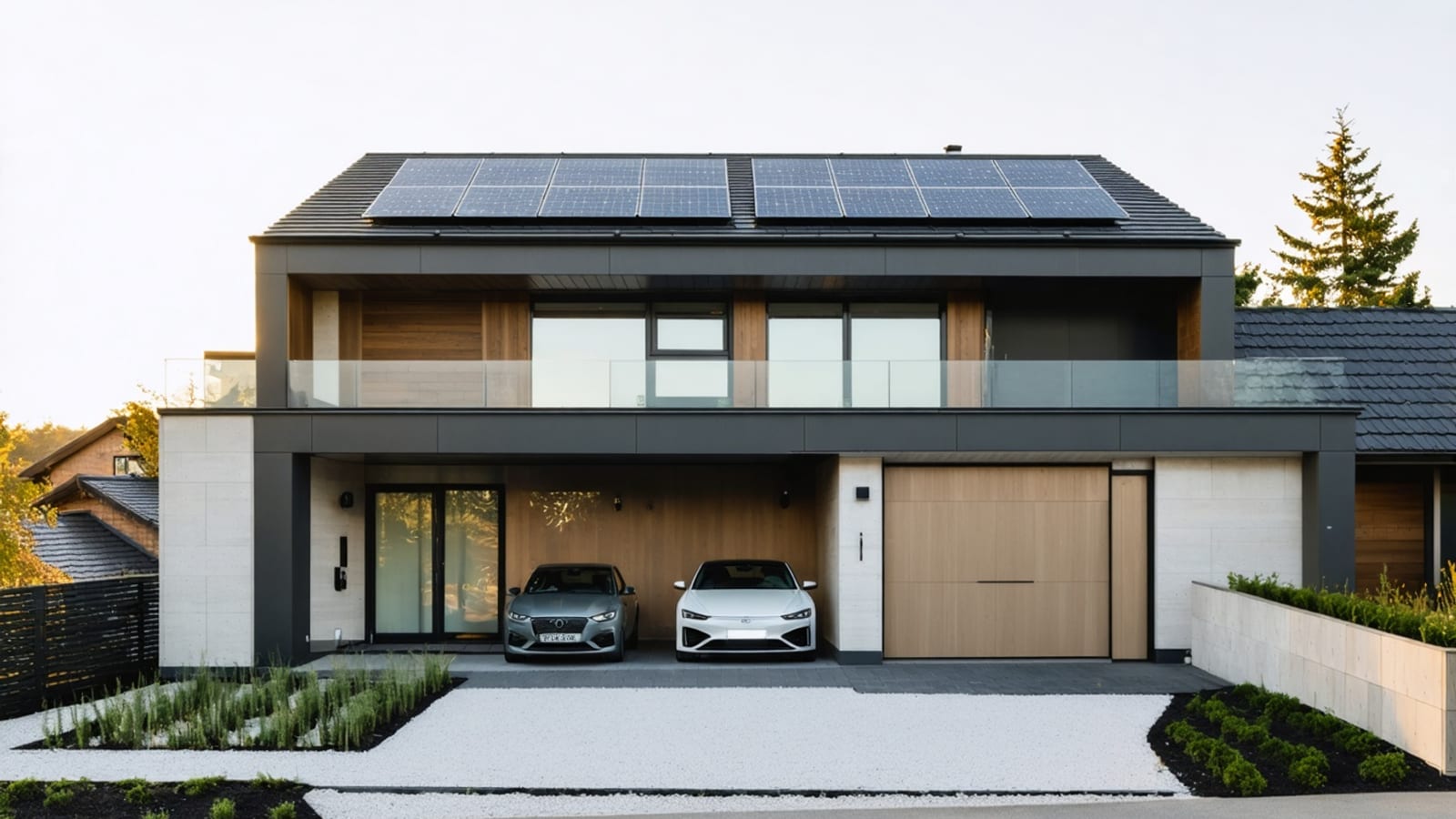
Whole-home electrification is the full replacement of combustion appliances with electric equivalents — heat pump for heating and cooling, heat pump water heater for hot water, induction range for cooking, panel upgrade to carry the new load, and an EV charger when the next vehicle arrives. The 2026 economics have shifted substantially from earlier analyses, mostly because 25C is dead and HEEHRA has gone live in a handful of key states.
This is a real numbers breakdown. We're not selling you electrification — we're laying out what it costs, what rebates knock off, how long before it pays back, and whether phased beats all-at-once for most households.
The full bundle, component by component
A complete whole-home electrification project in 2026 covers five major systems. Here's what each costs installed, pre-rebate.
Heat pump (space heating and cooling): $14,000-$24,000 for central ducted, $4,000-$8,000 for single-zone mini-split, $12,000-$20,000 for multi-zone mini-split serving a whole home. The heat pump guide covers sizing and equipment selection in detail.
Heat pump water heater (HPWH): $3,500-$6,500 installed. Models from Rheem, Bradford White, and AO Smith dominate the residential market. HPWHs need roughly 1,000 cubic feet of ambient air to operate efficiently, so basement or garage placement works best.
Induction range: $2,000-$4,500 for the appliance plus $500-$1,500 for 240V electrical if not already present. High-end models (Miele, Wolf, Thermador) push the appliance cost to $6,000-$10,000.
Electrical panel upgrade: $2,500-$5,000 to upgrade from 100A or 150A to 200A service. Required if existing panel can't accommodate heat pump plus HPWH plus induction plus EV charger load. Permit and utility coordination add 2-4 weeks.
Level 2 EV charger: $800-$2,500 installed, depending on distance from panel and whether hardwired or plug-in. Most households install one during the panel upgrade to share the electrical permit.
Total pre-rebate range: $30,000-$60,000 for a complete bundle in a typical 2,000-2,500 sq ft home. The wide range reflects regional labor differences, equipment tier choices, and whether existing electrical service can support the new load.
The rebate-stacked net cost
For income-qualified households (under 150% Area Median Income), 2026 rebate stacking can drop net cost dramatically.
HEEHRA pays up to $8,000 for a heat pump (full rebate for under-80% AMI; 50% of cost up to $4,000 for 80-150% AMI). It also covers $1,750 for a heat pump water heater, $840 for induction range, $4,000 for electrical panel upgrade, and $2,500 for wiring — all inside a $14,000 household cap.
Utility rebates stack on top. Mass Save, ConnectedSolutions, Xcel, ComEd, PG&E, and roughly 2,000 other programs offer $500-$3,500 on heat pumps, $300-$1,200 on HPWHs, and smaller amounts on induction ranges and panel upgrades.
State credits add further layers in select states. New York Clean Heat, California TECH Clean, Massachusetts Mass Save bonus programs, and Colorado's state rebate each add $500-$2,500 on qualifying equipment.
For an income-qualified household in a state with active HEEHRA and a generous utility program, a $45,000 pre-rebate bundle can come in at $15,000-$25,000 net out-of-pocket. For higher-income households (above 150% AMI), HEEHRA is unavailable, so the net lands at $30,000-$45,000 — still real savings but less transformative.
The rebate stacking guide walks through exactly which programs stack and which are mutually exclusive. The order of application matters — see our rebate stacking order post for the sequence that preserves full benefit.
Operating cost delta by climate zone
This is where the payback math actually lives. Electrification pays back on the operating-cost line, and the delta varies sharply by climate zone and fuel replaced.
Replacing oil heat (Northeast, rural Midwest): Biggest winner. Oil heat runs $3,500-$5,500 per year for a typical home; a cold-climate heat pump runs $900-$1,800 per year on electricity. Annual savings: $1,700-$3,700.
Replacing propane heat (rural, off-pipeline): Similar to oil. Propane at $3.50-$4.50/gal is even more expensive per BTU than oil. Annual savings: $1,500-$3,000.
Replacing natural gas heat (urban/suburban in cold and temperate climates): Smaller win. Gas is cheap per BTU, so switching to heat pump saves 20-40% rather than 50-60%. Annual savings: $400-$1,200 in cold climates, $200-$600 in temperate climates.
Replacing natural gas heat in the Gulf Coast and Deep South: Minimal or negative on heating alone. Cheap gas plus mild winters means heating savings are small. Electrification still wins on cooling efficiency and future fuel price insulation, but pure heating ROI is weakest here.
Replacing electric resistance heat: Strong win everywhere. Heat pumps deliver 2.5-4x the heat per kWh as resistance. Annual savings: $800-$2,000 depending on climate.
HPWH savings are more uniform. Replacing an electric resistance water heater typically saves $300-$500 per year. Replacing a gas tank water heater saves $100-$250 per year. Induction range savings versus gas are small ($40-$80 per year) — induction is mainly a cooking performance and indoor air quality upgrade, not a bill-saver.
Home value impact in 2025 data
Appraisal data from 2025 shows a real but uneven premium on fully electrified homes.
Northeast (MA, NY, CT, NJ, PA, VT, NH, ME): 3-6% appraised premium on electrified homes versus gas-heated comparables in the same neighborhood. This is the strongest market for electrification resale value, driven by high fuel costs and aggressive state electrification policy.
California and Pacific Northwest: 3-5% premium, with higher premiums in coastal markets where electrification is treated as a signal of modernization.
Upper Midwest (MN, WI, MI): 1-3% premium, concentrated in energy-conscious buyer pools.
Sun Belt and Southeast: 0-2% premium. Electrification doesn't strongly differentiate homes in markets where gas is cheap and existing buyer expectations favor conventional HVAC.
For homeowners planning to sell within 5-7 years, the appraisal premium can offset a meaningful share of out-of-pocket electrification cost — turning a $20,000 net investment into a $12,000-$15,000 effective cost after resale recovery.
Time to breakeven
Combining operating savings plus home value premium plus rebate stacking, typical breakeven lands in these ranges:
Income-qualified household, Northeast or California, oil or propane heat replacement: 5-8 years. The combination of huge rebates and huge operating savings makes this the fastest payback scenario.
Income-qualified household, gas heat replacement, moderate climate: 8-12 years. Smaller operating savings stretch the payback.
Higher-income household (above 150% AMI), any climate: 10-16 years. No HEEHRA means full out-of-pocket on equipment, and payback depends entirely on operating savings and home-value premium.
Full bundle in low-gas-cost, mild climate (Gulf Coast, Deep South): 14-20 years. Operating savings are thinnest here, and home-value premium is smallest.
These ranges exclude the new-vehicle case. Adding an EV to a household that would otherwise have bought a gasoline vehicle moves the EV charger from "electrification cost" to "fuel savings mechanism," which can compress overall household energy spending by another $800-$1,500 per year.
Phased versus all-at-once
Most households electrify in phases, not in a single capital event. The two common phasing strategies:
Strategy A: Equipment-failure-driven. Replace each combustion appliance with its electric equivalent when the original fails. Heat pump when the furnace dies, HPWH when the tank leaks, induction when the gas range gives out. This spreads cost over 5-12 years and avoids prematurely scrapping working equipment.
Strategy B: Rebate-window-driven. Accelerate replacements to capture time-limited rebates. If HEEHRA is live in your state and has queue risk (Maine and Vermont have already hit reservation caps), replacing earlier than needed locks in the rebate before funds exhaust.
Phased electrification costs slightly more in total (no bundle pricing from a single contractor), but the cash flow is easier and the rebate risk is lower. All-at-once electrification makes sense if you're already doing a major renovation, if HEEHRA in your state has launch certainty and no queue risk, or if you're replacing oil or propane heat (where operating savings compound fastest).
There's a third strategy worth considering for households with working combustion equipment but 5-10 years of remaining life: the partial pre-emptive swap. Install a heat pump now (capturing the rebate and starting the operating savings clock), but leave the existing water heater, range, and panel in place until they age out naturally. This captures the biggest payback component without forcing a full simultaneous capital outlay.
The rebate finder surfaces current program status in your ZIP so you can decide whether to accelerate. The heat pump calculator models phased vs bundled scenarios against your income band and equipment choices. And the HEEHRA guide covers income verification and equipment eligibility for the single largest rebate in the stack.
The honest ROI read
Whole-home electrification is a capital-intensive project with a 6-14 year payback for most households, compressed to 5-8 years for the best-case rebate-and-operating-savings combo. It is not a short-term financial win for higher-income households in low-gas-cost markets — for those homeowners, the pitch is comfort, indoor air quality, and fuel price insurance rather than dollar ROI.
For income-qualified households in states with active HEEHRA, generous utility programs, and high-cost legacy fuel (oil, propane), the math is different. Rebate stacking can turn a $45,000 project into a $15,000 project, and operating savings can recover that in under a decade. That is a real wealth-building move, not a virtue signal.
The math changes by state, climate, income band, and current fuel. Run your specific numbers before committing — the calculator and rebate finder exist to give you a real answer, not a brochure. And if your state's HEEHRA program is not yet live, track launch timing carefully: waiting for rebate launch can make sense, but only if your existing equipment isn't at immediate failure risk.