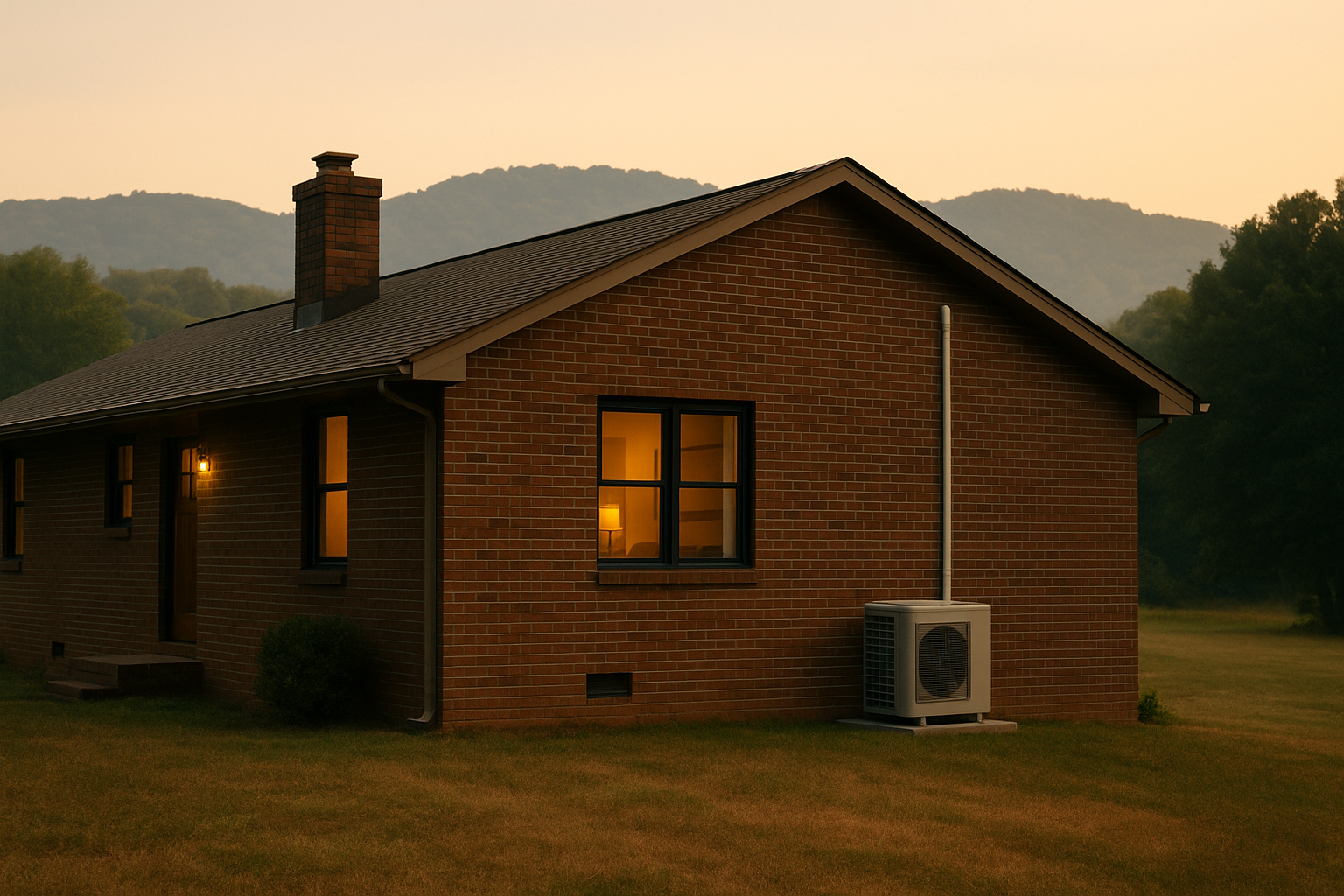
Do you know which company actually sends you an electric bill in Tennessee? If the answer that comes to mind is "TVA," you are half right, and that half is the part that determines how a heat pump rebate reaches your invoice.
The Tennessee Valley Authority generates and transmits power across the state, but it sells that power wholesale to roughly 153 local power companies. Those LPCs — municipal boards and electric cooperatives including Nashville Electric Service, Memphis Light, Gas and Water, Knoxville Utilities Board, and EPB in Chattanooga — handle retail billing, metering, and most customer-facing efficiency programs.
That structure makes Tennessee behave differently from every other state guide in this series. In a single investor-owned utility market, one company controls the incentive; here, the utility half of your project depends on which of 153 LPCs happens to serve your meter.
Tennessee's HEEHRA rebates are administered by the state, not by TVA. TVA sells wholesale power to roughly 153 local power companies, and those LPCs run their own separate utility incentives.
What HEEHRA Pays For Before Tennessee Enters The Picture
HEEHRA is the common name for the Home Electrification and Appliance Rebates program created by Section 50122 of the Inflation Reduction Act. Congress set the measure-level caps and the income tiers, while the states administer the funds, build the contractor networks, and decide when applications open.
That division matters because the caps below are federal ceilings rather than guarantees. A state can administer a program that pays less than the ceiling for a given measure, and no state program can pay more than it.
The federal per-measure caps under HEEHRA include but are not limited to:
| Measure | Federal HEEHRA cap | Why it matters in Tennessee |
|---|---|---|
| Heat pump for space heating and cooling | Up to $8,000 | The largest single line item, and the one most often paired with a utility offer |
| Heat pump water heater | Up to $1,750 | Common retrofit in all-electric TVA-territory homes with aging resistance tanks |
| Electrical panel or service upgrade | Up to $4,000 | Frequently the gating item in older Memphis and Chattanooga housing stock |
| Electrical wiring | Up to $2,500 | Applies to branch circuits added to support new equipment |
| Insulation, air sealing, and ventilation | Up to $1,600 | Shrinks the load before the equipment is sized, which lowers tonnage |
| Heat pump clothes dryer | Up to $840 | Counts against the same household ceiling as the heat pump |
| Electric stove, cooktop, range, or oven | Up to $840 | Only relevant where gas cooking is being displaced |
| Household total | Up to $14,000 | A shared pool across all measures, not a stack of separate allowances |
Keep in mind that the $14,000 figure is the whole envelope. A full $8,000 heat pump rebate plus a full $4,000 panel upgrade leaves roughly $2,000 of headroom for everything else in the project.
The federal heat pump rebate caps at $8,000, and the whole-household HEEHRA total caps at $14,000. A panel upgrade draws up to $4,000 from that same $14,000 ceiling.
The Income Tiers: 80% And 150% Of Area Median Income
HEEHRA sorts households into three brackets, and the bracket sets what share of the project cost the rebate covers. Below 80% of area median income the program covers 100% of qualified costs up to the caps, between 80% and 150% of AMI it covers 50%, and above 150% of AMI the rebate does not apply.
The word carrying the weight there is area. AMI is published for each county or metropolitan area and adjusted for household size, so the qualifying figure in Shelby County is not the qualifying figure in Sevier County or Coffee County.
This is worth pulling rather than estimating, particularly if you live in a rural county adjacent to a metro area. Tennessee's statewide median household income runs below the medians in the Nashville and Knoxville metros, so a household that rules itself out based on a statewide number may be reading the wrong table entirely.
Before you assume a tier. Income limits are published by county and household size, and household size changes the threshold materially — a four-person household clears a higher number than a one-person household in the same county.
Verify the current figure with the state energy office administering the program rather than a third-party calculator, since the tables are revised on a federal schedule.
HEEHRA covers 100% of qualified project costs for households under 80% of area median income and 50% for households between 80% and 150%. Above 150% of AMI, the rebate does not apply.
Who Processes The Paperwork In Tennessee
This is where the TVA structure reshapes the project. HEEHRA money is federal, passed to the state and administered through the Tennessee Department of Environment and Conservation's Office of Energy Programs, which is the body that stands up the approved-contractor network and the income-verification workflow.
TVA sits outside that chain entirely. TVA is a federal power producer selling wholesale, and its customer-facing offerings — the EnergyRight umbrella, the Quality Contractor Network, the income-qualified Home Uplift program, and the Home Energy Loan — reach households through participating local power companies rather than through the state rebate office.
A Tennessee household pursuing both a state rebate and a utility incentive is therefore running two intake processes with two approved-contractor lists. Not every LPC participates in every TVA offering, and participation is a decision each utility board makes independently.
| Program | Who administers it | Who you deal with | Form of benefit |
|---|---|---|---|
| HEEHRA (Home Electrification and Appliance Rebates) | State energy office | An approved contractor, at point of sale | Income-tiered discount off the invoice |
| TVA EnergyRight offerings | TVA with participating LPCs | Your local power company | Varies by LPC and by offering |
| Home Uplift | TVA with participating LPCs and partners | Your local power company | Income-qualified upgrades at no cost to the household |
| Home Energy Loan | TVA with participating LPCs | Your local power company | Financing, not a rebate |
| LPC-specific programs | The individual utility | Your local power company | Varies widely between LPCs |
| Federal tax credits | IRS, at filing | Your tax preparer | Credit against tax liability |
The practical consequence is that "TVA offers it" and "my utility offers it" are two different statements in this state. Confirming your LPC's participation early is what keeps a quoted incentive from evaporating at submission.
State HEEHRA rebates are designed to come off the invoice at point of sale through an approved contractor. Utility incentives in TVA territory are processed separately by your local power company.
What TVA Territory Means For Qualifying Equipment
The equipment question in Tennessee has two answers, because there are two lists. HEEHRA anchors its equipment requirement to ENERGY STAR certification for the relevant category, while utility-side programs across the TVA network have historically set their own efficiency floors and installation conditions.
That divergence is easy to miss on a quote sheet. A mid-tier ducted system can satisfy the federal certification requirement and still land below an LPC program's SEER2 or HSPF2 threshold, which means the state rebate lands and the utility incentive does not.
The specification details that most often decide whether a unit clears both lists include:
- ENERGY STAR certification. This is the baseline for HEEHRA-qualified equipment in each category, and it is verified at the model level rather than the brand level. Two models in the same product family can differ here.
- AHRI-matched systems. Ducted systems are rated as matched combinations of outdoor unit, indoor coil, and air handler, and the rated performance only holds for the matched pair. A field substitution of the indoor coil can move the system to a different AHRI reference number with different published numbers.
- Cold-climate designation. Most of Tennessee does not require a cold-climate-designated unit on load grounds alone, but some program tiers reward it. Where an incentive is tied to low-ambient capacity retention, the designation becomes the deciding line rather than a nice-to-have.
- Contractor credentialing. Utility-side offers in TVA territory commonly require a Quality Contractor Network member, while the state rebate requires a contractor on the state's own approved list. Membership on one list does not imply membership on the other.
- Documentation depth. An ACCA Manual J load calculation, an itemized invoice separating equipment from labor, and model and serial numbers are the records both processes tend to ask for. Reconstructing them after the crew leaves is the most common source of delay.
Note that the cheapest way to satisfy both lists is to specify to the stricter of the two from the start. Chasing the utility threshold after the equipment is ordered usually costs more than specifying up a tier at the quoting stage.
HEEHRA-qualified equipment must meet ENERGY STAR requirements for its category. A local power company program may set a different SEER2 or HSPF2 floor, so one unit can clear one list and miss the other.
Sizing For Tennessee's Climate Zones
Tennessee spans IECC climate zones 3A and 4A, with the western counties around Memphis in 3A and most of Middle and East Tennessee in 4A. Winter design temperatures across the populated corridors generally land in the teens to low 20s Fahrenheit, with the Tri-Cities and the Cumberland Plateau running colder than the metro averages suggest.
That is a mild-to-moderate heating climate by national standards, which changes the sizing conversation considerably. A properly modeled system in Nashville or Memphis is often cooling-limited or close to balanced, whereas in Bristol or Crossville the heating load is more likely to drive equipment selection.
The gap between a rule-of-thumb tonnage and a modeled load is where oversizing enters. Running the numbers through a heat pump load calculator before the quote, and reading how cold-climate heat pump sizing differs from conventional sizing, keeps the specification honest at both design conditions.
Tennessee's large stock of all-electric homes with resistance strip backup is its own variable. If the existing air handler carries 10 kW or 15 kW of strip heat, the control strategy matters as much as the equipment — see how heat pump backup heat is staged and how balance point controls decide when strips energize.
Panel capacity is the other frequent surprise, particularly in older housing stock in Memphis and Chattanooga. HEEHRA reserves up to $4,000 for a panel or service upgrade precisely because it is such a common blocker, and our guide to heat pump panel capacity covers how to assess headroom before a contractor arrives.
Water heating deserves its own line in the plan rather than a late addition. A heat pump water heater draws its own $1,750 cap, and installing it in the same visit as the space-conditioning work usually consolidates the electrical scope.
Stacking Rules Worth Confirming Before You Budget
One federal rule is firm. A single upgrade cannot draw from both HEAR, which is HEEHRA, and HOMES, the Home Efficiency Rebates program created by Section 50121, though a household may use both programs for different measures where the state allows it.
Beyond that, stacking with utility incentives is governed by individual program rules rather than a single national answer. Some programs reduce their incentive by the amount of another rebate received, and others cap combined incentives at a percentage of total project cost.
Federal tax credits sit in a separate lane, since they are claimed at filing rather than at the register. Whether a credit applies to equipment placed in service in your project year is a question with a moving answer, so check the federal tax credit status page first, then read the HEEHRA and 25C stacking rules and the rebate versus tax credit decision tree for the mechanics.
A single upgrade cannot draw from both the HEAR and HOMES rebate programs. A household can still pair a HEEHRA rebate with a separate utility incentive when that program's rules allow it.
A Sequencing Checklist Before You Sign A Contract
Because the paperwork lives in two places, the order of operations does real work in Tennessee. Here's a list of the steps that tend to prevent rework:
- Identify your local power company by name. The name on your electric bill, not "TVA," is the entity whose program rules apply. Everything on the utility side follows from that single fact.
- Confirm program status with the state energy office. HEEHRA rollout timing, application windows, and approved-contractor lists are state-administered and change by phase. A program that is open in one state may not yet be open in another.
- Pull your county AMI threshold for your household size. The tier decides whether the rebate covers 100% or 50% of qualified costs, which changes the entire project budget. Estimating from a statewide figure is the most common way households misread their own eligibility.
- Ask contractors about both credentials at the quoting stage. A contractor on the state approved list and in the Quality Contractor Network can process both tracks. One who holds only one credential leaves half the incentive unreachable.
- Get a Manual J before the equipment is selected. The load calculation is the document that supports the tonnage on the invoice, and several program tracks request it. It also protects against oversizing in a climate where the cooling load frequently governs.
- Line up the electrical scope early. Panel capacity, circuit availability, and any service upgrade determine whether the mechanical install can proceed on schedule. Discovering a panel constraint on install day converts a one-visit project into a three-week one.
All of these steps share a single purpose, which is making sure the equipment on the purchase order satisfies both sets of rules before money moves. The sequence costs a few hours upfront and removes most of the failure modes that show up at submission.
Where Tennessee Fits In The Broader Rebate Map
Compared with neighboring states, Tennessee trades a single utility counterparty for a network of them. A household in Georgia's HEEHRA landscape deals with one dominant investor-owned utility alongside the state program, whereas a Tennessee household's utility experience depends on whether its meter sits behind a large municipal board or a small rural cooperative.
That is not necessarily a disadvantage. Several of the larger LPCs run substantial programs of their own, and the income-qualified track in TVA territory reaches households that fall outside conventional rebate structures.
What it does require is one extra verification step that most state guides do not. Before you commit to equipment, confirm the state program status, confirm your LPC's participation, and confirm that the specific model on the quote clears both efficiency floors.
For the full set of state-by-state breakdowns, income tier tables, and program timing, start with our HEEHRA rebate guide. For equipment selection questions that sit upstream of the rebate math, the heat pump selection guide covers specification and sizing in more depth.
This article is for informational purposes and is not financial, tax, legal, or medical advice. Consult a licensed professional — a CPA, an HVAC contractor, your local power company, or the state energy office administering the program — before acting.