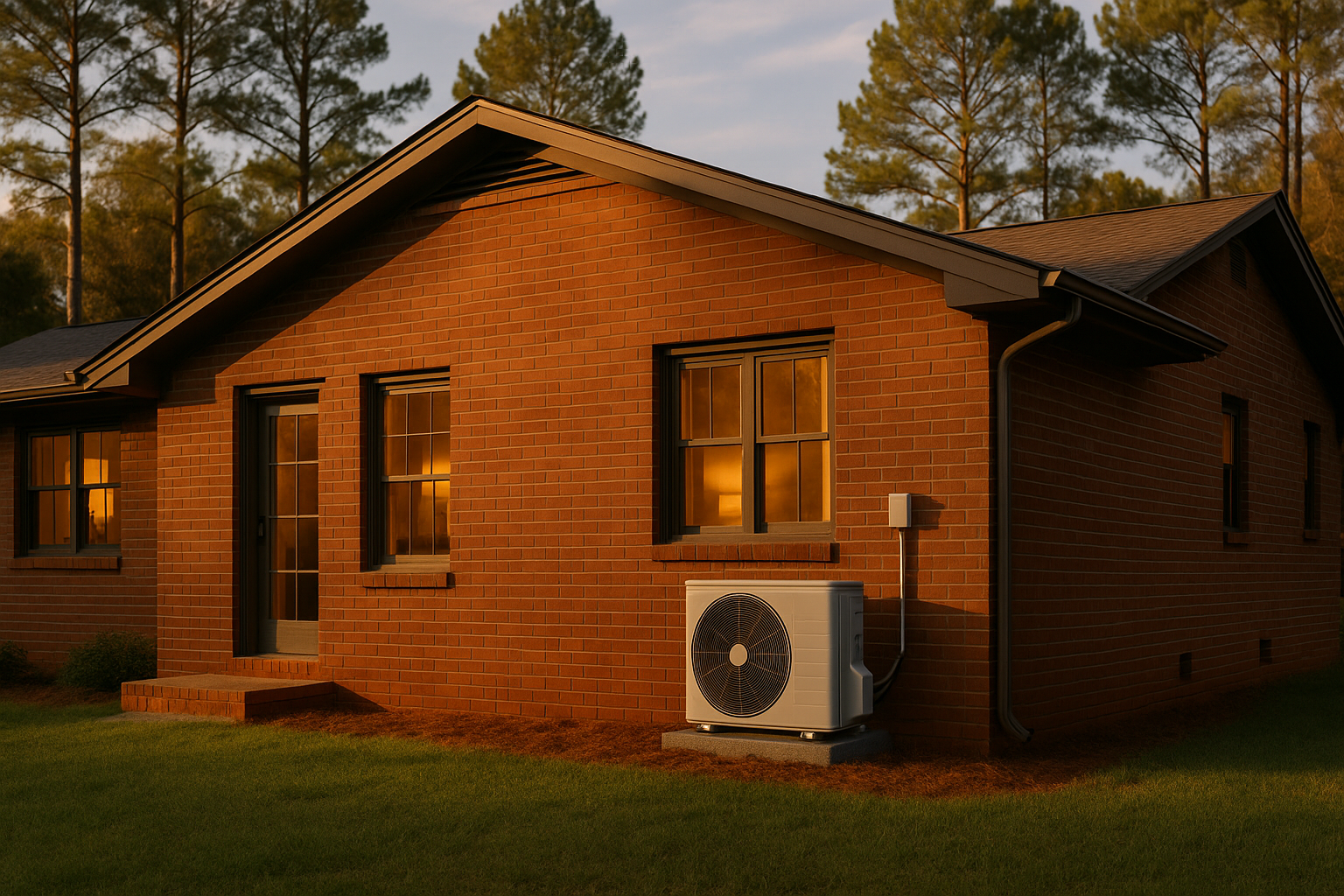
Electricity is the main space-heating fuel in roughly half of Georgia's occupied homes, according to U.S. Energy Information Administration survey data — a share exceeded by only a handful of states. Most of that equipment is not a modern inverter-driven system, but an aging single-stage air-source heat pump propped up by resistance strip heat every time the outdoor temperature falls below its balance point.
That combination makes Georgia one of the states where the Home Electrification and Appliance Rebates program — HEEHRA — could move the most money into the most households. It is also a state where homeowners have an unusually hard time finding a straight answer about what the program pays, who qualifies, and when the application window actually opens.
HEEHRA rebate caps are set by federal statute, not by Georgia: up to $8,000 for a qualifying heat pump and $14,000 per household across all measures. Georgia's state energy office sets the launch date and program rules.
What HEEHRA Pays, Measure By Measure
HEEHRA was created under Section 50122 of the Inflation Reduction Act, which appropriated approximately $4.5 billion nationally and directed the Department of Energy to distribute it through state energy offices. Because the per-measure ceilings are written into the statute itself, they are identical in Georgia, Idaho, and every other participating state — what varies by state is the rollout schedule, the contractor network, and the paperwork.
Here is how the ceilings break down across the electrification measures the program covers:
| Measure | Maximum rebate | Typical Georgia relevance |
|---|---|---|
| Electric heat pump (space heating and cooling) | Up to $8,000 | Highest-value measure; replaces aging strip-backed systems |
| Heat pump water heater | Up to $1,750 | Common first measure in phased state launches |
| Electrical panel upgrade | Up to $4,000 | Frequently required on 100-amp service homes |
| Electrical wiring | Up to $2,500 | Branch circuits for new equipment locations |
| Insulation, air sealing, and ventilation | Up to $1,600 | Attic sealing in vented-crawlspace housing stock |
| Heat pump clothes dryer | Up to $840 | Optional; often deferred to preserve the household cap |
| Electric stove, cooktop, range, or oven | Up to $840 | Applies to induction and standard electric ranges |
| Household total, all measures combined | Up to $14,000 | Hard ceiling regardless of project count |
Keep in mind that every figure above is a ceiling rather than an entitlement, and the amount you receive is also constrained by your income tier and by the actual installed cost of the work. A heat pump installation quoted at $9,400 does not automatically produce an $8,000 rebate — the tier math runs first, and the statutory cap only bites afterward.
The Two Income Tiers, Measured Against Georgia AMI
HEEHRA divides applicants into two eligible bands and one excluded band, all indexed to area median income. Households below 80% of AMI are eligible for 100% of project costs up to the caps above, households between 80% and 150% of AMI are eligible for 50% of project costs up to those same caps, and households above 150% of AMI are not eligible for HEEHRA at all.
Georgia households under 80% of area median income can have 100% of a qualifying project covered up to the statutory caps. Households between 80% and 150% of AMI receive 50%. Above 150% AMI, HEEHRA does not apply.
The practical consequence of the 50% band is that the $8,000 heat pump ceiling is rarely the binding constraint for moderate-income Georgia households. On a $12,000 ducted system, a household at 120% of AMI would look at roughly $6,000 in rebate — the coverage percentage, not the cap, is what determines the number.
Why Your County Matters More Than Your Salary
AMI is not a statewide figure, and this is where Georgia households most often mis-estimate their eligibility. HUD publishes income limits by county or metropolitan statistical area and adjusts them for household size, which means the same household income can land in different tiers depending on whether the address is in Fulton County or in a rural county in the southern half of the state.
Metro Atlanta counties carry substantially higher AMI figures than most of south and middle Georgia, so a four-person household earning the same wage crosses the 80% threshold in one place and sits comfortably below it in another. Before you plan around a tier, pull the current HUD income limits for your specific county and household size — our breakdown of how the HEEHRA income tiers are calculated walks through the arithmetic step by step.
Note that most state programs verify income through recent tax returns, pay stubs, or categorical eligibility — enrollment in a program such as LIHEAP or SNAP often serves as automatic proof of the under-80% tier. Households already receiving energy assistance in Georgia should check whether that categorical path removes the documentation burden entirely.
Which Equipment Actually Qualifies
Statutory eligibility and program eligibility are two different filters, and the second one is stricter. DOE requires that rebated equipment meet or exceed ENERGY STAR certification, and state programs typically layer on their own qualified-product list plus a requirement that installation be performed by a contractor enrolled in the program.
The categories that matter most for Georgia housing stock include but are not limited to:
- Ducted air-source heat pumps. The dominant retrofit path in Georgia, since most homes already have ductwork from an existing heat pump or central air system. Variable-speed inverter models hold capacity far better at low ambient temperatures than the single-stage units they typically replace.
- Ductless mini-splits. Eligible under the same $8,000 ceiling, and often the better answer for additions, bonus rooms over garages, and homes where the existing duct system leaks into a vented crawlspace.
- Heat pump water heaters. Capped at $1,750, and frequently the measure states open first because installation is simpler and the contractor pool is larger. Our guide to heat pump water heater selection and placement covers the ambient-air and condensate requirements that trip up garage installs.
- Electrical panel upgrades. Capped at $4,000, and genuinely load-bearing in older Georgia homes on 100-amp service where a heat pump and a heat pump water heater cannot both land without a service change. Run the arithmetic in advance using our walkthrough of panel capacity for heat pump retrofits.
- Envelope work. Insulation, air sealing, and ventilation share a $1,600 ceiling, and pairing them with the equipment measure usually produces a smaller, cheaper, better-performing system.
Qualifying HEEHRA equipment must be ENERGY STAR certified and installed by a program-enrolled contractor. Ducted systems and ductless mini-splits both fall under the $8,000 heat pump ceiling.
All of these measures draw from the same $14,000 household ceiling, which forces a sequencing decision rather than a shopping list. Most households get more value from panel plus heat pump plus envelope than from spreading the allocation across a dryer and a range.
Where Georgia's Application Timeline Currently Stands
HEEHRA is a state-administered program, and in Georgia the administering body is the Georgia Environmental Finance Authority — GEFA functions as the state energy office and holds the DOE allocation. That single fact resolves most of the confusion, because it means no federal portal will ever accept your application and no contractor can pay out a HEEHRA rebate before GEFA's program is live.
Every state moves through the same sequence: application to DOE, award and funding agreement, program design and quality-assurance framework, contractor enrollment and training, then a public application portal. Because states have moved through those stages at very different speeds, the only reliable status check is GEFA's own published program page rather than a national tracker or a contractor's sales pitch.
Three signals tell you a state program is genuinely open rather than announced: a published list of enrolled contractors, a live income-verification portal, and a qualified-product list with model numbers. If any one of those is missing, the program is still in design and no rebate can be reserved.
The Georgia Environmental Finance Authority administers Georgia's HEEHRA allocation. No federal portal accepts applications, and no contractor can process a rebate until GEFA's program and contractor network are live.
Be aware that a common pattern across states is a phased launch — a single measure such as heat pump water heaters opens first, whole-home electrification follows months later. A Georgia household planning around a specific replacement date may want to consider whether the equipment failing this winter can be bridged, or whether the timing risk outweighs the rebate.
Funds are also finite. The DOE allocation is a fixed pool per state, and states that launched early have already seen demand outpace the low-income tranche, so an open portal does not guarantee available funding at the moment you apply.
Sizing For Georgia's Climate, Not For The Rebate Cap
Georgia spans a wide design-temperature range, and the equipment decision changes meaningfully across it. Atlanta's 99% winter design temperature sits in the low twenties Fahrenheit, the north Georgia mountain counties run colder still, and the coastal plain around Savannah rarely drops near either — check ACCA Manual J design conditions for your specific county rather than assuming a statewide number.
The dominant failure mode in Georgia retrofits is not undersizing but oversizing, because the cooling load usually dictates the equipment and the humid subtropical summer tempts contractors toward extra tonnage. An oversized system short-cycles, removes less latent moisture, and leaves the house cool and clammy in July while doing nothing useful for the January load.
Ask any contractor for the room-by-room Manual J, not a rule-of-thumb tonnage based on square footage — a contractor who cannot produce the calculation has not done one. You can pressure-test their number against our heat pump load calculator before signing anything.
For homes in the northern counties, capacity retention at low ambient temperature is the specification that matters, and our guide to cold-climate heat pump sizing covers how to read the extended-range AHRI data rather than the nameplate. Pair that with sensible balance point and backup heat controls so the resistance strips stop engaging every time the thermostat sees a two-degree setback recovery.
Stacking HEEHRA With Georgia Power And Federal Programs
Utility rebates are funded by ratepayers, not by the DOE allocation, which means they generally run on an entirely separate track from HEEHRA. Georgia Power's residential efficiency incentives are the most widely available of these — our breakdown of Georgia Power heat pump and efficiency rebates covers current program structure and the equipment tiers that qualify.
Utility rebates generally stack with HEEHRA because they draw on ratepayer funds rather than the DOE allocation. HEEHRA cannot be combined with the HOMES whole-home rebate on the same measure.
The one hard prohibition inside the federal architecture is that a household cannot claim both HEEHRA and the HOMES performance-based rebate for the same measure. Federal tax credit interaction is a separate question with its own rules — start with how HEEHRA and 25C interact and the 25C versus HEEHRA decision tree, and verify current federal credit availability on our federal tax credit status page before assuming a credit is still on the table for your installation year.
What To Have Ready Before The Portal Opens
Program windows in other states have closed faster than households could assemble documentation, so preparation carries real value even while Georgia's launch date is unsettled. Here is what tends to matter on day one:
- Income documentation. Recent tax returns and pay stubs for all adults in the household, or proof of enrollment in a categorical program such as LIHEAP or SNAP.
- A completed Manual J. The load calculation determines equipment selection, and having it in hand shortens the contractor conversation considerably.
- An electrical assessment. Service size, panel age, and available breaker spaces determine whether the $4,000 panel measure needs to be part of the project.
- A measure sequence. Decide in advance how you would allocate the $14,000 household ceiling across equipment, panel, and envelope work.
None of that preparation is wasted if the timeline slips, because every item on the list also improves the outcome of an unsubsidized replacement. The full program architecture, tier math, and state-by-state comparison live in our HEEHRA program guide.
Georgia HEEHRA Questions, Answered
Who administers HEEHRA rebates in Georgia?
The Georgia Environmental Finance Authority serves as the state energy office holding Georgia's DOE allocation, and it sets the program rules, contractor enrollment requirements, and application portal.
Is HEEHRA a tax credit or an upfront discount?
HEEHRA is a rebate rather than a credit, and DOE guidance pushes states toward point-of-sale delivery through enrolled contractors. That means the reduction typically appears on the invoice rather than on a tax return.
Can renters or landlords use HEEHRA in Georgia?
The statute contemplates multifamily participation where at least half the units house low-income residents, though the mechanics are set at the state level. Single-family renters generally need owner participation for equipment measures.
Does a DIY installation qualify for the rebate?
No. Program-enrolled contractor installation is a standard requirement across state HEEHRA designs, because DOE ties the funding to quality-assurance and verification obligations the state must satisfy.
Will HEEHRA cover the full cost of a heat pump?
For households under 80% of area median income, the program covers 100% of project cost up to $8,000 for the heat pump measure. Costs above that ceiling remain the household's responsibility.
The Practical Read For Georgia Households
Georgia's electric-heat saturation means an unusually large share of households stand to benefit from HEEHRA, and the statutory caps are generous enough to change the economics of a replacement rather than merely soften it. The constraint is not the money — it is the sequencing between a program that has not published its portal and equipment that fails on its own schedule.
Households in that position generally do best by locking down the two things the program cannot supply: an accurate load calculation and a clear picture of their income tier and electrical service. Everything else is a matter of watching GEFA's program page and moving when the contractor list goes live.
This article is for informational purposes and is not financial, tax, legal, or medical advice. Consult a licensed professional (CPA, elder-law attorney, HVAC contractor, state Medicaid office) before acting.