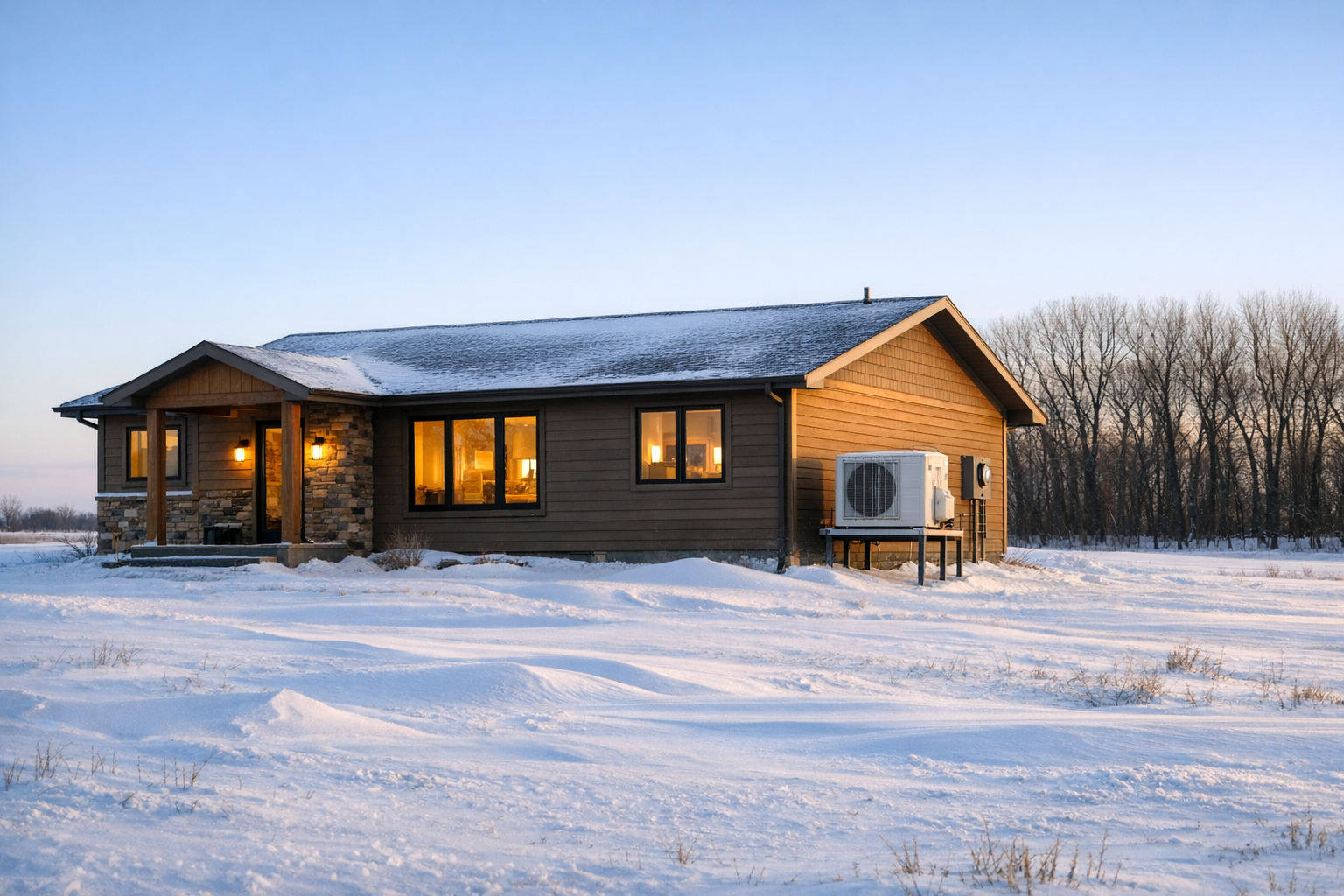
Are you planning a heat pump installation in Sioux Falls, Rapid City, Aberdeen, or anywhere across the South Dakota prairie and wondering why the federal rebates you have read about never seem to apply to you? If so, you are asking the right question before you sign a contract.
South Dakota is the only state that did not apply for its share of the Inflation Reduction Act home energy rebates, which includes the Home Electrification and Appliance Rebates (HEEHRA) program. That said, a heat pump can still pencil out here — the incentives simply come from different places, and homeowners need to know where to look.
South Dakota did not apply for its IRA home energy rebate allocation, so HEEHRA point-of-sale heat pump rebates are not available in the state. Utility, co-op, and weatherization programs still operate.
What HEEHRA Is And Why It Is State-Administered
HEEHRA is a federal rebate program created by Section 50122 of the Inflation Reduction Act and funded through the U.S. Department of Energy. Keep in mind that DOE never pays these rebates directly to homeowners; instead, it allocates funds to each state energy office, which then designs, launches, and runs its own program.
In states that participate, HEEHRA offers income-qualified households point-of-sale rebates on heat pumps, heat pump water heaters, electrical panels, wiring, and insulation. As a result, the entire program depends on a state choosing to apply, building the administrative infrastructure, and getting DOE approval for its plan.
Our HEEHRA state-by-state status tracker follows where each state sits in that process. For the broader picture of how the program works, income tiers included, see the ElectrifyAtlas HEEHRA guide.
Why South Dakota Declined The Federal Rebate Funds
Under then-Governor Kristi Noem, South Dakota chose not to submit an application for its IRA home energy rebate allocation before DOE's deadline. Every other state, along with the District of Columbia, filed an application in some form, which left South Dakota as the single gap on the national map.
Reporting at the time placed the decision within the administration's broader skepticism toward new federal spending programs and the conditions attached to them. Accordingly, the state energy office never built a HEEHRA program, never hired an implementation contractor, and never published an income-verification process.
South Dakota's administration did not file for its HEEHRA and HOMES allocation before the Department of Energy deadline. Without an application, the state did not build a HEEHRA or HOMES program, contractor network, or rebate portal.
Remember that the decision covered both halves of the IRA home energy package. That means South Dakota residents cannot access the HOMES whole-house performance rebates (Section 50121) either, even though those were not limited to electrification upgrades.
What The Decision Means For Your Heat Pump Budget
In practical terms, a South Dakota homeowner pays the full installed price of a heat pump minus whatever the local utility or co-op offers. There is no state-run point-of-sale discount at the contractor's counter and no HEEHRA income tier to qualify for.
What's more, the federal tax credit that used to soften that cost is gone. The 25C Energy Efficient Home Improvement Credit ended for equipment placed in service after December 31, 2025, and the residential clean energy credit (25D) for solar ended on the same date.
Federal credit status for 2026 installs. Neither 25C nor 25D applies to equipment placed in service in 2026 in any state — our federal tax credit status page keeps the current record.
This all adds up to a market where local incentives carry most of the weight. In fact, in South Dakota the utility rate you pay after installation often matters more to long-run economics than any one-time rebate.
Heat Pump Incentives South Dakota Homeowners Can Still Claim
Although HEEHRA is off the table, several categories of support remain active. The programs below are the ones worth checking first, and each sponsor updates its amounts and eligibility rules on its own schedule.
Investor-Owned Utility Rebates
South Dakota's investor-owned electric utilities have run residential efficiency programs approved by the South Dakota Public Utilities Commission. These programs have historically included rebates for qualifying air-source heat pumps, ground-source heat pumps, or both.
The utilities worth checking include, but are not limited to:
- Xcel Energy (Sioux Falls area). Xcel's South Dakota service territory has offered residential heat pump rebates tied to efficiency ratings. Note that its South Dakota program is separate from the Colorado lineup covered in our Xcel Colorado rebates guide, so amounts and rules differ.
- Otter Tail Power Company (northeast South Dakota). Otter Tail has paired heat pump rebates with off-peak and dual-fuel rate options. Its programs are especially relevant for homes in the Milbank, Webster, and surrounding service areas.
- Black Hills Energy and NorthWestern Energy. Both serve large portions of the state with electric or natural gas service. Their offerings have varied by fuel and by year, so confirm current program status directly before budgeting around them.
Overall, investor-owned utility rebates tend to require AHRI-certified equipment that meets minimum SEER2 and HSPF2 thresholds. Keep the AHRI certificate number from your quote, because most applications ask for it.
Rural Electric Cooperative Programs
Much of South Dakota is served by rural electric cooperatives rather than investor-owned utilities. Many of these co-ops purchase power through generation and transmission cooperatives such as East River Electric Power Cooperative, Rushmore Electric, and Basin Electric, and they have actively promoted heat pumps for years.
Many South Dakota electric co-ops offer heat pump rebates plus discounted off-peak or dual-fuel heating rates. Check your co-op's current program page, since amounts and equipment rules vary by co-op.
Co-op programs commonly fall into three types:
- Equipment rebates. Per-ton or flat-amount rebates for air-source, mini-split, or geothermal heat pumps meeting the co-op's efficiency floor.
- Off-peak or dual-fuel rates. A reduced electric rate for heating load that the co-op can interrupt during peak demand, with a propane or gas furnace carrying the home through those windows.
- Load-control credits. Bill credits for allowing the co-op to cycle water heaters or other controllable loads, which can be combined with a heat pump water heater upgrade.
Of course, the dual-fuel rate is often the most valuable of the three over the life of the equipment. A lower per-kWh price on every heating kilowatt-hour compounds every winter, while a rebate is paid once.
Weatherization Assistance For Income-Qualified Households
The federal Weatherization Assistance Program is separate from the IRA rebates and continues to operate in South Dakota. The state administers it through the Department of Social Services, with local community action agencies handling intake and installation.
Weatherization does not typically buy a heat pump outright. However, it funds insulation, air sealing, and safety work that can shrink your heating load enough to change the size of the heat pump you need.
Yes. The Weatherization Assistance Program still serves income-qualified South Dakota households through local community action agencies, covering insulation and air sealing rather than heat pump equipment.
The Low Income Home Energy Assistance Program (LIHEAP) also helps eligible households with heating bills. Additionally, LIHEAP and weatherization intake often happen through the same local agency, so one call can start both.
Comparing South Dakota To Its Neighbors
South Dakota's position stands out most when you look across its borders. The table below summarizes the broad incentive landscape for 2026 installs; always verify current status with the program sponsor before you buy.
| Incentive layer | South Dakota | Most participating states |
|---|---|---|
| HEEHRA point-of-sale rebates | Not available (no application filed) | Available or in rollout, varies by state |
| HOMES performance rebates | Not available | Available or in rollout, varies by state |
| Federal 25C tax credit | Ended for 2026 installs | Ended for 2026 installs |
| Utility and co-op rebates | Active, varies by provider | Active, varies by provider |
| Off-peak or dual-fuel rates | Common among co-ops | Varies widely |
| Weatherization Assistance Program | Active | Active |
North Dakota offers a useful point of comparison because the two states share a climate and much of the same co-op power supply. Our HEEHRA North Dakota guide covers how that state approached its allocation.
Sizing And Backup Heat In A South Dakota Climate
Without a state rebate to absorb mistakes, an oversized or undersized system costs South Dakota homeowners more than it would elsewhere. This is why a room-by-room ACCA Manual J load calculation matters before you accept any quote.
Winter design temperatures across the state sit well below zero, and the 99% design temperature in Sioux Falls, Pierre, and Aberdeen is colder than in most of the heat pump markets where contractors learned their rules of thumb. As a result, a cold-climate heat pump with published capacity at 5°F, and ideally at -13°F, is the right starting point for most whole-home installs.
Most South Dakota homes need a cold-climate heat pump rated for capacity at 5°F, plus either electric strip backup or a dual-fuel furnace for the coldest hours. A Manual J calculation sets the size.
Our cold-climate heat pump sizing guide walks through the capacity-at-temperature tables you should request from contractors. For a quick starting estimate before that conversation, try the ElectrifyAtlas heat pump calculator.
Backup heat is the other half of the decision. A dual-fuel setup pairs naturally with co-op off-peak rates, while electric strip heat is simpler but can drive up bills during long cold snaps — our heat pump backup heat guide lays out the tradeoffs.
How To Stack What Remains
Stacking in South Dakota involves fewer layers than in a HEEHRA state, yet the order still matters. Some utility rebates require pre-approval, and some co-op rates require a separate meter or load-control switch installed before the heat pump is commissioned.
Here's a sequence that tends to protect the most value:
- Call your utility or co-op first. Confirm current rebate amounts, efficiency minimums, pre-approval rules, and whether an off-peak or dual-fuel rate is available at your address.
- Check weatherization eligibility. If your household may qualify, contact the local community action agency before sizing, since insulation and air sealing can reduce the load.
- Get a Manual J and at least two quotes. Ask each contractor for the AHRI certificate number and the equipment's capacity at 5°F.
- Coordinate metering before installation. If you are joining a dual-fuel rate, schedule the meter or control equipment so the system qualifies from day one.
- File rebate paperwork promptly. Most programs set a submission window after installation, and missing it forfeits the rebate.
For more detail on sequencing, see our rebate stacking application order guide and the broader rebate stacking guide.
What It Costs Without HEEHRA
Installed heat pump prices depend on home size, ductwork condition, equipment tier, and whether electrical upgrades are needed. Our heat pump installation cost breakdown covers the national ranges and the variables that move them.
Be aware that panel capacity can become a hidden cost in older South Dakota farmhouses and mid-century ranches. In a HEEHRA state, a panel upgrade might be partially rebated; here, it typically is not, so ask your contractor to confirm your service size early.
Decision rule by reader phase. Each stage of the project has one check that protects the most value:
- Pre-purchase. Call your utility or co-op before collecting quotes.
- Mid-quote. Compare capacity at 5°F rather than nameplate tonnage.
- Post-install. File rebate paperwork inside the program window and confirm your heating rate on the first winter bill.
Could South Dakota Opt In Later?
South Dakota did not file before DOE's deadline, and there is no active state process to build a program. Any reversal would require new federal and state action, so homeowners are better served planning around incentives that exist today.
Naturally, we will update this page and the national HEEHRA tracker if that changes. Until then, the utility, co-op, and weatherization programs above are the real foundation of a South Dakota heat pump budget.
This article is for informational purposes and is not financial / tax / legal / medical advice. Consult a licensed professional (CPA, elder-law attorney, HVAC contractor, state Medicaid office) before acting.