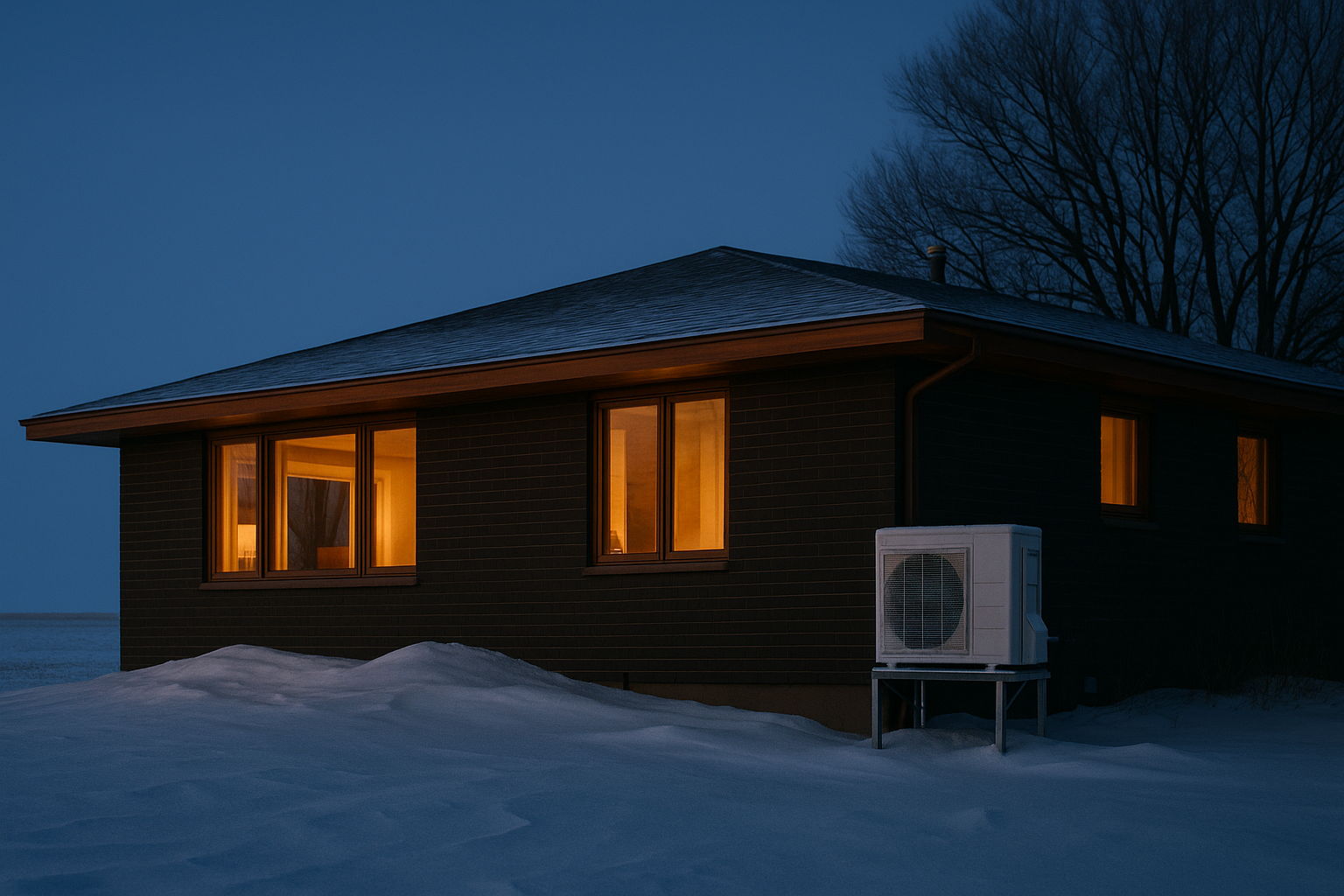
Bismarck's 99% winter design temperature sits near -18°F, and much of the Red River Valley and the state's northern tier lands somewhere between -15°F and -25°F on the ASHRAE tables. Federal rebate paperwork treats a heat pump installed in Fargo and one installed in Phoenix as the same line item, and the equipment behind those two line items has almost nothing in common.
HEEHRA — the Home Electrification and Appliance Rebates program authorized under Section 50122 of the Inflation Reduction Act — offers up to $8,000 toward a qualifying heat pump inside a $14,000 per-household ceiling. What that money buys in North Dakota depends less on the rebate table than on whether the equipment it pays for holds usable capacity when the wind comes out of the northwest at -20°F.
Three variables decide a North Dakota HEEHRA project: program status and who administers it, the income tier that sets your rebate percentage, and the design-temperature math that narrows the qualifying equipment list. Each is covered below, in the order a homeowner tends to encounter them.
HEEHRA rebates in North Dakota are state-administered by the Department of Commerce, not claimed on a federal tax return. Funds are delivered at point of sale through contractors the state has approved and enrolled.
Who Administers HEEHRA In North Dakota
The Inflation Reduction Act routed rebate funding to the states rather than to the IRS, which means every household's experience runs through a state energy office rather than through a tax return. In North Dakota that office is the Department of Commerce, working through its Division of Community Services.
The mechanics are consistent across every state that has launched. The Department of Energy approves a state's application and program design, the state stands up an enrolled contractor network, and rebates are applied as a discount at the point of sale rather than reimbursed months later.
Program status is the detail that changes fastest, and it is the one worth confirming directly rather than inferring from a national article. Before committing to a project schedule, verify current North Dakota program status, application windows, and contractor enrollment with the Department of Commerce, and read our HEEHRA program guide for how state rollouts have generally been phased.
Two structural rules apply regardless of launch date. Most states open the low-income tier first and the moderate-income tier later, and a household generally cannot draw both HEEHRA and the separate HOMES performance rebate for the same measure.
North Dakota's situation has a useful comparison point in the far north. Our breakdown of HEEHRA in Alaska covers how extreme-climate states handle equipment qualification and contractor scarcity, and much of that pattern reads directly onto the northern Plains.
HEEHRA Rebate Amounts And The $14,000 Ceiling
HEEHRA is a set of measure-level caps that stack toward a household maximum, not one lump-sum grant. The table below reflects the statutory federal amounts, which apply in North Dakota exactly as they do elsewhere.
| Measure | HEEHRA maximum | North Dakota relevance |
|---|---|---|
| Heat pump for space heating and cooling | $8,000 | The anchor measure; cold-climate models carry a price premium this cap partly absorbs |
| Heat pump water heater | $1,750 | Ambient temperature in an unconditioned basement or utility room affects real-world performance |
| Electric stove, cooktop, range, or oven | $840 | Draws against the same household ceiling |
| Heat pump clothes dryer | $840 | Draws against the same household ceiling |
| Electrical panel upgrade | $4,000 | Frequently triggered by backup heat strips on older 100-amp services |
| Electrical wiring | $2,500 | Branch circuits for the outdoor unit, air handler, and strip heat |
| Insulation, air sealing, and ventilation | $1,600 | Lowers design heating load directly, which shrinks the equipment required |
| Household total | $14,000 | Hard ceiling across all measures combined |
All of these caps share one budget, which is why the sequencing of a North Dakota project matters more than it does in a mild climate. A cold-climate system, a service upgrade, and envelope work together can consume nearly the entire ceiling before a single appliance is considered.
The $14,000 HEEHRA ceiling is a stack of measure-level caps, not a single grant. A heat pump at $8,000, a panel upgrade at $4,000, and envelope work at $1,600 reach $13,600 before any appliance is added.
The Two Income Tiers, And Why 80% AMI Is The Line That Matters
HEEHRA sets rebate generosity by household income measured against area median income. Households below 80% of AMI may receive 100% of qualified project cost up to the caps above, and households between 80% and 150% of AMI may receive 50%.
Above 150% of AMI, a household falls outside the program entirely. That cliff is why an accurate income determination is worth doing before contractor quotes rather than after.
Above 150% of area median income a household is not HEEHRA-eligible at all. The 80% line is the one that matters most: crossing it drops coverage from 100% of project cost to 50%.
Area median income is not a statewide figure. HUD publishes income limits by county and adjusts them for household size, so the 80% threshold in Cass County is a different dollar amount than the same threshold in Williams, Burleigh, or Grand Forks County.
Household size moves the number substantially in both directions. A four-person household sits at a materially higher dollar limit than a one-person household in the identical county, which is why two neighbors with similar incomes can land in different tiers.
Note that qualified project cost under HEEHRA includes installation labor, not just equipment. In a state where cold-climate installs often involve refrigerant line routing, snow-clearance mounting, and electrical work, labor is a meaningful share of the invoice the rebate is measured against.
What A -20°F Design Temperature Does To Equipment Selection
This is where North Dakota diverges sharply from the national heat pump conversation. A design temperature in the negative teens or lower changes both which equipment qualifies as a serious candidate and how that equipment must be sized.
Rated Capacity And Capacity At Design Temperature Are Different Numbers
AHRI nameplate capacity is published at 47°F outdoor ambient, a condition North Dakota sees in October and April rather than in January. Heat pump output falls as outdoor temperature drops, because there is progressively less heat in the outdoor air for the refrigerant circuit to harvest.
For a well-engineered cold-climate unit, output at 5°F commonly lands somewhere in the range of 60% to 80% of the 47°F rating, and output at -13°F often falls to roughly half. Conventional equipment degrades far faster and, in many cases, has no published rating at those conditions at all.
A cold-climate heat pump rated at 36,000 BTU/hr at 47°F may deliver roughly half that at -13°F. Size from the manufacturer's low-ambient capacity table, not the nominal tonnage on the label.
The practical consequence is that nominal tonnage is close to useless as a selection tool in North Dakota. Our guide to cold-climate heat pump sizing walks through reading the extended capacity tables and matching them against a Manual J load rather than a rule-of-thumb BTU-per-square-foot figure.
Manual J itself should be run against the 99% winter design temperature for the specific location, not against the coldest reading anyone remembers. Designing to a record low oversizes the system for thousands of operating hours in order to serve a handful, and you can sanity-check the inputs with our heat pump load calculator.
The Certifications That Actually Screen For Cold
Federal HEEHRA rules require ENERGY STAR certified heat pumps, which is a floor rather than a North Dakota-appropriate standard on its own. States may layer additional performance requirements on top, so the specific qualifying list published by the Department of Commerce is the authoritative version.
Two screens carry real information at these temperatures, and both are worth applying regardless of what the minimum program rule says:
- ENERGY STAR Cold Climate designation. This is a distinct designation within the residential air-source heat pump specification, tied to performance retention at low ambient rather than to seasonal averages alone. It filters out equipment that scores well on SEER2 and HSPF2 while collapsing in deep cold.
- NEEP cold-climate product listing. The Northeast Energy Efficiency Partnerships list requires manufacturers to publish capacity and coefficient of performance at 47°F, 17°F, 5°F, and in many cases -13°F, along with a minimum COP at 5°F. For a North Dakota project, that low-ambient column is the entire point of the listing.
Both screens exist because seasonal ratings average away the hours that matter most in a cold climate. Our overview of cold-climate heat pump brands compares how manufacturers present these figures, and the technology explainer on enhanced vapor injection heat pumps covers the compressor design most commonly used to hold capacity below zero.
Defrost behavior deserves a separate look as well. Frost accumulation is worst in the humid 20°F to 35°F window rather than at -20°F, where absolute humidity is very low, and our discussion of defrost cycles and sizing covers how those cycles factor into delivered seasonal capacity.
Backup Heat, Balance Points, And Panel Capacity
Almost every North Dakota heat pump installation is a two-source system by design. The heat pump carries the large majority of annual heating hours, and a backup source covers the coldest stretch and the defrost intervals.
The balance point is the outdoor temperature at which heat pump output equals the building's heat loss. Below it, backup heat is required, and where that point falls is a function of the equipment curve and the envelope rather than of the brand on the label.
Backup comes in two common forms in the state, and the choice has electrical consequences. Electric resistance strips are simple and inexpensive to install but expensive to run, while a retained propane or natural gas furnace in a dual-fuel configuration switches over at a set outdoor temperature.
| Strip heat size | Approximate output | Approximate draw at 240V |
|---|---|---|
| 5 kW | 17,100 BTU/hr | 21 amps |
| 10 kW | 34,100 BTU/hr | 42 amps |
| 15 kW | 51,200 BTU/hr | 63 amps |
| 20 kW | 68,200 BTU/hr | 83 amps |
A 10 kW electric backup strip delivers about 34,100 BTU/hr and draws roughly 42 amps at 240 volts. A 15 kW strip delivers about 51,200 BTU/hr at roughly 63 amps, which is where panel capacity becomes the constraint.
Those amperage figures explain why the $4,000 panel allowance appears in so many northern-tier projects. A house on a 100-amp service with an existing electric water heater and range has limited headroom for a 15 kW strip bank, and our guide to heat pump panel capacity covers running the load calculation before the equipment is ordered.
Control strategy is the other half of the equation. Setting switchover and lockout thresholds correctly keeps strips from engaging during mild-weather recovery cycles, and the mechanics are laid out in our pieces on balance point controls and heat pump backup heat.
The North Dakota Co-op Rate Variable
Much of rural North Dakota is served by electric cooperatives rather than by investor-owned utilities. Many of those cooperatives offer off-peak or dual-fuel electric heating rates, which discount heating kilowatt-hours in exchange for a controllable backup source and a load-management device.
Many North Dakota electric cooperatives offer off-peak or dual-fuel heating rates that require a controllable backup heat source. Enrolling can change operating cost more than equipment choice does.
These rate structures interact directly with the backup-heat decision described above, since eligibility usually depends on having a backup source the utility can call. Confirm the specific terms with your serving cooperative before finalizing a control strategy, because enrollment rules and control-device requirements vary between systems.
Sequencing A North Dakota Project
Order of operations affects both rebate efficiency and equipment size. The sequence below reflects how the pieces depend on one another:
- Confirm program status and tier. Check current Department of Commerce program status and pull the HUD income limit for your county and household size before requesting quotes.
- Address the envelope first. Air sealing and insulation lower design heating load, which shrinks required capacity and can drop the backup heat bank by a stage or two.
- Run a Manual J at the local design temperature. Use the 99% winter value for your location, not a national default and not a record low.
- Select equipment from low-ambient capacity tables. Compare published output at 5°F and -13°F across candidates rather than comparing nominal tonnage.
- Size backup and check the panel. Establish the balance point, size the strips or dual-fuel switchover accordingly, then verify service capacity against a full load calculation.
Working in this order tends to reduce total project cost rather than simply reshuffle it. A smaller design load produces smaller equipment, a smaller backup bank, and in some cases avoids a service upgrade altogether.
Federal incentive rules have shifted in recent years, so any stacking plan should be built against current status rather than against older guidance. Our federal tax credit status page tracks what is currently available alongside state and utility programs.
Common Questions About HEEHRA In North Dakota
Does the rebate reduce my contractor invoice, or do I receive a check later?
HEEHRA is structured as a point-of-sale rebate delivered through contractors enrolled in the state program. The discount appears on the invoice rather than arriving as a reimbursement after the work is complete.
Do renters and rental properties qualify?
The program covers single-family and multifamily properties, and multifamily buildings in which at least half of residents fall below the low-income threshold are generally treated as low-income for eligibility purposes. Because state implementation of the multifamily pathway varies, confirm the specific North Dakota rules with the Department of Commerce.
Is whole-home electrification required, or can I replace only the heating system?
HEEHRA is measure-based, so a household may pursue a heat pump without converting every appliance. Keep in mind that the panel and wiring allowances are tied to a qualified electrification project rather than being available as standalone electrical work.
Should envelope work happen before or after equipment selection?
Envelope work first, in nearly every case. Air sealing and added insulation reduce the design heating load that Manual J calculates, and selecting equipment before that work is done locks in capacity sized for a building that will no longer exist.
Where To Go From Here
North Dakota is one of the more demanding heat pump environments in the country, and it is also one where the equipment has changed most dramatically in the past several years. The rebate ceiling is identical to Arizona's; the engineering behind it is not.
If you are weighing a project, the two documents that carry the most decision weight are your county's HUD income limit and the manufacturer's low-ambient capacity table for the specific model under consideration. Everything else follows from those two numbers, and our HEEHRA guide collects the state-by-state detail alongside them.
This article is for informational purposes and is not financial, tax, legal, or medical advice. Consult a licensed professional (CPA, elder-law attorney, HVAC contractor, state Medicaid office) before acting.