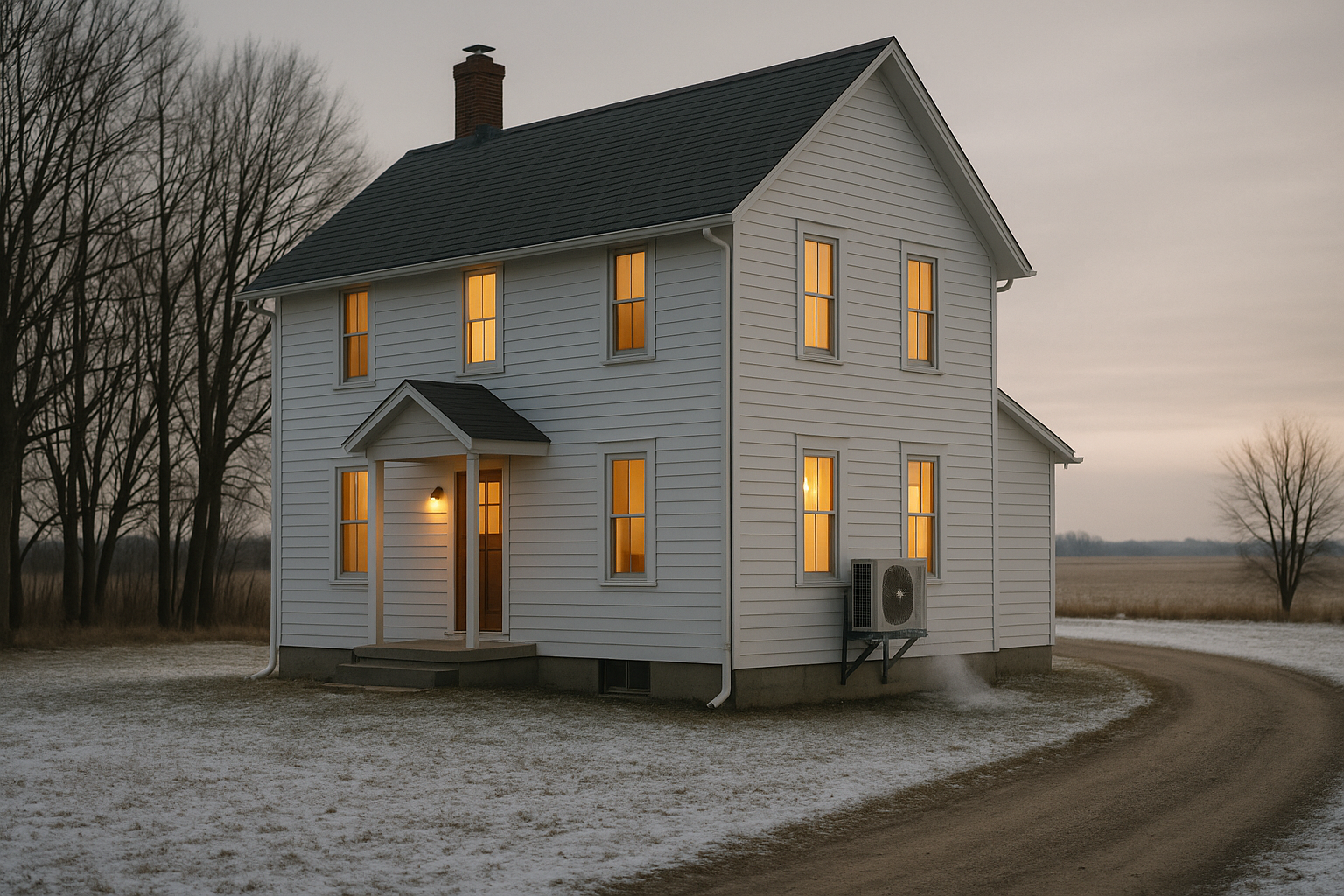
Do you know whether the federal electrification rebates you have been reading about can actually be booked in Iowa today? If you own a home here, that question is worth settling before you call a contractor, because the Home Electrification and Appliance Rebates program is one federal statute delivered through fifty separate state programs.
Iowa makes the question harder than most states for two reasons. The heating season is long enough that sizing and backup-heat decisions carry real money, and the utility map is split between two investor-owned utilities, roughly 136 municipal electric systems, and dozens of rural electric cooperatives.
What follows separates the parts that are settled federal law from the parts that still depend on an Iowa agency posting a portal. Keep in mind that the federal caps below are fixed by statute, while everything about timing, application mechanics, and contractor networks is a state decision.
HEEHRA is the Inflation Reduction Act's state-administered electrification rebate, capped at $14,000 per household. Iowa availability depends on the state's rollout, so confirm status with the Iowa Economic Development Authority first.
What HEEHRA Is, In Plain Statutory Terms
HEEHRA — the Home Electrification and Appliance Rebates program, created by Section 50122 of the Inflation Reduction Act and often abbreviated HEAR in federal documents — is a point-of-sale rebate for swapping combustion or resistance equipment for electric equipment. It is income-qualified, capped per measure and per household, and funded through formula allocations that the U.S. Department of Energy distributes to state energy offices.
The distinction that trips up most homeowners is administrative rather than technical. Congress set the caps and the eligibility math, but each state writes its own application flow, contractor qualification rules, and launch date, which is exactly why our HEEHRA program guide tracks states individually rather than as one national program.
The structural features that hold true in every state include but are not limited to:
- Income qualification. Eligibility runs off area median income, not a flat federal income line, so the same household income qualifies differently in Polk County than in a rural non-metro county.
- Per-measure caps. Each equipment category carries its own ceiling, and those ceilings do not float with equipment prices.
- A household total. The $14,000 aggregate applies across all measures, so a full electrification project can hit the ceiling before the last appliance is installed.
- State administration. Funds move through the state energy office, and the contractor typically applies the rebate at the point of sale rather than the homeowner filing for reimbursement.
All of these are federal constants. What varies from Iowa to Illinois to Colorado is when the money is actually claimable and through which contractor network.
Iowa's Rollout Status And What To Verify First
Iowa's state energy office sits inside the Iowa Economic Development Authority, which is the agency that would receive and administer DOE home energy rebate funding. Because rollout timing has moved repeatedly across states, treat Iowa availability as unconfirmed until you can see an open application channel with your own eyes.
That verification is a short exercise, and it is worth doing before a contractor quotes you a price that assumes rebate money.
Four things to confirm before signing. Each one is a yes-or-no answer you can get in a single phone call or webpage visit.
- Program status. Whether the Iowa Economic Development Authority has opened a Home Electrification and Appliance Rebates application channel, and whether it is accepting new reservations or is waitlisted.
- Contractor eligibility. Whether your installer appears on the state's participating contractor list, since HEEHRA is generally applied by the contractor, not reimbursed to the homeowner afterward.
- Income documentation. Which HUD income limit table and household-size column the state is using, and what proof of income it accepts.
- Reservation timing. Whether funds are reserved at contract signing or at installation, which determines your exposure if the allocation runs dry mid-project.
If any of the four cannot be answered, the safer read is that the rebate is not yet bankable and the quote should stand on its own economics.
The Income Tiers: 80% AMI, 150% AMI, And Which HUD Area You Live In
HEEHRA's income math is a two-step function rather than a sliding scale, and the step you land on changes the rebate by a factor of two. The reference point is area median income published by HUD, adjusted for household size, for the metropolitan area or non-metro county where the home sits.
Iowa is a mix of HUD metropolitan areas — Des Moines–West Des Moines, Cedar Rapids, Iowa City, Davenport, Waterloo–Cedar Falls, Sioux City, Ames, and Dubuque among them — and non-metro counties that use a county or statewide non-metro figure. Two households with identical income can therefore land in different tiers depending on which side of a county line they live on.
HEEHRA uses two income tiers. Households under 80% of area median income can have up to 100% of project cost covered, and households at 80% to 150% AMI up to 50%. Above 150% AMI, HEEHRA does not apply.
| Income tier | Share of project cost covered | Practical effect |
|---|---|---|
| Under 80% of AMI | Up to 100%, subject to per-measure caps | The per-measure ceiling, not the percentage, becomes the binding constraint on most projects |
| 80% to 150% of AMI | Up to 50%, subject to per-measure caps | A $12,000 heat pump install returns roughly $6,000, well under the $8,000 measure cap |
| Above 150% of AMI | Not eligible for HEEHRA | The decision shifts entirely to utility programs and whatever federal credit is currently in force |
Note that the percentage and the dollar cap operate together, and whichever bites first controls. Our breakdown of how HEEHRA income tiers are calculated walks through the household-size adjustment that most online calculators skip.
Rebate Amounts By Equipment Category
The per-measure caps are written into the statute and are identical in every state, which makes them the one part of an Iowa HEEHRA quote you can verify without calling anyone. What a state controls is whether those dollars are available, not how large they are.
HEEHRA caps are statutory: $8,000 for a heat pump, $1,750 for a heat pump water heater, $840 per electric appliance, $4,000 for a panel upgrade, and $14,000 per household in total.
| Measure | Statutory cap | Iowa-specific note |
|---|---|---|
| Air-source heat pump (space heating and cooling) | $8,000 | The category where a cold-climate-rated unit and a real load calculation matter most in zones 5A and 6A |
| Heat pump water heater | $1,750 | Unconditioned Iowa basements run cold in January, which affects placement and recovery rate |
| Electric stove, cooktop, range, oven, or heat pump clothes dryer | $840 per appliance | Often the measure that pushes a project against the panel capacity limit |
| Electrical panel or service upgrade | $4,000 | Eligible only as part of a qualifying electrification project, not as a standalone job |
| Electrical wiring | $2,500 | Covers the branch circuit and service work the new equipment requires |
| Insulation, air sealing, and ventilation | $1,600 | The measure with the best return in Iowa's older housing stock, and the one most often deferred |
| Household total | $14,000 | A whole-home electrification package will typically exceed this, so sequencing matters |
Add those caps together and the arithmetic makes the point on its own — the individual measures sum to more than the household ceiling. Accordingly, a household planning heat pump, water heater, panel, and envelope work in one season should decide in advance which measures the $14,000 is spent on.
Qualifying Equipment In A Zone 5A And 6A Winter
Equipment qualification for HEEHRA hangs on ENERGY STAR certification for the relevant appliance category, which is a floor rather than a specification. Iowa spans IECC climate zones 5A and 6A, with the northern tier of counties in 6A, and a unit that merely clears the ENERGY STAR floor can still be the wrong unit for a February morning in Mason City.
Qualifying equipment must be ENERGY STAR certified, and in Iowa's zone 5A and 6A winters the Cold Climate designation matters more. Ask for the AHRI certificate covering the matched indoor and outdoor pair.
The specifications that separate a qualifying unit from an appropriate one include:
- ENERGY STAR Cold Climate designation. This designation adds capacity-retention and low-temperature performance criteria beyond the base certification, and it is the single most useful filter for an Iowa install.
- SEER2 and HSPF2 ratings. These replaced SEER and HSPF under the M1 test procedure in 2023 and are measured at higher external static pressure, so a SEER2 figure is not directly comparable to an older SEER number on a competitor's spec sheet.
- The AHRI Certified reference number. Ratings apply to a specific matched outdoor and indoor combination, and a substituted air handler or coil voids the published performance.
- Published capacity tables. Ask for output at 47°F, 17°F, 5°F, and where available −5°F, because the nameplate tonnage tells you nothing about what the unit delivers at your design temperature.
- Modulation range. A variable-speed inverter compressor turning down to a low fraction of rated capacity avoids the short-cycling that plagues oversized single-stage equipment in Iowa's long shoulder seasons.
Iowa's 99% winter design temperature runs roughly from near 0°F in the southern counties to approximately −10°F or colder along the Minnesota border, and the exact figure for your county should come from the ACCA Manual J or ASHRAE table rather than an estimate. That number drives everything downstream, which is why our guidance on cold-climate heat pump sizing treats the design temperature as the first input, not the last.
A Manual J load calculation, a Manual S equipment selection against the manufacturer's capacity tables, and a Manual D duct review are the three documents worth insisting on. If a contractor sizes from square footage or from the tonnage of the outgoing furnace, the rebate paperwork may still clear while the system underperforms for the next fifteen years — and you can pressure-test the arithmetic yourself with our heat pump load calculator before the proposal arrives.
Backup heat is the other Iowa-specific decision. Whether you specify electric resistance strips or a dual-fuel arrangement with the existing furnace changes both the operating cost curve and the electrical load, and our discussion of heat pump backup heat strategies covers where the balance point typically lands in a 6A climate.
Iowa's Split Utility Territories
Federal rebate rules are uniform statewide, but the utility incentives that stack on top of them are not. Iowa's two investor-owned electric utilities, MidAmerican Energy and Alliant Energy's Interstate Power and Light, file energy efficiency plans with the Iowa Utilities Commission — the agency formerly known as the Iowa Utilities Board — while municipal systems and rural electric cooperatives operate outside that structure entirely.
Iowa's utility incentives split by territory. MidAmerican and Alliant file efficiency plans with the Iowa Utilities Commission, while municipal utilities and rural cooperatives set their own — confirm your provider first.
Iowa's efficiency-program budgets also carry a legislative history worth knowing. Senate File 2311, enacted in 2018, capped investor-owned electric utility energy efficiency spending at 2% of revenue and gas at 1.5%, and allowed large customers to opt out, which materially reduced the size of Iowa's utility rebate pool relative to neighboring states.
Municipal systems such as Cedar Falls Utilities, Ames Electric Services, and Muscatine Power and Water set their own program budgets and terms, as do the state's rural electric cooperatives. Be aware that your rebate eligibility follows the meter, not the mailing address, and homes on the edge of a municipal boundary are frequently misquoted for exactly this reason.
The practical consequence is that two identical houses forty miles apart in Iowa can face different total incentive stacks on the same equipment. That variance is a good argument for confirming your provider and its current program terms before comparing quotes, and for reading how a neighboring state handles the same split in our Illinois HEEHRA breakdown.
Panel Capacity, Wiring, And The $4,000 Line Item
HEEHRA's $4,000 panel allowance and $2,500 wiring allowance exist because electrification frequently outruns the existing service. In Iowa's older housing stock, 100-amp services are common, and adding a heat pump with resistance backup can push the calculated load past what that service supports.
HEEHRA allows up to $4,000 for an electrical panel upgrade and $2,500 for wiring, but only inside a qualifying electrification project. A load calculation determines whether your existing service can carry the equipment.
The load driver is usually the backup heat rather than the compressor. A 10 kW electric resistance heat kit draws roughly 41.7 amps at 240 volts, which is a substantial addition to a 100-amp service already carrying a range, a dryer, and a water heater.
An NEC load calculation, rather than a visual look at the breaker panel, is what settles the question. Our walkthrough of heat pump panel capacity requirements covers the standard and optional calculation methods and the load-management devices that sometimes avoid a service upgrade altogether.
Stacking HEEHRA With Federal Credits And Utility Programs
Stacking is where the largest arithmetic errors happen, because rebates and tax credits interact rather than simply adding. A rebate generally reduces the expenditure base on which a federal credit is calculated, so claiming both on the same equipment does not produce the sum of the two headline numbers.
The federal credit landscape also changed at the end of 2025, and the residential clean energy credit that covered solar expired on December 31, 2025. Before you build a solar-plus-heat-pump plan around a federal credit, confirm what remains in force on our federal tax credit status page.
Sequencing matters more than most quotes suggest. Our analysis of HEEHRA and 25C stacking mechanics and the 25C versus HEEHRA decision tree lay out the order of operations for households that sit near the 150% AMI line and could reasonably go either way.
A Decision Rule, Indexed To Where You Are
The right next step depends less on the equipment than on your timing, and Iowa homeowners tend to arrive at this question in one of three postures. Here is how each one resolves.
- Pre-purchase, with a working furnace. Get the Manual J and the county design temperature first, then confirm HEEHRA status with the Iowa Economic Development Authority and your utility's current program terms — this is the only posture with enough runway to let the rebate influence the equipment choice.
- Mid-application, with a quote in hand. Verify that the reservation is tied to a specific fund commitment and that the AHRI certificate matches the exact indoor and outdoor units listed on the proposal, since substitutions after approval are a common source of denied claims.
- Emergency replacement in January. Treat the rebate as unavailable and evaluate the quote on its own merits, because a failed furnace in a 6A winter is not a situation that tolerates a multi-week approval cycle. If the rebate later proves claimable, that is upside rather than the basis for the decision.
In all three cases the underlying rule is the same. The federal caps are knowable today, the Iowa administration is not, and a purchase that only makes sense with the rebate is a purchase that depends on an agency timeline you do not control.
Definitions And Background Information
What does AMI mean in the HEEHRA context?
Area median income is the HUD-published median for a metropolitan area or non-metro county, adjusted for household size. HEEHRA measures your household against 80% and 150% of that figure, which is why the same income qualifies differently across Iowa.
What is the difference between HEEHRA and HOMES?
HEEHRA, under Section 50122, pays for specific electrification measures and is income-qualified. The Home Efficiency Rebates program, under Section 50121, pays based on modeled or measured whole-home energy savings and is structured differently.
What is a 99% winter design temperature?
It is the outdoor temperature that local conditions stay above 99% of the hours in a year, and it is the temperature a Manual J load calculation sizes to. Designing to the record low instead produces a badly oversized system.
Why does HSPF2 matter more than SEER2 in Iowa?
HSPF2 measures seasonal heating efficiency, and Iowa's load is heating-dominated across both climate zone 5A and 6A. SEER2 describes cooling performance, which carries less weight in a state with a long heating season.
What is a balance point, and why does it appear on Iowa quotes?
The balance point is the outdoor temperature at which heat pump output equals the home's heat loss. Below it, backup heat engages, and where that point sits determines a meaningful share of your winter operating cost.
Where To Go From Here
Iowa's HEEHRA picture is unusually easy to misread because two of its three layers are unsettled — the state rollout and the utility incentive, with only the federal caps fixed. Separating those layers before you shop is what keeps a quote honest.
If you are working through equipment selection next, our comparisons of cold-climate heat pump brands and heat pump water heater selection pick up where this guide ends. For the full state-by-state program tracker, start at the HEEHRA guide hub.
This article is for informational purposes and is not financial, tax, legal, or engineering advice. Consult a licensed professional — a CPA, a licensed HVAC contractor, a licensed electrician, or the Iowa Economic Development Authority's energy office — before acting.
Published by The ElectrifyAtlas Editors.