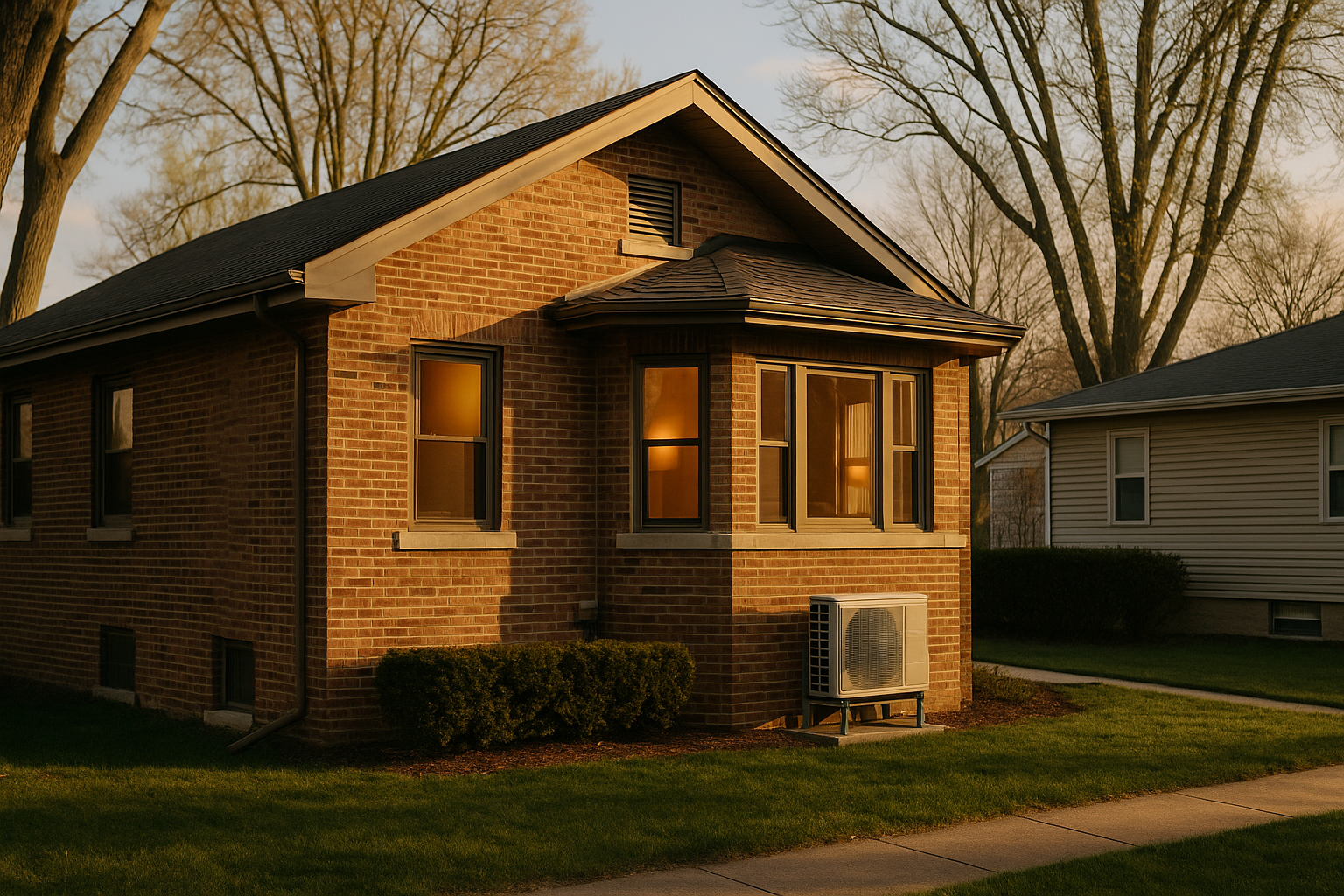
The Illinois EPA opened its HEEHRA portal in early 2026, and households earning under 150% of area median income can now claim up to $14,000 in upfront rebates on heat pumps, heat pump water heaters, induction cooktops, and electrical upgrades. Below: the actual rebate tiers, the income caps for major Illinois counties, the contractor-mediated application path through IL EPA, and the equipment requirements you need to confirm before peak summer install season hits.
Have you been waiting on Illinois to open its share of the federal HEEHRA dollars? The Illinois Environmental Protection Agency finalized its rollout in February 2026, and the application portal is now live for income-qualified homeowners statewide.
That puts Illinois in the same camp as New York's NYSERDA-administered HEEHRA program and the broader state-by-state HEEHRA status tracker we've been keeping current. Illinois is the eighteenth state to flip its portal on — and the timing matters, because peak summer install season starts in May.
What is HEEHRA in Illinois? HEEHRA is the federal High-Efficiency Electric Home Rebate Act, administered in Illinois by the Illinois EPA as of February 2026. Eligible households earning up to 150% of area median income can receive between $4,000 and $14,000 in upfront rebates on heat pumps, induction cooktops, electrical panel upgrades, and weatherization measures.
How Much Can Illinois Households Actually Get?
Total HEEHRA awards in Illinois cap at $14,000 per household across all eligible projects. That ceiling is set by federal statute and applies in every state, but Illinois has confirmed it will not impose a lower cap of its own.
The per-measure caps follow the federal HEEHRA structure exactly. Heat pumps get the largest single allocation at $8,000, with smaller buckets for water heaters, cooking appliances, electrical work, and insulation.
| Eligible Measure | Per-Project Cap |
|---|---|
| ENERGY STAR-certified heat pump (HVAC) | $8,000 |
| Heat pump water heater | $1,750 |
| Heat pump clothes dryer | $840 |
| Electric or induction cooktop / range | $840 |
| Electrical panel or breaker box upgrade | $4,000 |
| Electric wiring upgrades | $2,500 |
| Insulation, air sealing, ventilation | $1,600 |
| Maximum total per household | $14,000 |
Who Qualifies — The AMI Income Tiers
HEEHRA eligibility runs off Area Median Income, which the U.S. Department of Housing and Urban Development sets county-by-county. Illinois uses the 2025 HUD AMI tables for its 2026 program year, with an annual refresh planned each April.
There are two qualifying tiers, and each one delivers a different rebate percentage. The lower-income tier gets full coverage; the moderate-income tier gets half.
Tier 1 — Up to 80% AMI (100% of project cost covered)
Households at or below 80% of their county's area median income receive a rebate equal to 100% of equipment and installation cost, up to the per-project caps above. For most cold-climate heat pump installs in Illinois, that means a fully covered system.
Tier 2 — 80% to 150% AMI (50% of project cost covered)
Households between 80% and 150% AMI receive a rebate equal to 50% of project cost, also capped at the per-measure dollar limits. For a $12,000 cold-climate heat pump install, that translates to $6,000 back at the point of sale.
Above 150% AMI — Not eligible for HEEHRA
Households earning more than 150% of county AMI cannot access HEEHRA. However, the federal 25C tax credit and any utility-specific rebates from ComEd or Ameren remain on the table.
For deeper detail on how the tiers work nationally, see our HEEHRA income tier breakdown. Illinois adopts the federal structure without modification, so the national rules apply directly.
What are the Illinois HEEHRA income limits? Eligibility is based on county-level Area Median Income from the 2025 HUD tables. Households at or below 80% AMI receive 100% rebate coverage, those between 80% and 150% AMI receive 50% coverage, and households above 150% AMI are not eligible for HEEHRA but may still claim the federal 25C tax credit.
What 80% and 150% AMI Look Like in Illinois Counties
AMI varies sharply across the state. A household of four in Cook County faces very different income thresholds than the same household in Adams or Pulaski County downstate.
| County (Household of 4) | 80% AMI | 150% AMI |
|---|---|---|
| Cook (Chicago metro) | $92,200 | $172,875 |
| DuPage | $92,200 | $172,875 |
| Lake | $95,400 | $178,875 |
| Sangamon (Springfield) | $77,750 | $145,800 |
| Champaign | $76,800 | $144,000 |
| Peoria | $74,200 | $139,125 |
| St. Clair (Metro East) | $72,950 | $136,800 |
| Rural downstate (median of remaining counties) | $67,200 | $126,000 |
These figures are 2025 HUD values used by IL EPA for the 2026 program year. Actual eligibility is calculated at point of sale by the contractor's portal, so you don't need to self-certify before getting a quote.
Eligible Equipment — What Illinois Will and Won't Cover
Equipment must appear on Illinois EPA's qualified products list, which leans heavily on ENERGY STAR Most Efficient and CEE Tier 2/3 designations. The state has not added supplementary efficiency floors above the federal minimum.
Heat pumps must meet the cold-climate spec (HSPF2 ≥ 8.1 or COP ≥ 1.75 at 5°F) for installs north of I-80, which covers most of the state's heating demand. If you're sizing a system for the Chicago region, our cold-climate heat pump sizing guide walks through Manual J calculations for Illinois winters.
Heads up — HEEHRA is rebate-only, not a tax credit. The money comes off your invoice at install, not on your following spring tax return. That distinction matters for stacking with the 25C federal credit, which we walk through in detail.
How to Apply Through the Illinois EPA
Illinois uses a contractor-mediated application model, similar to what New York and Massachusetts deployed in their rollouts. You don't apply directly — your installer submits everything through the IL EPA portal on your behalf.
The full path takes three to six weeks from contractor selection to install, depending on income verification turnaround. Expect longer windows in May and June as install volume peaks.
Step 1 — Find an IL EPA-approved contractor. The state maintains a searchable directory at illinois-epa.gov/heehra. As of April 2026, roughly 340 contractors are enrolled, concentrated in Chicagoland and the Metro East.
Step 2 — Get a quote and submit income documentation. Your contractor uploads your most recent federal tax return or pay stubs into the portal. IL EPA verifies your AMI tier within 5-10 business days.
Step 3 — Receive pre-approval and schedule install. Pre-approval locks in your rebate at the verified tier. The rebate is applied as a discount on your final invoice — you never write a check for the full amount.
Step 4 — Contractor submits proof of install. Within 30 days of completion, the contractor uploads install photos, equipment serial numbers, and a signed completion certificate. IL EPA reimburses the contractor directly, typically within 14 days.
How do I apply for HEEHRA in Illinois? Applications go through an IL EPA-approved contractor, not directly through the homeowner. The contractor submits your income documentation, receives pre-approval within 5-10 business days, applies the rebate as an upfront discount on your invoice, and then claims reimbursement from the state after install is verified.
How Long the Whole Process Actually Takes
From the moment you sign with an enrolled contractor, the timeline runs three to six weeks to install completion. The bottleneck is income verification, which IL EPA processes in 5-10 business days during normal load and closer to 10-15 in peak season.
Once you have pre-approval in hand, the install schedule itself is on the contractor — and Illinois is currently running a six-week backlog with the most popular installers. Booking now for an August or September install is the realistic path for non-emergency replacements.
How long does the Illinois HEEHRA application take? From contractor selection to completed install, the typical timeline runs three to six weeks. Income verification with IL EPA takes 5-10 business days, contractor pre-approval is immediate after verification, and the rebate is applied to your invoice the day of install. Expect longer turnarounds during the May-September peak season.
Stacking HEEHRA with 25C and Utility Programs
HEEHRA does not stack on the same dollar as the federal 25C tax credit. You cannot claim both for the same equipment line item, but you can combine HEEHRA on the heat pump with 25C on the panel upgrade — provided the contractor itemizes correctly.
Illinois utility rebates from ComEd and Ameren do stack on top of HEEHRA. Most ComEd heat pump bonuses sit in the $300-$1,500 range, applied as bill credits within 60-90 days of install.
For the full sequencing logic — which application goes first, which receipt feeds which form — see our rebate stacking application order guide. Getting this sequence wrong is the single most common reason homeowners leave money on the table.
Can I stack HEEHRA with the 25C federal tax credit in Illinois? Yes, but not on the same equipment. You can claim HEEHRA on the heat pump and 25C separately on the electrical panel upgrade or weatherization, as long as your contractor itemizes each measure on the invoice. Double-claiming the same line item is disallowed by federal HEEHRA rules.
Common Pitfalls Specific to Illinois
Three issues have surfaced in the first weeks of program activity. None are fatal, but each can slow your timeline by weeks if you don't plan around them.
Pitfall 1 — Using a non-enrolled contractor. A licensed Illinois HVAC contractor is not automatically a HEEHRA contractor. Verify enrollment in the IL EPA directory before signing anything.
Pitfall 2 — Submitting a 2024 tax return after April 15, 2026. IL EPA wants the most recent filed return. Filing a 2025 return mid-application restarts your income verification clock.
Pitfall 3 — Assuming "ENERGY STAR" is enough. The qualified products list is narrower than ENERGY STAR generally. Confirm the specific model number is on the IL EPA list, not just the manufacturer's qualified family.
How Illinois Compares to Other State HEEHRA Rollouts
Illinois's per-household cap and tier structure are identical to every other state's HEEHRA program — that's set by federal statute. What differs is administrative speed, contractor enrollment density, and income-verification turnaround.
| State | Portal Live | Verification Turnaround | Enrolled Contractors |
|---|---|---|---|
| New York (NYSERDA) | Q3 2024 | 3-7 days | 1,800+ |
| Massachusetts | Q4 2024 | 5-10 days | 900+ |
| California | Q1 2025 | 10-15 days | 2,400+ |
| Illinois | Q1 2026 | 5-10 days | ~340 (growing) |
Contractor density will be the bottleneck for Illinois homeowners through 2026. If you live outside Chicagoland or the Metro East, expect a longer search to find an enrolled installer in your service area.
Frequently Asked Questions About HEEHRA in Illinois
When did Illinois HEEHRA actually open?
The Illinois EPA opened its contractor portal in February 2026, with the first homeowner-facing rebates flowing in March 2026. The state was allocated approximately $130 million in HEEHRA funding under the 2022 Inflation Reduction Act, but did not finalize its administrative plan until late 2025.
Is HEEHRA money first-come, first-served in Illinois?
Yes. Illinois received a fixed allocation from the federal Department of Energy, and once the state's pool is exhausted, no further rebates are issued. IL EPA estimates the current allocation will fund roughly 18,000-22,000 households, depending on per-project mix.
Do I need to be the homeowner to qualify?
For single-family applications, yes — the applicant must be the property owner of record. Renters in multifamily buildings may benefit indirectly through the multifamily HEEHRA track, which the building owner applies for separately and which has its own income-qualification rules.
Can I get HEEHRA on a ductless mini-split?
Yes. Ductless mini-splits qualify if they meet the cold-climate efficiency floor, and the same $8,000 cap applies whether you install ducted or ductless. See our breakdown of ducted versus ductless heat pumps in cold climates for the equipment selection logic.
What happens if I install before getting pre-approval?
You forfeit the rebate. HEEHRA is not retroactive in Illinois — the pre-approval and contractor-mediated invoice discount are mandatory steps. Self-installs and DIY work are also not eligible under any income tier.