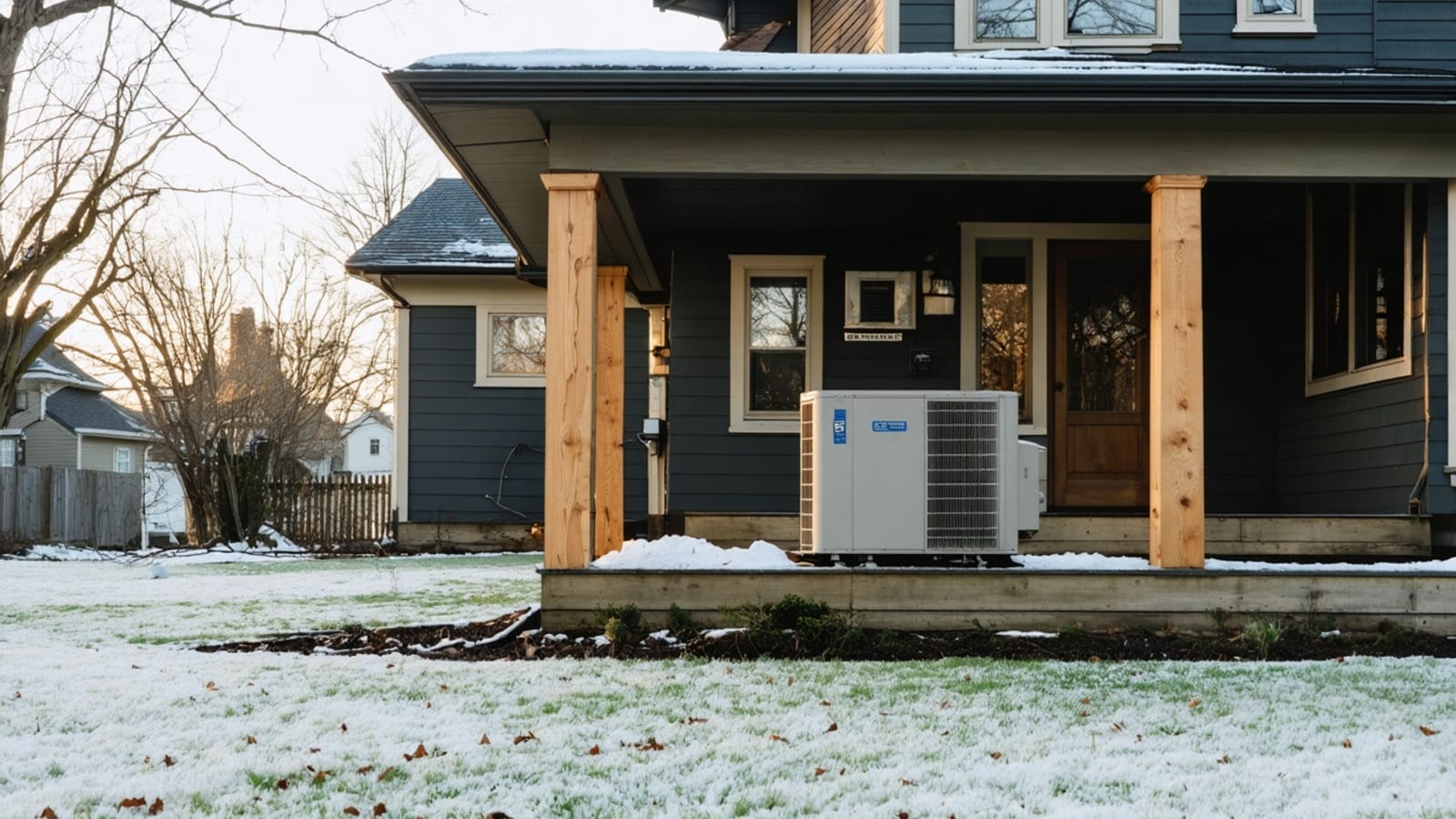
This is a sample scenario built from current NYSERDA Clean Heat program rules, National Grid upstate-territory rebate tariffs, and typical 2026 installer quotes in the Buffalo metro. No single homeowner matches this exact composite — the math below is a worked example of what an oil-to-heat-pump conversion looks like for a moderate-income household in a postwar western New York colonial.
The point is to show how oil-replacement economics pencil when every layer of the 2026 stack is applied, not to profile a specific customer.
The homeowner and the home
The home is a 2,000 square foot 1952-vintage center-hall colonial on the east side of Buffalo, with a full basement, three bedrooms on the second floor, and a living room plus dining room plus small kitchen on the first. Existing heat is a 1988 oil furnace feeding forced-air ductwork in a basement trunk plus first-floor boots plus second-floor registers. The ductwork is undersized by modern standards but generally intact and serviceable.
The house has no central AC — summer cooling is handled by two through-wall units that are 15+ years old and ready for replacement. The homeowner explicitly wants central cooling as part of the conversion, which is why a ducted heat pump (rather than a ductless multi-zone) is the right system choice.
The electrical service is 150A, which has headroom for the heat pump's 50-amp circuit and the backup 5-kW electric resistance strip but not much margin for additional electrification (HPWH, induction) without a panel upgrade. That is a second-phase consideration outside this scenario.
The climate zone is ASHRAE 5A — cold-humid. Buffalo's 99% design temperature is 4 degrees Fahrenheit, which puts the equipment spec firmly in the NEEP Cold Climate Air Source Heat Pump Product List. See the cold climate heat pump sizing deep-dive for the equipment selection logic in similar climate zones.
The equipment spec
The proposed system is a Carrier Infinity 25VNA4 5-ton variable-speed inverter-driven outdoor unit paired with a matched Carrier FV4C air handler, both AHRI-certified on the NEEP CCASHPPL. HSPF2 is 9.0, SEER2 is 19.0, and delivered capacity at 5 degrees Fahrenheit is 85% of nameplate (approximately 51,000 BTU on the 60,000 BTU nameplate).
The air handler includes a 5-kW electric resistance heat strip for backup — Buffalo's design temperature requires it, and NYSERDA's Clean Heat specification allows it as long as the heat pump is the primary heat source and strips are locked to engage only below 5 degrees Fahrenheit.
The system includes an ecobee Smart Thermostat Premium with outdoor temperature sensor for strip-engagement logic, a new 200-amp-capacity-rated disconnect at the outdoor unit (even on 150A service, modern NEC requires the larger disconnect), and duct modifications to increase return air capacity — the existing return is undersized by approximately 15% for the 5-ton airflow.
Manual J load calculation confirms 54,000 BTU heating load at design temperature, with modest oversizing to allow for post-retrofit comfort margin. See our Manual J load calculation guide for the sizing methodology.
The pre-rebate quote
Three-installer bids from Buffalo-area NYSERDA-certified contractors for this exact equipment spec cluster between $20,000 and $24,000. The midpoint used in this sample is $22,000. The itemization below:
- Equipment (outdoor unit + air handler + electric strip + thermostat + disconnect): $11,200
- Labor (4-day install, 3-person crew): $5,800
- Electrical (new 50-amp heat pump circuit, upgraded disconnect, conduit run): $1,800
- Duct modifications (return-air expansion, two supply additions): $1,400
- Oil tank removal and cap (above-ground basement tank, no contamination): $1,000
- Permits (Buffalo mechanical + electrical): $300
- Contingency (refrigerant line re-routing, structural penetrations): $500
The oil tank removal line is separate from the heat pump install because the contractor typically subs this out to an oil-service company. The $1,000 figure assumes a clean basement tank with no spillage history — contamination pushes the number significantly higher.
The rebate stack
Four layers apply here. The order below is the practical filing sequence.
Manufacturer rebate — $600. Carrier Cool Cash on the Infinity 25VNA4 5-ton class typically runs $500-$800 in spring and fall promotions. The $600 assumption is the midpoint for spring 2026 campaigns. Filed by the contractor at quote with manufacturer pre-approval.
National Grid utility rebate — $2,000. National Grid's upstate-New-York residential heat pump rebate pays $1,000 per ton for cold-climate ducted systems, capped at $2,000 per project. The 5-ton system claims the cap. National Grid is point-of-sale through participating contractors in the Buffalo, Syracuse, and Albany markets.
NYSERDA Clean Heat — $4,500. NYSERDA Clean Heat is the state's flagship heat pump incentive, funded by the Regional Greenhouse Gas Initiative (RGGI) and administered separately from HEEHRA. Clean Heat pays $1,000 per ton on cold-climate systems with a bonus tier for oil-replacement conversions (an additional $500 per ton up to a $2,500 bonus cap). The 5-ton system claims $1,000 x 5 = $5,000 base, but with the $4,500 program cap per project (as of 2026 tariff), the effective payout is $4,500. Clean Heat is point-of-sale through NYSERDA-listed contractors.
HEEHRA 50% tier — $4,000. A household at 110% of Buffalo MSA AMI falls in the 80-150% HEEHRA tier, which pays 50% of project cost up to a $4,000 heat pump cap and $8,000 per-household cap across all appliances. The $4,000 heat pump cap binds in this scenario. HEEHRA is calculated on net-of-Clean-Heat-and-National-Grid cost per NYSERDA's published methodology: $22,000 - $4,500 - $2,000 = $15,500 net, and 50% of that is $7,750, but the $4,000 heat pump cap applies. HEEHRA is point-of-sale through NYSERDA in New York.
Total rebate stack: $600 (Carrier) + $2,000 (National Grid) + $4,500 (Clean Heat) + $4,000 (HEEHRA) = $11,100.
Federal 25C is zero for 2026 installs — the repeal hit all air-source heat pumps regardless of fuel replaced. See 25C vs HEEHRA decision tree for the full status of each federal category.
Application order
The practical filing sequence for a Buffalo homeowner pursuing this stack:
- Before signing the contract, confirm the contractor is NYSERDA-listed for both Clean Heat and HEEHRA (NYSERDA administers both through a unified contractor portal in New York). Confirm the contractor is also a National Grid participating installer.
- At quote, lock in Carrier Cool Cash in writing via manufacturer pre-approval.
- Submit the HEEHRA application through the NYSERDA EmPower Plus portal concurrent with contract signing. Turnaround is 10-14 business days in New York.
- Submit the Clean Heat application simultaneously — NYSERDA combines the two applications internally but they are distinct funding sources.
- At install, the contractor applies Carrier, National Grid, Clean Heat, and HEEHRA discounts to the invoice as a bundled point-of-sale deduction. The homeowner pays net at project completion.
- The oil tank removal is invoiced separately — not reimbursable under any of the stacked programs but occasionally subsidized by a small $200-$500 utility decommissioning credit which is not assumed in this scenario.
The net number
Pre-rebate cost: $22,000. Total rebate stack: $11,100. Net out-of-pocket: $10,900.
This lands in the middle of the $9,000-$12,000 target range, which is the typical outcome for oil-replacement conversions in the NYSERDA Clean Heat territory. The 80-150% AMI tier is the most common rebate-relevant income band in upstate New York, and the stacking math above represents the typical outcome for this segment.
Operating cost comparison: the oil furnace at 75% AFUE burning approximately 780 gallons of No. 2 fuel oil per year at Buffalo's 2026 price of $4.20 per gallon costs $3,275 per year in fuel alone, plus roughly $300 per year in oil-delivery service fees and annual burner tune-up. Total annual operating cost: approximately $3,575.
The 5-ton Carrier heat pump at National Grid's residential rate (approximately 19 cents per kWh all-in for upstate New York in 2026) will run roughly 9,000 kWh per year for heating plus roughly 2,000 kWh for summer cooling, for a total of approximately $2,090 per year. Adding backup strip engagement for roughly 35 hours per winter at 5 kW (175 kWh, or $33), the all-in annual operating cost is approximately $2,125.
Net annual operating savings: approximately $1,450 per year. Oil prices are historically volatile — the 10-year average has been $3.20-$4.80 per gallon — so the operating savings can swing $400 per year in either direction based on oil price movement. The heat pump's electricity cost is more stable.
Ten-year operating savings at current rates: $14,500. Combined with the $11,100 rebate stack, the effective 10-year cost of this oil-replacement conversion is approximately $-3,700 — the operating savings exceed the net out-of-pocket within the first decade. For a homeowner planning to stay in the house 15+ years, this is a positive-NPV project on operating savings alone, before accounting for any home-value premium or avoided oil-tank-replacement capital.
Why this scenario is typical
The homeowner who fits this composite is a long-term Buffalo resident with household income in the $90,000-$100,000 range, in a postwar single-family colonial that has been on oil heat for most of its life. Upstate New York still has roughly 1.5 million oil-heated housing units in 2026.
Oil replacement is where the HEEHRA-plus-Clean-Heat stack produces the most transformative rebate economics in New York. The combined programs specifically target legacy fossil-fuel conversions via NYSERDA's oil-replacement bonus, which natural-gas conversions do not receive.
Oil-fired heating is almost always the first electrification move in Buffalo because the operating-cost delta is largest, equipment age is usually near replacement anyway, and the oil tank can be removed at the same time. HPWH, induction, and panel upgrades tend to come in a second phase after the homeowner has lived with the heat pump for a winter.
The 80-150% AMI tier captures the broad middle of upstate New York's income distribution, which is why this stacking pattern is the most common outcome in the region. See our HEEHRA guide for income-tier mechanics, the rebate stacking guide for cross-program interactions, and the heat pump guide for cold-climate equipment selection. Use the rebate finder on the homepage to confirm current program status in your specific Buffalo-area ZIP, and the heat pump calculator to model your own home's numbers.