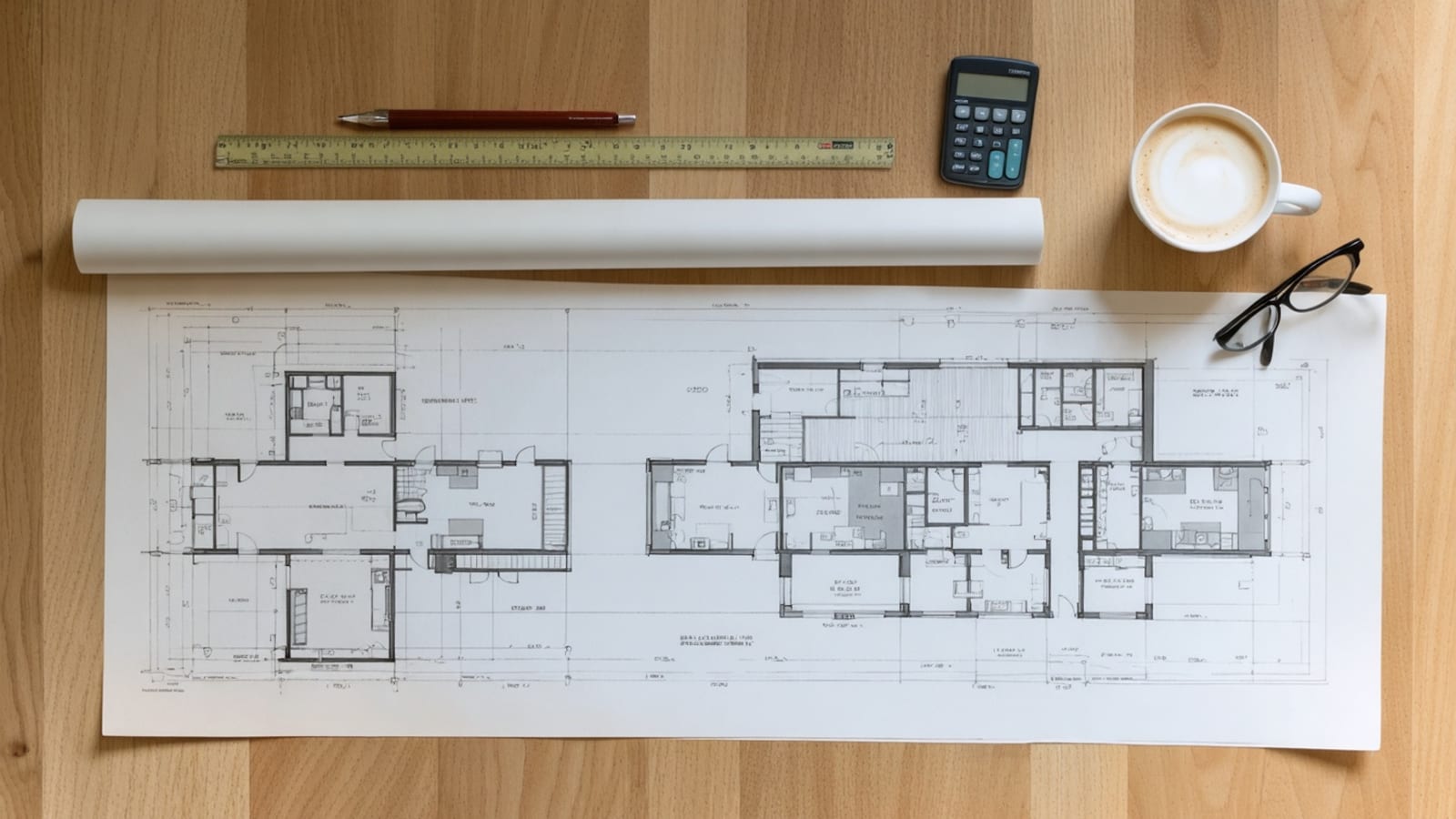
Manual J is the Air Conditioning Contractors of America (ACCA) published standard for calculating a home's residential heating and cooling load. It takes your house as an inputs-and-outputs model — envelope, windows, infiltration, internal gains, design temperatures — and produces a BTU-per-hour number that drives equipment sizing, duct design, and (ultimately) your annual energy cost. Every reputable heat pump quote should reference a Manual J output. Contractors who size by rule of thumb or "match the old furnace" are systematically wrong by 30–60%, and that error compounds across the 15-year life of the equipment.
What Manual J actually calculates
Manual J Residential, 8th Edition (MJ8) is the current ACCA standard. The calculation is a room-by-room thermal model that sums heat losses (winter) and heat gains (summer) across the building envelope at the design-day temperature extremes for your ZIP code.
Inputs feed into the model in six buckets.
Building envelope — wall R-value, ceiling R-value, floor R-value, slab or basement thermal bridging, and orientation-weighted area. A 2,000-sqft home with R-13 walls loses roughly 40% more heat through exterior walls than the same home retrofit to R-21.
Windows and doors — U-factor (inverse of R-value) and Solar Heat Gain Coefficient (SHGC), weighted by orientation. A south-facing triple-pane window with low-e coating performs radically differently from a north-facing single-pane original.
Infiltration — air changes per hour (ACH), typically derived from a blower door test (ACH50) or estimated from building age and construction quality. Infiltration is often the single largest line item in an older home's heat loss.
Design temperatures — the 99% winter design temperature and 1% summer design temperature for your county, published by ACCA in the Manual J tables. Design temperatures are not the coldest day ever recorded — they're the threshold exceeded only 1% or 2% of the year, which is the right target for equipment sizing.
Internal gains — people, lighting, appliances, electronics. Usually a modest contributor (3,000–8,000 BTU/hr) but material in very tight homes.
Ventilation — required fresh-air exchange for combustion, bath fans, range hoods, and (in tight new construction) mechanical ventilation per ASHRAE 62.2.
The output is a room-by-room load table plus a whole-house total. The whole-house heating load at the 99% design temperature is what drives heat pump tonnage selection.
Why contractor shortcuts oversize by 30–60%
The most common residential HVAC shortcut is one of three rules of thumb.
"One ton per 500 square feet." This is a 1970s-era rule that assumes R-11 walls, single-pane windows, and leaky construction. Applied to a modern home with R-21 walls and double-pane low-e windows, it oversizes by 40–60%.
"Match the old furnace/AC." The existing 80,000 BTU furnace was almost certainly oversized when it was installed — the contractor then applied the same rule of thumb 20 years ago. Carrying that mistake forward compounds it. Plus the house may have had insulation upgrades, new windows, or air sealing in the meantime.
"Take the biggest unit in the line — you can't go wrong with more capacity." This was approximately true for single-speed equipment, where oversizing cost only marginally more and ran a little less efficiently. It is catastrophically wrong for variable-speed heat pumps, which need to spend most of their runtime at modulated loads to hit their rated SEER2/HSPF2 numbers.
The 30–60% oversizing number is not rhetorical. ACCA's own 2019 study of 500 residential installations found median oversizing of 46% on cooling load and 34% on heating load, with over 90% of installs sized above Manual J.
Why oversizing particularly hurts heat pumps
A variable-speed inverter-driven heat pump can modulate down to roughly 25–30% of nameplate capacity. Oversize a 3-ton system by 40% and you've installed 4.2 tons of capacity in a home that needs 3. The unit now spends the vast majority of the year running at or below its modulation floor — which means short cycling (on-off-on-off), poor dehumidification, reduced lifespan, and substantially lower measured efficiency than the AHRI rating would predict.
Cold-climate heat pumps are particularly sensitive because their capacity falls with outdoor temperature. A 3-ton unit rated at 36,000 BTU/hr at 47°F may deliver only 24,000 BTU/hr at 5°F. Sizing to the 47°F rating in a climate zone 5 home is a common error that turns every cold snap into an auxiliary-heat-strip emergency. Sizing to the 5°F delivered capacity is equally wrong — it overshoots the shoulder-season load by a factor of three.
The right target is the mean high load at the 99% design temperature, with the understanding that the variable-speed compressor will modulate up to meet peak days. This is what Manual J gives you. It is not what a rule of thumb gives you.
How to request a proper Manual J from an installer
Three specific moves separate installers who do Manual J from installers who claim to.
Ask to see the printout. A real Manual J output is a multi-page PDF from Wrightsoft, Elite Software, or Cool Calc with your address, the date, the software version, and the room-by-room table. "We ran the numbers in our heads" is not Manual J. "We have a spreadsheet" is almost never Manual J. The printout is the defensible artifact.
Ask for the design temperatures used. Your installer should state the 99% winter and 1% summer design temperatures for your county and show them on the printout. If they cannot name them, they did not run Manual J.
Ask about envelope inputs. Did they measure R-values, estimate from building age, or assume nominal values? Tight-envelope homes benefit most from Manual J precision; leaky-envelope homes benefit from blower door numbers. If the installer did not walk the envelope and document assumptions, the Manual J is garbage-in, garbage-out.
A useful side benefit: installers who resist showing a Manual J are signaling that either they did not run one or they are not confident in their numbers. That's dispositive information on its own. Our installer selection checklist has the full red-flag list.
When you can DIY Manual J
DIY tools have gotten good. Two options are worth knowing.
Cool Calc Manual J (coolcalc.com, $49 for a single home) is a web-based ACCA-approved tool that walks you through inputs room-by-room with good defaults and tooltips. It produces a Manual J printout a contractor will accept as a starting point.
HVAC-Calc Residential (hvaccomputer.com, $49 desktop software) is a Windows application aimed at DIY homeowners and small contractors. More flexibility than Cool Calc, slightly steeper learning curve.
The limiting factor on DIY is not the software — it's measurement accuracy. You need to know wall R-values (check insulation labels in attic or call building department for original plans), window U-factors (look for NFRC stickers, or assume 0.50 for standard double-pane and 0.30 for low-e double-pane), and infiltration rates (blower door test is ideal at $250–$500, otherwise estimate from building age).
DIY Manual J is also useful as a check on a contractor's number. If your contractor quotes a 4-ton system and your DIY Manual J says 2.5 tons, that's a conversation to have before signing.
Typical load-calc ranges
For quick sanity checking, here are approximate Manual J outputs for 2,000-sqft homes across envelope tiers in Climate Zone 5 (Chicago, Denver, Boston).
Leaky pre-1940 construction — R-11 walls, R-19 attic, single-pane or double-pane clear glass, 0.7+ ACH50. Heating load 70,000–90,000 BTU/hr at 0°F design. Requires 5-ton cold-climate heat pump with backup.
Average 1980s–1990s construction — R-13 walls, R-30 attic, double-pane clear glass, 0.4–0.6 ACH50. Heating load 45,000–60,000 BTU/hr. Requires 3.5-to-4-ton cold-climate heat pump.
Modern 2015+ code-compliant — R-21 walls, R-49 attic, double-pane low-e, 0.25–0.35 ACH50. Heating load 30,000–42,000 BTU/hr. Requires 2.5-to-3-ton cold-climate heat pump.
Tight retrofit or Passive House-adjacent — R-30+ walls, R-60 attic, triple-pane, 0.10 ACH50. Heating load 18,000–28,000 BTU/hr. Requires 1.5-to-2.5-ton heat pump — often a ductless mini-split system.
In hot-humid climate zones (1–3), cooling loads drive sizing and the numbers shift. A 2,000-sqft Atlanta home runs roughly 40,000 BTU/hr cooling load on the 1% design day with a corresponding 20,000 BTU/hr heating load — which is why cooling-dominated climates typically install smaller-tonnage heat pumps than their square footage suggests.
Translating load calc to heat pump tonnage
Tonnage selection is not "divide BTU by 12,000 and round up." The correct rule for variable-speed heat pumps is: size to the mean high load (roughly 85–90% of the 99% design day load) and let the variable-speed compressor modulate up to meet peak days.
A Manual J heating load of 48,000 BTU/hr at the 99% design temperature suggests a heat pump with ~42,000 BTU/hr delivered capacity at design temperature — which typically maps to a 3.5-ton cold-climate unit (because cold-climate capacity derates from nominal tonnage at low outdoor temperatures). The unit will modulate down to ~10,000 BTU/hr in shoulder seasons and up to 48,000 BTU/hr on the coldest days.
Do not size to the coldest hour ever recorded. Do not size to the old furnace. Do not size to "just in case." Size to the Manual J mean high, trust the compressor modulation, and let auxiliary heat strips handle the 1–2% of hours that exceed design. For the full tonnage walkthrough including envelope tier adjustments, see our heat pump sizing guide and the heat pump calculator.
What the rebate programs require
HEEHRA in most live states requires documented Manual J at submission — New Mexico's EMNRD makes this explicit, California's CEC BUILD includes it in the technical review, and Colorado's CEO requires the full Manual J + Manual S + Manual D stack. See our HEEHRA guide and the rebate stacking guide for state-specific documentation requirements. Installers who skip Manual J are disqualifying you from the rebate before the equipment ships.