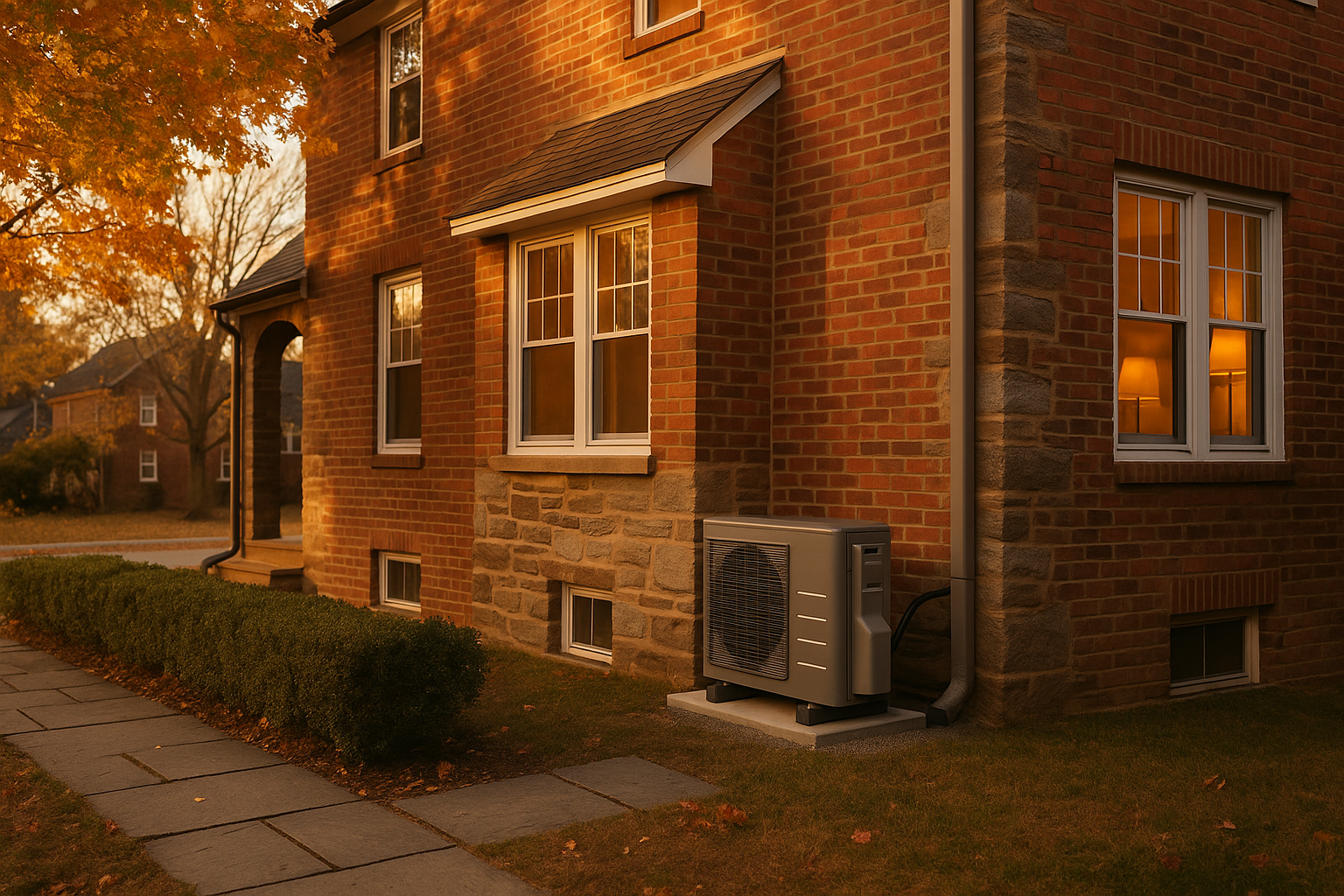
Pennsylvania's Act 129 has run on five-year clocks since the law passed in 2008, and the fifth of those clocks started on June 1, 2026. For the roughly 1.6 million electric customers PECO serves across Philadelphia, Bucks, Chester, Delaware, Montgomery, and part of York County, that date reset the residential rebate catalog, the budget standing behind it, and the contractor roster authorized to file against it.
Act 129 program years run June 1 through May 31, so Phase V spans five program years ending May 31, 2031. A rebate figure quoted to you in April 2026 was a Phase IV number, and the Phase V figure filed with the Public Utility Commission may be higher, lower, or restructured into a tier that did not previously exist.
Act 129 Phase V began June 1, 2026 and runs five program years through May 31, 2031. PECO re-filed its residential heat pump rebate tiers with the PA PUC for the new phase, so Phase IV amounts no longer apply.
What Act 129 Phase V Actually Changed
Act 129 requires Pennsylvania's larger electric distribution companies — PECO among them — to hit consumption and peak-demand reduction targets set by the PUC in a phase implementation order. Each utility then files an Energy Efficiency and Conservation plan spelling out the measures it will promote, the rebate amounts it will pay, and the conservation service providers who will deliver the work.
That plan filing, not the marketing page, is the document your rebate actually comes from. When a phase turns over, every line in it is open for revision: a measure can gain a tier, lose one, or fall off the catalog entirely if it no longer earns its place.
Two statutory guardrails shape what survives the rewrite. Act 129 caps what a utility may spend on its plan as a share of its 2006 revenue, and it requires a low-income carve-out sized to the low-income share of load — so the pool is finite, and part of it is reserved before the general residential catalog is funded.
What's more, the phase reset is not just a price change. Contractor enrollment, application portals, and documentation requirements are all re-established at the start of a phase, which is why some installers were still quoting stale numbers well into the summer of 2026.
The Cost Test That Decides Which Heat Pumps Get Paid
Every measure in an Act 129 plan has to survive the Total Resource Cost test, a benefit-cost screen weighing the lifetime value of avoided energy against the full installed cost of the measure. Measures that clear it comfortably get funded generously; measures that barely clear it get a thin rebate or a pilot slot.
Keep in mind that Act 129 is an electricity statute. It credits kilowatt-hours and peak kilowatts saved, which is why the strongest heat pump case in PECO territory has always been a home that already heats with electricity.
Act 129 credits electricity savings, so every measure is screened by the Total Resource Cost test. Replacing electric resistance heat or an aging electric heat pump models cleanly, which is why those conversions rebate most reliably.
Replacing electric baseboard, a heat-strip air handler, or a fifteen-year-old air-source unit produces a large, easily modeled electric savings number. A gas-to-electric conversion, by contrast, saves therms while adding kilowatt-hours, and an electric-savings framework does not score that the same way even when the household's total energy use and emissions both fall.
That asymmetry is the most useful thing to understand before you start collecting quotes. It explains why a neighbor with baseboard heat may collect a rebate you cannot, and why fuel-switching support in Pennsylvania has leaned on state and federal dollars rather than on utility programs.
Philadelphia, PGW, And The Fuel Question
PECO is an electric utility across its entire footprint but a gas utility in only part of it. Inside Philadelphia, natural gas service comes from Philadelphia Gas Works, a city-owned utility that is not an Act 129 electric distribution company at all.
In Bucks, Chester, Delaware, Montgomery, and York counties, PECO delivers both electricity and gas to many of the same addresses. For a suburban homeowner weighing a dual-fuel system, that means one utility sees both meters — and a city rowhome owner heating with gas is looking at a different program map than a Chester County household on the same block of the internet.
Pennsylvania is also a restructured electricity market, so what a heat pump costs to run depends on the generation supplier you shop as much as on PECO's delivery charges. Run your operating-cost math on the all-in cents per kilowatt-hour from a recent bill rather than on a headline rate, and re-check it when your supply contract rolls.
What The Rebates Pay
PECO's residential catalog has historically covered air-source heat pumps, ductless mini-splits, heat pump water heaters, smart thermostats, and home energy assessments, with the largest single payment going to the heat pump itself. Through Phase IV, residential heat pump rebates in this catalog generally sat in the low hundreds of dollars per system, with a higher-efficiency tier paying more than the entry tier.
Treat that as a scale reference, not a Phase V quote. The honest answer for any specific dollar figure in the current program year is that it comes off PECO's live residential rebate page or the contractor's rebate worksheet, dated after June 1, 2026.
Verify the number, not the memory. Phase V amounts were re-filed with the PA PUC and can be revised mid-phase. Confirm the current figure against PECO's residential rebate listing and the participating contractor's worksheet before you sign, and ask which program year the quote is written against.
Water heating deserves its own line in the analysis rather than a footnote. A heat pump water heater is usually the cheapest per-kilowatt-hour-saved measure in the catalog, which is covered in more detail in our guide to heat pump water heater sizing and rebates.
Which Equipment Qualifies
Eligibility on a heat pump turns on paperwork more than on brand loyalty. The documents a participating contractor assembles for a claim include but are not limited to:
- The AHRI reference number. Ratings apply to a matched combination of outdoor unit, indoor coil or air handler, and in some cases a specific control. A new condenser bolted to an existing coil often has no valid certified rating, and without one there is nothing to submit.
- ENERGY STAR certification. Utility catalogs and federal programs both key off the current ENERGY STAR criteria for air-source heat pumps, so a model that was listed two revisions ago may not be listed today.
- The SEER2 and HSPF2 ratings. These are the post-2023 test-procedure ratings, and they read lower than the old SEER and HSPF numbers for the same equipment. Comparing a SEER2 figure against a legacy SEER figure will make a good machine look worse than it is.
- Cold-climate designation, where a tier requires it. The ENERGY STAR cold-climate tier layers on a higher HSPF2 threshold plus a published coefficient of performance at 5°F, which is the number that actually predicts how the system behaves on a January morning in Pottstown.
- The load calculation. Higher-tier rebates and any federally funded work increasingly ask for an ACCA Manual J result rather than a square-footage rule of thumb.
PECO rebates require AHRI-matched indoor and outdoor equipment installed by a participating contractor. ENERGY STAR certification plus minimum SEER2 and HSPF2 ratings set the floor, with a higher tier for cold-climate models.
All of these documents exist to prove one thing: that the savings the utility claimed in its PUC filing are the savings your house will actually produce. A contractor who waves off the AHRI match is not cutting red tape — they are removing the basis of the claim.
Which Contractors Can Actually File
Act 129 residential programs are delivered through a network of enrolled contractors working under PECO's conservation service provider. Enrollment is per phase, so an installer who filed dozens of Phase IV rebates has to be current in the Phase V roster to file a single one now.
In practice the rebate is handled one of two ways: the contractor discounts it on the invoice and collects from the program, or you submit after the fact with the invoice, the AHRI certificate, and the model and serial numbers. The first path is cleaner, though it makes contractor selection and rebate access the same decision.
Permits matter here too. Philadelphia work runs through Licensing and Inspections, and suburban townships each have their own mechanical and electrical permit process — a missing final inspection can hold up a rebate the same way a missing AHRI number can.
The Program-Year Budget Is A Real Constraint
Act 129 budgets are annual inside the five-year phase, and residential rebates are paid first-come, first-served until the program-year allocation is committed. A phase that runs to 2031 does not guarantee a rebate on any particular Tuesday.
Act 129 budgets are set annually within the phase and paid first-come, first-served. When a program-year fund is committed, PECO can suspend or step down a rebate before May 31 even though the phase runs to 2031.
The practical effect is that timing sits alongside equipment selection as a variable you control. Households replacing on a planned schedule rather than on a failure often find the early months of a program year — June onward — carry less risk of a suspended measure than the spring.
How Phase V Sits Alongside Pennsylvania's HEEHRA Rollout
The federal money most people call HEEHRA is formally the Home Electrification and Appliance Rebate program, one half of the Inflation Reduction Act's Home Energy Rebates. In Pennsylvania it is administered by the Department of Environmental Protection, not by PECO, and it draws on the state's Department of Energy allocation of roughly $124 million across both rebate programs.
That distinction matters because the two pots answer to different rules. PECO's rebate answers to the PUC and the Total Resource Cost test; the HEAR rebate answers to DOE guidance and a household income test measured against area median income.
Pennsylvania's HEAR rebates are administered by the state DEP, not by PECO. HEAR pays up to $8,000 toward a qualifying heat pump for households under 80% of area median income, and 50% of project cost from 80–150% AMI.
The statutory HEAR ceilings are fixed nationally: up to $8,000 for a heat pump, $1,750 for a heat pump water heater, $4,000 for an electrical panel upgrade, $2,500 for wiring, and $1,600 for insulation, air sealing, and ventilation, with a $14,000 household total. Households above 150% of area median income are outside HEAR entirely, which puts them back on utility rebates and whatever federal credit is current.
| Dimension | PECO Act 129 Phase V | Pennsylvania HEAR (HEEHRA) | Pennsylvania HOMES |
|---|---|---|---|
| Administered by | PECO, under PA PUC order | PA Department of Environmental Protection | PA Department of Environmental Protection |
| Funded by | Ratepayer efficiency surcharge | IRA federal allocation | IRA federal allocation |
| Income test | None on the general catalog; separate low-income channel | Under 80% AMI, and 80–150% AMI at half cost | Tiered, with larger awards below 80% AMI |
| Heat pump ceiling | Per PECO's filed Phase V tier | $8,000 statutory maximum | Based on modeled or measured whole-home savings |
| Clock | Program year, June 1 to May 31, through 2031 | Until the state allocation is exhausted | Until the state allocation is exhausted |
| Qualifying basis | Electric savings, TRC-screened | Specific appliance categories | Whole-home energy reduction percentage |
Note that a single upgrade cannot be paid by both HOMES and HEAR — federal guidance bars that duplication. Choosing between them is a separate analysis, walked through in our federal rebate and credit decision tree.
Stacking Order Protects The Bigger Number
Utility money and state-administered federal money generally braid, but the braid has a ceiling. Below 80% AMI, HEAR is written to cover up to 100% of project cost; from 80% to 150% AMI it covers half — and in both cases the percentage applies to what the project actually costs after other reductions.
Utility and federal rebates generally braid, but HEAR cannot exceed 100% of project cost at the low-income tier. Applying the PECO rebate first lowers the invoice HEAR is then measured against.
The consequence is easy to miss. A household eligible for full HEAR coverage may find a utility rebate adds nothing on a small project, while a household at the moderate tier or above 150% AMI finds the PECO rebate carrying real weight.
Federal tax treatment is the third layer and moves independently of both. Rebates reduce the cost basis you can claim a credit against, and the residential solar credit expired December 31, 2025 — our federal tax credit status page tracks what remains current, and the rebate and credit stacking mechanics post covers the sequencing.
Sizing And Panel Capacity In Southeastern Pennsylvania
Philadelphia's 99% winter design temperature sits in the mid-teens Fahrenheit, with western Chester County and the northern Bucks uplands running a few degrees colder. That is a mild design condition by national standards, and it means a well-selected variable-speed heat pump can carry most of the winter without leaning hard on backup heat.
The failure mode here is oversizing rather than undersizing. Replacing an 80,000 BTU/hr furnace with equivalent heat pump tonnage produces short-cycling, poor humidity control in July, and a system that never reaches the efficiency printed on its label — which is why the load calculation tool and a real Manual J beat a rule of thumb every time.
Backup heat strategy follows directly from the load calculation and the balance point. Our post on cold-climate heat pump sizing covers how capacity at 5°F interacts with the switchover setting, and the same logic applies at a milder mid-Atlantic design temperature.
Electrical service is the other constraint that surfaces late and expensively. Older Philadelphia rowhomes and mid-century suburban builds frequently sit on 100-amp service, and a heat pump plus strip backup can push a load calculation past it — the panel capacity walkthrough covers how to run that check before equipment is ordered.
A Decision Rule, Indexed To Where You Are
Different readers arrive at this page at different points in the project, and the governing constraint changes with the phase. Here is how the pieces line up:
| Where you are | What governs | What to pin down first |
|---|---|---|
| Pre-purchase, system still working | Program-year budget timing | Current Phase V rebate tier and the AHRI-matched model list |
| Emergency replacement, no heat | Contractor enrollment | Whether the available installer is on the current participating roster |
| Below 150% AMI | HEAR ceilings and income tier | Your AMI tier and the DEP application channel before signing anything |
| Mid-application on state rebates | Non-duplication rules | Whether the same measure is already claimed under HOMES |
| Comparing across state lines | Different utility, different statute | How a neighboring program is structured — see our BGE Maryland rebate breakdown |
Households that fit more than one row generally resolve them in that order: confirm the equipment can be rebated at all, then confirm the contractor can file, then sequence the federal money. Working the other direction tends to produce a signed contract that no program will pay against.
Before You Commit
The through-line of Act 129 Phase V is that the rules are stable for five years while the numbers inside them are not. A phase gives you the framework — the TRC screen, the program-year clock, the participating-contractor requirement — and the annual filings give you the dollars.
Take three things off PECO's current residential rebate listing before scheduling work: the rebate amount for your equipment tier, the efficiency minimums that tier requires, and confirmation that your installer appears in the participating network. Our rebate stacking guide and state HEEHRA guide cover how those three answers feed the rest of the decision.
This article is for informational purposes and is not financial, tax, or legal advice. Consult a licensed professional — a CPA, a qualified HVAC contractor, or your state energy office — and verify all program terms with PECO and the Pennsylvania Department of Environmental Protection before acting.