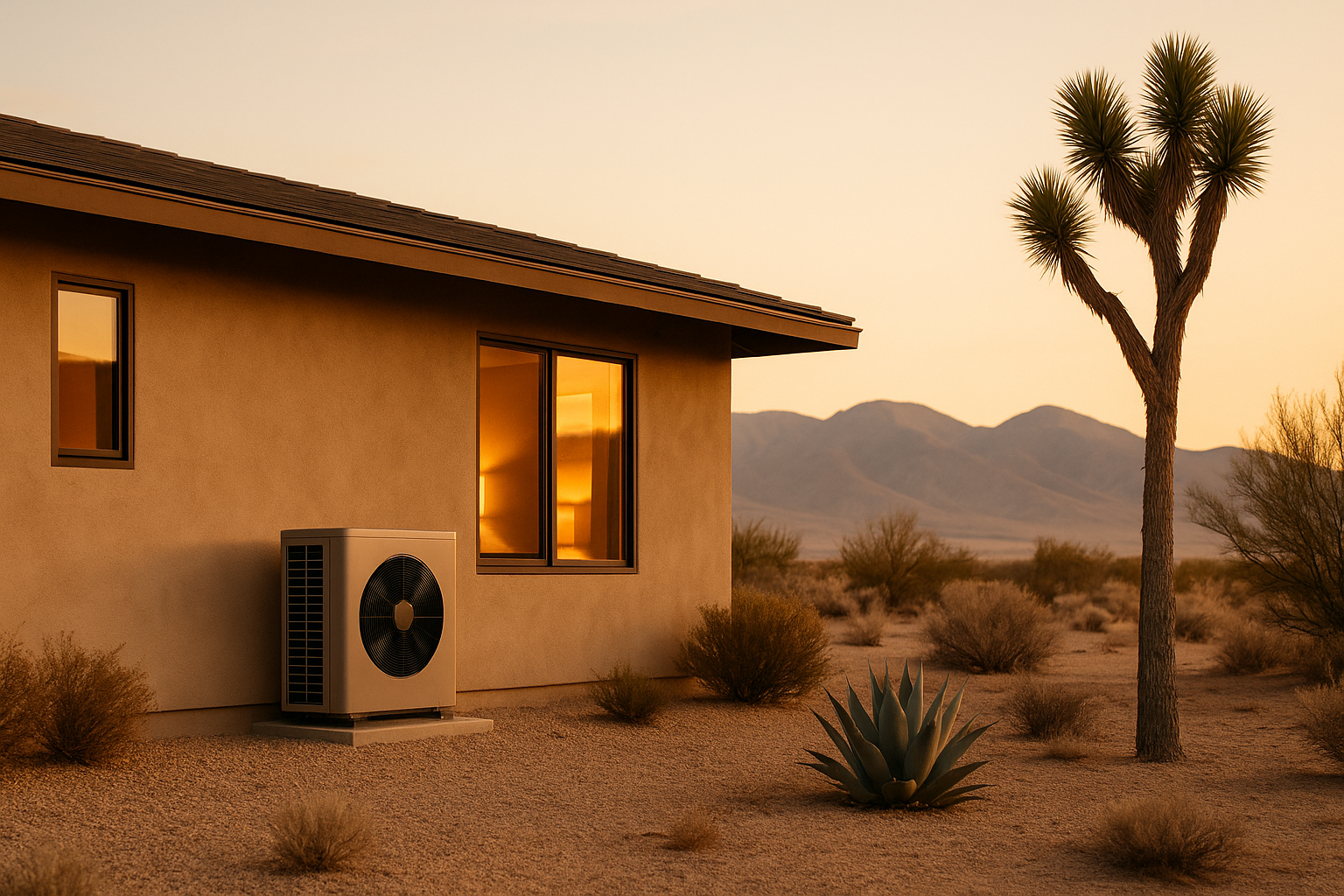
Most Nevada homeowners hear the word HEEHRA and picture a tax credit — a line they will claim next April after fronting the full cost of a new heat pump. However, HEEHRA is a point-of-sale rebate, meaning the discount comes off the price at purchase and is administered by the state, not refunded on your tax return months later.
That distinction matters, because it changes how much cash you need up front and who decides your eligibility. Nevada now has federal Home Electrification and Appliance Rebate funds moving through the Nevada Governor's Office of Energy, yet almost no plain-language guide explains the amounts, the income tiers, and the equipment that actually qualifies.
This guide fixes that. Below are the verified federal caps Nevada administers, the Area Median Income tiers that decide your share, and the specific equipment that clears the program's efficiency bar.
Income-qualified Nevada households can receive up to $8,000 toward a heat pump and up to $14,000 total across electrification upgrades, administered by the Nevada Governor's Office of Energy.
How HEEHRA Works In Nevada — And Who Runs It
HEEHRA — the High-Efficiency Electric Home Rebate program, now formally the Home Electrification and Appliance Rebates, or HEAR — was funded by the Inflation Reduction Act and handed to each state to run. In Nevada, that administrator is the Nevada Governor's Office of Energy, which sets the application process, the contractor requirements, and the rollout timeline.
Because it is state-administered, the exact launch date, participating contractors, and portal details differ from Colorado, New Mexico, or any other state. What does not change are the federal caps and the income-tier rules, which every state — Nevada included — must follow.
The rebate is designed to hit you at the register. Rather than reimbursing you later, a qualified contractor or retailer applies the discount to your invoice, which is why your household income tier has to be verified before the work begins.
The program also leans on qualified contractors rather than DIY installs, since the rebate paperwork and equipment verification flow through the installer. Accordingly, part of choosing a system is choosing a contractor enrolled in Nevada's program once the state portal is live.
HEEHRA is an upfront, point-of-sale rebate — the discount is applied to your invoice at purchase. Unlike the federal 25C tax credit, you do not wait until you file your taxes to see the money.
Nevada HEEHRA Rebate Amounts By Upgrade
Every HEEHRA rebate is capped per measure, with an overall ceiling of $14,000 per household. The table below lists the federal maximums Nevada administers, though the amount you actually receive depends on your income tier, covered in the next section.
| Upgrade | Maximum HEEHRA Rebate |
|---|---|
| Heat pump (space heating & cooling) | $8,000 |
| Heat pump water heater | $1,750 |
| Electric stove, cooktop, range, or oven | $840 |
| Heat pump clothes dryer | $840 |
| Electrical panel upgrade | $4,000 |
| Electrical wiring | $2,500 |
| Insulation, air sealing & ventilation | $1,600 |
| Household total (all measures) | $14,000 |
Keep in mind that these are maximums, not guaranteed payouts. Your rebate is limited to the lower of the cap or your income-based percentage of the project cost.
Nevada HEEHRA caps include $8,000 for a heat pump, $1,750 for a heat pump water heater, $4,000 for an electrical panel, and $840 each for an electric stove or heat pump dryer — $14,000 total per home.
Consider a $12,000 ducted heat pump installation. A household below 80% of AMI would see the full cost covered up to the $8,000 heat pump cap, while a household at 120% of AMI — squarely in the 50% tier — would receive $6,000, half the project cost, since that sits under the cap.
Note that the $14,000 ceiling is cumulative across all measures, so a household maximizing the heat pump, water heater, and panel lines has little room left for a stove or dryer. Prioritizing the highest-impact upgrades — usually space heating and water heating — is how most Nevada households spend that budget.
Who Qualifies — Nevada's HEEHRA Income Tiers
HEEHRA is means-tested, and your Area Median Income tier sets the share of project cost the rebate covers. AMI is a HUD figure that varies by county and household size, so the same income lands differently in Clark County than in a rural northern county.
There are three tiers. Below 80% of AMI, the rebate covers 100% of project costs up to the caps; between 80% and 150% of AMI, it covers 50%; above 150% of AMI, the household is not eligible for HEEHRA rebates.
Nevada households below 80% of area median income get 100% of project costs covered up to the caps; those from 80% to 150% AMI get 50%. Above 150% AMI, you use the 25C tax credit instead.
Importantly, HEEHRA eligibility is based on household income relative to AMI, not on assets or credit score. This makes it reachable for fixed-income and working-class Nevada households that a loan-based upgrade would exclude.
For a full walkthrough of how the percentages and household-size math work, see our explainer on how HEEHRA income tiers work. Naturally, the higher your covered percentage, the more the program does for a whole-home project.
How to check your Nevada AMI tier. HUD publishes income limits by county and household size each year, and the Nevada Governor's Office of Energy verifies your tier during the application. Confirm which of the three tiers you fall into before planning a project, because it decides whether the program covers half or all of your cost.
A whole-home example. Suppose a qualifying Nevada household in the 100% tier replaces a gas furnace with a heat pump ($8,000), adds a heat pump water heater ($1,750), and upgrades an undersized panel ($4,000). Those measures total $13,750 in covered upgrades, landing just under the $14,000 household ceiling.
Qualifying Equipment — What Nevada HEEHRA Will Cover
Not every heat pump on a distributor's shelf qualifies. HEEHRA equipment must meet federal efficiency standards, which in practice means ENERGY STAR-certified models rated for the relevant SEER2, HSPF2, and — in Nevada's colder north — cold-climate performance.
For heat pumps, that usually means an ENERGY STAR-qualified variable-speed inverter system, ducted or ductless, sized by a Manual J load calculation rather than a rule of thumb. For water heating, the program covers ENERGY STAR heat pump water heaters, which move heat instead of generating it with resistance elements.
To qualify for HEEHRA in Nevada, equipment must meet federal efficiency standards — typically ENERGY STAR-certified heat pumps rated for the required SEER2 and HSPF2, plus proper Manual J sizing by the contractor.
The qualifying list runs beyond heating to electric or induction cooktops, heat pump clothes dryers, and the electrical work — panel upgrades and wiring — that older Nevada homes often need to support them. For a closer look at one of the most common add-ons, see our guide to heat pump water heaters.
Older Nevada homes — particularly mid-century Las Vegas ranches and Reno bungalows — frequently run 100-amp panels that cannot support a heat pump alongside an induction range and a heat pump water heater. That is precisely why HEEHRA funds panel upgrades and wiring, since the electrification measures often depend on the electrical backbone being upgraded first.
Stacking HEEHRA With The Federal 25C Tax Credit
HEEHRA and the federal 25C Energy Efficient Home Improvement Credit are separate programs, and you can use both — with one rule. The rebate reduces your out-of-pocket cost first, and 25C then applies only to the remaining qualified amount you actually paid.
25C returns 30% of qualified costs, capped at $2,000 per year for a heat pump or heat pump water heater and $600 for a panel upgrade. Therefore a Nevada household in the 50% rebate tier can take the HEEHRA discount at purchase and still claim 25C on the balance the following tax year.
Yes — Nevada homeowners can stack HEEHRA and 25C. The rebate lowers your upfront cost, then 25C covers 30% of the remaining qualified amount, up to $2,000 for a heat pump. You cannot claim 25C on rebate-covered dollars.
Timing across the calendar also matters, because 25C resets annually. A household spreading a heat pump and a panel upgrade across two tax years can claim the credit twice, subject to each year's caps.
The sequencing is where households leave money on the table. For the framework on which program to lead with, see our HEEHRA and 25C stacking guide and the 25C vs. HEEHRA decision tree.
How Nevada's Climate Shapes The Right Heat Pump
Nevada is not one climate, and that changes which heat pump earns its rebate. Las Vegas and the Mojave south are cooling-dominated, where a high-SEER2 system spends most of the year rejecting heat.
Reno, Carson City, and the high desert around Elko run cold winters with design temperatures well below freezing, where HSPF2 and cold-climate capacity matter far more. Sizing for the wrong load — or leaning on a resistance backup heat strip you rarely need — wastes both money and rebate dollars.
As a rough anchor, Las Vegas winter design temperatures sit near freezing, while Reno and the northern valleys fall into the teens or below. That spread is why a single statewide heat pump recommendation does not exist — a model that thrives in Henderson may need a cold-climate rating and careful backup heat planning up north.
For homes in the northern high desert, matching capacity to the 99% winter design temperature is the difference between steady comfort and a short-cycling system. Our guide to cold-climate heat pump sizing covers the load-calculation approach Nevada's northern counties call for.
Getting Ready For Nevada's HEEHRA Rollout
Because HEEHRA is state-administered and funded from a fixed federal allocation, the practical question is readiness, not panic. The households that benefit most tend to confirm three things before they shop.
First, verify your AMI tier through HUD's county income limits, since it decides whether the program covers half or all of your project. Next, confirm the equipment you want is ENERGY STAR-qualified and correctly sized by a Manual J calculation, not a rule of thumb.
Finally, map the sequence — which measures HEEHRA will discount at purchase, and which remaining costs 25C can offset at tax time. You can see where Nevada fits among every state we track in our HEEHRA state-by-state guide.
Nevada draws these Home Energy Rebates from a finite federal pool rather than an open-ended entitlement. That is the real reason preparation pays off: the household that has already run its load calculation and confirmed its tier is positioned to move the moment the state portal opens.
Nevada's rebate funds are real and already moving through the state energy office, yet the amount you capture depends on the tier you qualify for and the equipment you choose. Confirm your AMI tier and your load calculation first, and the program's numbers will do the rest.
Disclaimer. This article is for informational purposes and is not financial, tax, or legal advice. Consult a licensed professional — a CPA, a licensed HVAC contractor, or the Nevada Governor's Office of Energy — before acting.