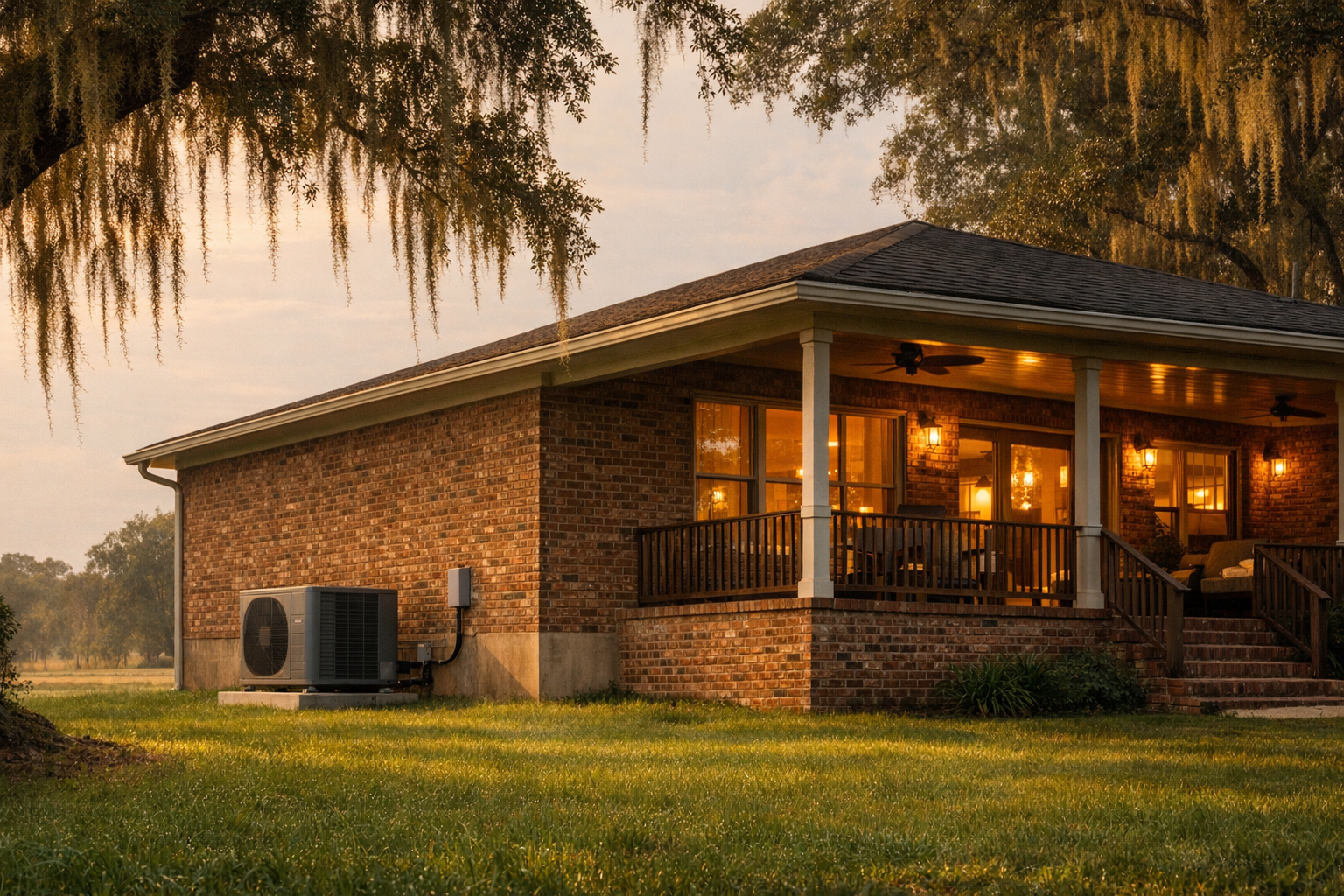
Is the system cooling your home rated for the summer you actually live through, or for a summer on a spec sheet? In Mississippi, that question decides whether a new heat pump runs comfortably for fifteen years or leaves the house cool, clammy, and expensive to run.
The High-Efficiency Electric Home Rebate Act (HEEHRA), which states run as the Home Electrification and Appliance Rebates (HEAR) program, can cover a large share of that equipment. That said, the rebate only pays for equipment that qualifies, and in the Gulf South equipment that qualifies on paper can still be the wrong size for the house.
This guide covers the federal rebate caps, the income tiers as they apply in Mississippi, the state agency in charge, and the humid-climate sizing math that decides which equipment is worth installing. For the national picture, our HEEHRA guide hub covers the program structure across every state.
Where HEEHRA Stands In Mississippi
HEEHRA is funded by the Inflation Reduction Act, but the money flows through state energy offices rather than straight from Washington. In Mississippi, the State Energy Office sits inside the Mississippi Development Authority (MDA) Energy and Natural Resources Division, which handles the application to the U.S. Department of Energy and the program design.
Keep in mind that each state sets its own launch date, contractor registration process, and income verification method. Before you plan a project around a rebate, it is worth confirming Mississippi's current status on our HEEHRA state-by-state status tracker and on MDA's own energy program pages.
What's more, HEEHRA rebates are paid at the point of sale through participating contractors and retailers. In practice, the discount shows up on the invoice rather than as a check that arrives months later, which changes how you budget for the job.
Rebate Amounts: The Federal Caps
The dollar caps are written into federal law, so they are the same in Mississippi as in every other state. What the state controls is how those caps are delivered, not how high they go.
The per-measure caps under the statute include the following:
| Upgrade | Maximum Rebate | Mississippi Relevance |
|---|---|---|
| Heat pump for space heating and cooling | $8,000 | Replaces aging central AC plus gas or resistance heat |
| Heat pump water heater | $1,750 | Also dehumidifies a garage or utility room |
| Electrical panel upgrade | $4,000 | Common in older homes with 100-amp service |
| Electrical wiring | $2,500 | New circuits for a heat pump or range |
| Insulation, air sealing, and ventilation | $1,600 | Cuts both sensible and latent cooling load |
| Electric or induction stove, cooktop, or range | $840 | Replaces a gas or propane range |
| Heat pump clothes dryer | $840 | No exterior vent required |
| Household total | $14,000 | Lifetime cap across all measures |
All of the above are ceilings, not guaranteed payouts. Your actual rebate is the lesser of the cap and the percentage of project cost your income tier allows.
The $14,000 household cap is a combined ceiling. A household that claims $8,000 for a heat pump and $4,000 for a panel upgrade has $2,000 left for every other measure combined.
Income Limits And Area Median Income In Mississippi
HEEHRA eligibility is based on household income compared to area median income (AMI), which the U.S. Department of Housing and Urban Development (HUD) publishes by county and metro area. The program uses two tiers, and our explainer on HEEHRA income tiers walks through the math in more detail.
Here is how the two tiers work:
- Under 80% of AMI. The rebate can cover up to 100% of the project cost, subject to the per-measure and household caps.
- 80% to 150% of AMI. The rebate can cover up to 50% of the project cost, subject to the same caps.
- Above 150% of AMI. The household is not eligible for HEEHRA, though utility programs may still apply.
Mississippi's median household income has ranked among the lowest of any state in recent U.S. Census Bureau American Community Survey releases. As a result, AMI thresholds in many Mississippi counties are lower in dollar terms than in most of the country, and a larger share of households may land in the 100% tier.
Keep in mind that AMI also varies within the state. The Jackson metro area, the Gulf Coast metro around Gulfport and Biloxi, and the DeSoto County suburbs of Memphis each carry different HUD figures than the rural counties of the Delta, so the same salary can fall into different tiers depending on where you live.
States may also allow categorical eligibility, meaning enrollment in a qualifying program such as SNAP, Medicaid, or LIHEAP can stand in for income documentation. Whether and how Mississippi uses categorical eligibility is an MDA program decision, so confirm the accepted documents before you apply.
What Humid Subtropical Loads Mean For Qualifying Equipment
Most of Mississippi falls in IECC climate zone 3A, with the coastal counties in zone 2A. The "A" stands for moist, and that single letter changes how a heat pump should be selected far more than the winter design temperature does.
A cooling system removes two kinds of heat. Sensible heat is the temperature you read on the thermostat, and latent heat is the moisture in the air, which a coil removes by condensing it into the drain pan.
Why Latent Load Matters More Here
In a dry climate, nearly all of a system's capacity goes to lowering temperature. In Jackson or Hattiesburg in July, a meaningful share of the capacity has to go to pulling water out of the air, and an ACCA Manual J load calculation reports both numbers separately for exactly that reason.
The ratio between the two is the sensible heat ratio (SHR). Equipment chosen through ACCA Manual S needs a coil and airflow combination whose SHR at design conditions matches the house, or the home will reach its set temperature while the humidity stays high.
The Oversizing Trap
The most common sizing shortcut in the Gulf South is a rule-of-thumb tonnage per square foot, often padded upward "for the heat." However, an oversized single-stage unit satisfies the thermostat in a few minutes, shuts off before the coil gets cold and wet enough to drain, and short-cycles all afternoon.
Short-cycling leaves moisture on the coil that can evaporate back into the airstream when the blower keeps running. This is why an oversized system can produce a home that reads 74°F and still feels clammy, along with higher wear on the compressor.
Our heat pump load calculator lets you check a contractor's tonnage against a room-by-room estimate before you sign. Note that a calculator is a cross-check, not a substitute for a full Manual J on the actual house.
Why Variable-Speed Equipment Fits The Climate
Variable-speed equipment with an inverter-driven compressor addresses the humidity problem directly. It can run at low capacity for long stretches, keeping the coil cold and wet, which pulls more moisture out per hour of runtime than a single-stage unit cycling on and off.
Many variable-speed systems also offer a dehumidification mode that slows the indoor blower to drop the coil temperature further. For a deeper look at the hardware, see our guide to inverter scroll compressors and modulation.
Which Ratings Actually Qualify
HEEHRA requires ENERGY STAR certified heat pumps, and the current ENERGY STAR specification for split air-source systems sets minimums for SEER2, EER2, and HSPF2. Be aware that ENERGY STAR revises these thresholds periodically, so confirm the model's listing in the ENERGY STAR product finder and its AHRI certificate before installation.
For Mississippi, the ratings carry different weight than they do further north:
- SEER2. Seasonal cooling efficiency, and the rating that drives most of a Mississippi home's annual electricity use for space conditioning.
- EER2. Efficiency at a single hot test condition, which tells you more about performance on a 95°F afternoon than SEER2 alone.
- HSPF2. Seasonal heating efficiency, which still matters in north Mississippi where winter nights regularly drop below freezing.
A cold-climate heat pump designation is not required for HEEHRA and is rarely necessary in zones 2A and 3A. That said, a household in Tupelo or Oxford may still want to compare low-temperature capacity on the AHRI listing, particularly if the home has no backup heat strip.
Supporting Upgrades That Shrink The Load
The $1,600 insulation, air sealing, and ventilation cap is easy to overlook, but in a humid climate it does double duty. Every cubic foot of outside air that leaks into the house carries both heat and moisture, so air sealing cuts the latent load as well as the sensible load.
For instance, a blower door test that measures air changes per hour at 50 pascals (ACH50) before and after sealing gives your contractor real numbers for the Manual J inputs. In turn, a tighter house may justify a smaller heat pump, which leaves more of the $14,000 household cap for other measures.
Moreover, ductwork in a vented attic is common across Mississippi, and attic temperatures in summer can far exceed outdoor air. Sealing and insulating those ducts, or relocating them inside conditioned space, can matter as much as the efficiency rating of the equipment itself.
Remember that installation details also affect qualifying performance. A ductless or mini-split system with a long refrigerant run can lose capacity, and our guide to line set length limits covers how manufacturers rate those runs.
Utility Programs Across Mississippi
Mississippi does not have a single statewide utility, which means stacking options depend on who delivers your power. The major providers include Entergy Mississippi in much of the central and western state, Mississippi Power along the Gulf Coast and in the southeast, a network of electric cooperatives, and Tennessee Valley Authority (TVA) local power companies across north Mississippi.
Each of these may offer its own efficiency incentives, and the program menus change from year to year. Households served by a TVA distributor may find the structure similar to what we cover in our guide to Tennessee utility rebates, since the TVA framework crosses state lines.
The order in which you apply for overlapping incentives can change the total you receive. Our guide to rebate stacking and application order explains why some programs calculate their share after others have paid.
Federal Credits: What Expired And What Did Not
The federal residential clean energy credit for solar under Section 25D expired on December 31, 2025. State and utility solar programs may continue, but the federal credit does not, and no HEEHRA rebate replaces it.
HEEHRA is a separate appropriation from the tax code, so changes to federal tax credits do not by themselves change the HEEHRA caps. For the current status of 25C and the other federal residential credits, see our federal tax credits status page.
Note that HEEHRA also has a sister program, the Home Efficiency Rebates (HOMES), which pays based on modeled or measured whole-home energy savings. Federal rules bar using both programs for the same single upgrade, although a household may be able to use each for different measures.
How Mississippi Compares To Its Neighbors
Mississippi shares a climate profile with Alabama and the western half of Tennessee, which makes those state guides useful reference points. Our deep dives on HEEHRA in Alabama and HEEHRA in Tennessee cover how neighboring energy offices have approached contractor networks and income verification.
The federal caps are identical across all three states. The differences come from state rollout decisions, AMI levels, and the utility programs available to stack alongside the rebate.
A Decision Rule By Project Phase
Where you are in the process changes what matters most. Here is how the pieces fit together at each stage:
- Before you get quotes. Check your county's HUD AMI figures against your household income, and confirm MDA's program status. If you know your tier, you know whether you are working with a 100% or 50% rebate.
- When comparing quotes. Ask each contractor for a Manual J that reports both sensible and latent loads, plus the AHRI certificate and ENERGY STAR listing for the proposed equipment. A quote that sizes by square footage alone is a signal to ask more questions.
- Before signing. Confirm the contractor is registered with the state program, since point-of-sale rebates generally require a participating installer. Then check which utility incentives you can stack and in what order.
- If your system has already failed. An emergency replacement in August leaves little time, but you may want to consider a short-term repair or rental unit if the rebate program is close to opening. Overall, the right equipment at a reduced price is usually worth a brief wait, though only you can weigh that against the heat.
All of these steps come back to the same principle. In Mississippi, the rebate covers the cost of the equipment, but the load calculation decides whether that equipment actually keeps the house dry and comfortable.
Plan Your Mississippi Heat Pump Project
HEEHRA can cover most or all of a heat pump installation for many Mississippi households, particularly given the state's AMI levels. Of course, the best rebate outcome is a system sized for humid subtropical loads, installed by a participating contractor, and stacked correctly with utility incentives.
Start with our HEEHRA program guide for the national framework, then run your numbers through the heat pump sizing calculator before your first contractor visit.
This article is for informational purposes and is not financial, tax, legal, or medical advice. Consult a licensed professional (CPA, elder-law attorney, HVAC contractor, state Medicaid office) before acting.