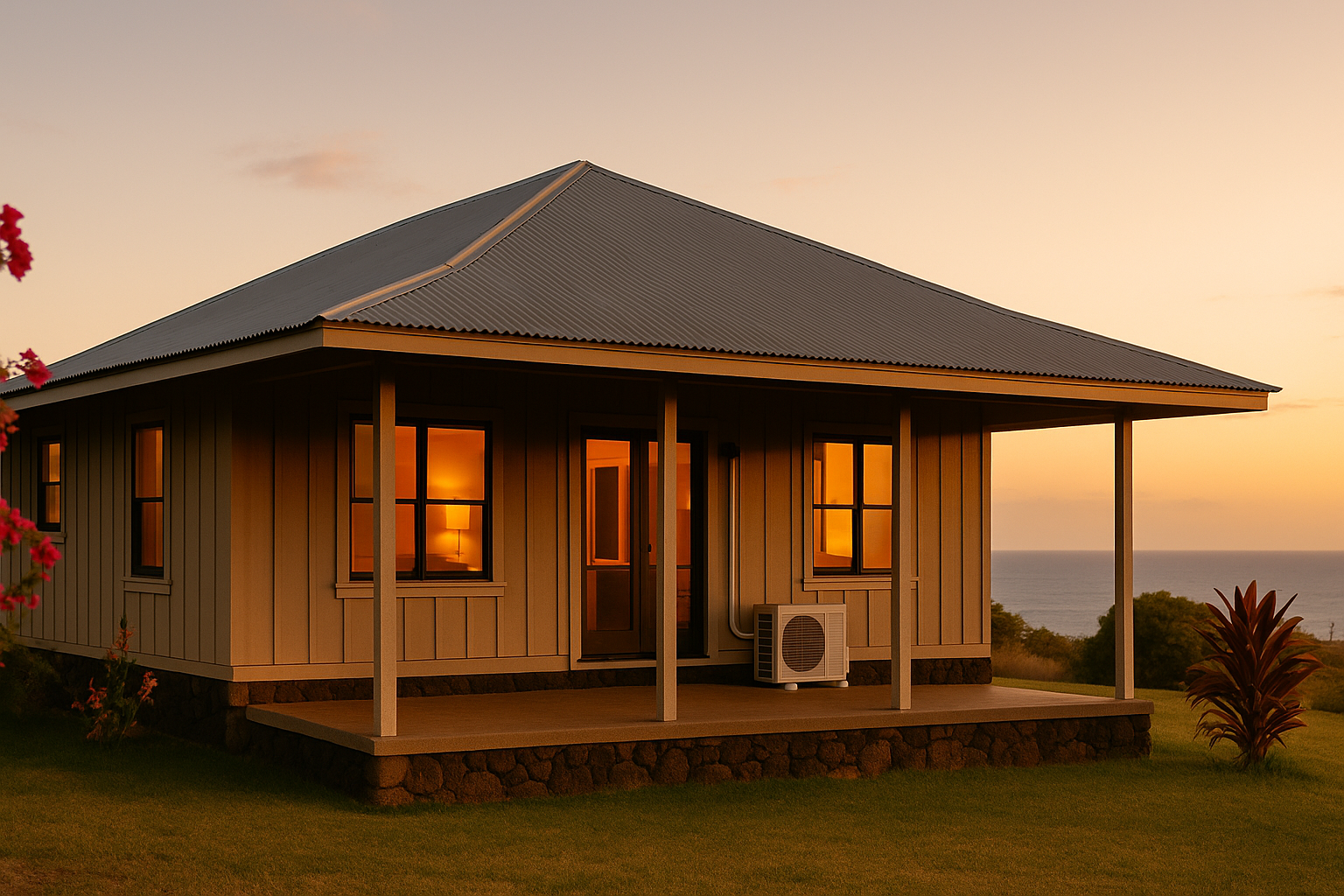
Hawaii households pay the highest residential electricity rates in the country, running at or above roughly 40 cents per kilowatt-hour in recent Energy Information Administration reporting — better than triple what a household in Idaho or Washington pays. Nowhere else in the United States does a single point of appliance efficiency return so much cash per year.
That fact reframes the federal Home Electrification and Appliance Rebates program, which most homeowners and contractors still call HEEHRA. The rebate ceilings are written into federal law and are identical in Honolulu and in Duluth, but the value of what those ceilings buy is set by your utility rate — and Hawaii's rate does more work per efficiency point than any other state's.
There is a wrinkle, though. HEEHRA was drafted around a heating-dominated mainland house, and Hawaii at sea level has no heating season worth naming.
That changes which measures deserve your attention and, more consequentially, which equipment a contractor can put on the invoice and still have it qualify. This guide walks the rebate schedule, the income tiers, and the load-calculation logic for a home whose only real thermal jobs are cooling and hot water.
Yes. HEAR rebates are keyed to the equipment installed rather than to heating hours. A heat pump water heater qualifies for up to $1,750 and a qualifying heat pump for up to $8,000, under a $14,000 household cap.
What HEEHRA Pays, Measure By Measure
HEEHRA is the common name for the Home Electrification and Appliance Rebates (HEAR) program created by Section 50122 of the Inflation Reduction Act. It is a federal appropriation that each state energy office designs and administers, which is why launch dates, contractor networks, and application mechanics differ from state to state even though the dollar caps do not.
The per-measure ceilings are fixed in statute. Keep in mind that each figure below is a maximum rather than an entitlement — what a household actually receives is the lesser of the cap, its income-tier percentage, and the real project cost.
| Qualifying measure | Federal cap | Relevance in Hawaii |
|---|---|---|
| Heat pump for space heating and cooling | $8,000 | High, but only if the unit is a true heat pump |
| Heat pump water heater | $1,750 | Highest practical return of any measure |
| Electric load service center upgrade | $4,000 | Common need in plantation-era and postwar homes |
| Electric wiring | $2,500 | Often paired with the panel upgrade |
| Insulation, air sealing, and ventilation | $1,600 | Attic and duct work, not wall cavity insulation |
| Electric stove, cooktop, range, or oven | $840 | Applies to propane-to-induction conversions |
| Heat pump clothes dryer | $840 | Modest, but stacks toward the household cap |
| Household maximum | $14,000 | Lifetime ceiling across all measures |
All of these sit under that single $14,000 household ceiling across the life of the program. Accordingly, a household that takes the full $8,000 heat pump rebate plus a $1,750 heat pump water heater has already committed roughly 70 percent of its lifetime allotment before touching the panel.
The Income Tiers, And How They Land In Hawaii
HEEHRA eligibility runs off area median income as published by HUD for your county and household size. Households below 80 percent of AMI can have up to 100 percent of the project cost covered, while households between 80 and 150 percent of AMI can have up to 50 percent covered.
Households above 150 percent of AMI are not eligible for HEAR rebates at all. We work through the tier mechanics, the documentation contractors typically ask for, and the household-size adjustments in our explainer on HEEHRA income tiers and AMI qualification.
Households under 80% of area median income can have up to 100% of project cost covered. Households at 80–150% of AMI can have up to 50% covered. Above 150% of AMI, HEAR rebates are unavailable.
Hawaii's county AMIs are high in raw dollar terms, and that catches people off guard in both directions. A salary that would place a household well above the line in a low-cost mainland county can still fall under 150 percent of AMI in Honolulu, Maui, Hawaii, or Kauai county — so the current HUD figure for your county is worth pulling before assuming you have priced yourself out.
Who Runs The Program In Hawaii
The Hawaii State Energy Office (HSEO), housed within the Department of Business, Economic Development and Tourism, is the state entity responsible for administering Hawaii's IRA home rebate allocations. That includes the HEAR rebates covered here as well as the separate, performance-based Home Efficiency Rebates (HOMES) track.
Because rollout schedules, approved-contractor lists, and portal mechanics are all state decisions, the most useful step before signing anything is confirming current program status with HSEO directly. Be aware that a contractor saying the rebate is live is not the same thing as HSEO saying so.
Program status changes. Before you commit to equipment, verify with the Hawaii State Energy Office that HEAR is accepting applications, that your contractor is on the participating list, and that the specific model number appears on the current qualifying-products list.
Why Water Heating Carries The Program In Hawaii
Strip out space heating and the residential energy pie in Hawaii looks unlike anywhere on the mainland. Water heating routinely becomes the single largest electric end use in a Hawaii home, ahead of cooling in the many houses that lean on trade winds and ceiling fans for much of the year.
A conventional electric resistance tank converts roughly one unit of electricity into one unit of heat. A heat pump water heater moves heat instead of making it, and modern units carry uniform energy factors in the neighborhood of 3.5 to 4.0 — roughly a quarter to a third of the electricity for the same hot water.
At mainland rates that spread is attractive. At Hawaii rates it becomes the highest-return appliance decision most island households will ever make, which is why the $1,750 line item deserves top billing here even though it is far from the biggest number on the schedule. Our deeper treatment of heat pump water heater selection and sizing covers first-hour ratings and tank capacity.
Hawaii's Ambient Air Is A Heat Pump Water Heater's Ideal Condition
Heat pump water heaters draw their heat from the air around the tank, so real-world performance tracks the temperature of the room they sit in. On the mainland, an unconditioned garage at 40 degrees pushes the unit toward its resistance backup element, and the advertised efficiency quietly evaporates every January.
Hawaii never does that. A garage, laundry room, or exterior utility closet on Oahu sits in the 70s year-round, which keeps the compressor inside its design envelope essentially every hour of the year and makes the nameplate number an honest expectation rather than an annual average you never quite reach.
What's more, the byproduct is genuinely useful here. The unit exhausts cool, dehumidified air into the space where it is installed — a small liability in a Minnesota basement in February and a free amenity in a humid Hawaii laundry room in August.
Hawaii's year-round 70-degree ambient air keeps a heat pump water heater in compressor mode nearly every hour, so it rarely falls back to its resistance element. Nameplate efficiency holds up in practice.
Solar Thermal, The State Mandate, And Where The Heat Pump Fits
Hawaii has required solar water heating on new single-family construction since 2010 under Act 204, with a narrow variance process for homes where collectors are impractical or where an approved alternative applies. More than fifteen years of that policy, layered on top of decades of utility-driven solar thermal programs, means a large share of Hawaii homes already carry collectors on the roof.
Those systems age. When a collector loop springs a leak or a differential controller dies, the default fallback is the tank's electric resistance element — and a household can spend years paying resistance-rate prices for hot water while a dead array sits overhead.
That failure is the moment a heat pump water heater deserves a quote, particularly if the storage tank is also near end of life. Remember that the federal residential clean energy credit under Section 25D, which covered solar water heating property, expired on December 31, 2025, so the federal subsidy that once softened a solar thermal repair is gone while the state-administered HEAR rebate continues on its own track.
Midday Electricity Is Hawaii's Cheapest Electricity
Hawaiian Electric's time-of-use offerings place the least expensive period in the middle of the day, when rooftop solar output across the grid peaks and the utility has surplus generation to absorb. That is the inverse of the evening-peak pattern most mainland homeowners have internalized.
A heat pump water heater with a schedulable operating mode can be told to make its hot water inside that midday window and then coast on tank storage through the evening. In effect the tank becomes a thermal battery charged at the cheapest hour on the rate sheet — a tactic with almost no equivalent value in a state where every hour costs about the same.
Note that TOU enrollment, period definitions, and rate differentials all change over time, and Kauai is served by Kauai Island Utility Cooperative rather than Hawaiian Electric, with its own rate structure. Confirming your current schedule comes before building any control strategy on top of it.
The Equipment Rule That Disqualifies Most Hawaii Cooling Jobs
This is where Hawaii homeowners lose rebate money without ever learning they lost it. The $8,000 line item is written for a heat pump for space heating and cooling, and that phrasing is doing real work.
A straight-cool condenser — an air conditioner with no reversing valve — does not qualify, however efficient it is and however certain you are that you would never run heating mode in Kakaako. The unit has to be a heat pump on its AHRI certificate, capable of reversing, even if that capability sits unused for its entire service life.
A cooling-only air conditioner does not qualify for the $8,000 HEEHRA measure. The unit must be AHRI-certified as a heat pump with rated heating capacity, even if you never run heating mode in Honolulu.
In practice this is a small problem carrying a small price. Most manufacturers build their ductless mini-split lines as heat pumps by default, and the incremental cost over the cooling-only version of the same chassis is usually modest measured against an $8,000 ceiling.
The failure mode is a contractor quoting from habit. If a proposal reads as AC, condensing unit, or straight cool, the AHRI reference number is the thing to request — the certified listing for a qualifying product will show rated heating capacity and an HSPF2 value, and a cooling-only product will show neither.
The Department of Energy also requires HEAR-funded appliances to meet or exceed applicable ENERGY STAR specifications, and states are free to set a higher bar. Accordingly, the qualifying-products list HSEO publishes is the document that governs the decision, not the manufacturer's marketing sheet or the distributor's rebate flyer.
What A Cooling-And-Water-Heating Load Calculation Looks Like
ACCA Manual J remains the correct method in Hawaii; only the inputs shift. Honolulu's 1 percent summer design condition sits near the upper 80s dry bulb with a mean coincident wet bulb in the low-to-mid 70s, while the 99 percent winter design temperature lands in the low 60s — a figure that produces essentially no heating load for a space held at 70 degrees.
The consequence is that your load is dominated by two things a mainland calculation treats as secondary: solar gain and latent load. Roof and glazing orientation, shading, attic ventilation, and glass SHGC drive the sensible side, while infiltration of humid outdoor air and ordinary occupant activity drive the moisture the equipment has to remove.
That latent fraction is why oversizing hurts more here than almost anywhere else. An oversized system satisfies the thermostat quickly, shuts down, and never runs long enough to wring water out of the air, leaving a house that is simultaneously cold and clammy and considerably more mold-prone than it needs to be.
Oversized cooling equipment satisfies the thermostat before it removes moisture, leaving a cold, humid house. In Hawaii's high-latent climate, a room-by-room Manual J matters more than a rule-of-thumb tonnage estimate.
Variable-speed inverter equipment tolerates the problem better than single-stage equipment because it can modulate down and run longer at part load. Even so, modulation has a floor, and a system sized off square footage rather than a room-by-room calculation will spend most of the year beneath it — our heat pump load calculator walks the inputs that actually move the answer.
Two ratings matter for a Hawaii selection and one mostly does not. SEER2 and EER2 describe cooling performance at seasonal and peak conditions respectively, and EER2 deserves unusual weight here because Hawaii's design day is a genuine steady-state cooling condition rather than a brief annual spike; HSPF2 is a heating metric that will not describe a single hour of a sea-level operating year.
Elevation Is The Exception To All Of This
Not every Hawaii address is a sea-level address. Kula and the rest of Upcountry Maui, Waimea on Hawaii Island, and Volcano village all sit high enough that overnight temperatures drop into the 50s routinely and into the 40s occasionally.
Those homes carry a genuine, if modest, heating load, and there the reversing valve stops being a compliance formality and starts being the point. A properly sized ductless heat pump covers both jobs in a climate where resistance space heating would be brutally expensive at 40-plus cents per kilowatt-hour.
For a home above roughly 2,000 feet, having the contractor run the heating side of the Manual J rather than zeroing it out is worth the ten minutes. The equipment selection rarely changes, but the capacity check at the winter design temperature occasionally does.
Panels, Wiring, And Salt Air
The rest of the HEEHRA schedule is where older Hawaii housing stock gets interesting. Plantation-era and early postwar homes across the islands frequently carry 60 to 100 amp services that were never designed to host a heat pump water heater, a mini-split condenser, and an induction range at the same time.
HEEHRA allocates up to $4,000 for an electrical load service center upgrade and up to $2,500 for wiring, which in many cases is the difference between a feasible electrification project and a stalled one. Plus, the $1,600 envelope allowance covers insulation, air sealing, and ventilation — measures that in a cooling-dominated home mean attic radiant barriers, duct sealing, and exhaust strategy far more than they mean wall cavity batts.
Be aware of two Hawaii-specific practicalities that no rebate program will solve for you. County permitting timelines, particularly through Honolulu's Department of Planning and Permitting, can stretch a project schedule well past what a mainland contractor would quote as normal.
The second is salt. Coastal installations across the islands see accelerated corrosion on outdoor coils, fasteners, and cabinets, and a standard condenser sited within a few hundred yards of surf can shed years of service life to it.
Coated coils, corrosion-resistant cabinet hardware, and a mounting location shielded from direct salt spray and standing water are all worth specifying at the quote stage. A rebate that buys equipment which fails in year six was never the savings it appeared to be on paper.
Stacking: Hawaii Energy, KIUC, And What Remains Federally
Hawaii Energy is the ratepayer-funded efficiency program overseen by the Hawaii Public Utilities Commission, serving Oahu, Maui County, and Hawaii Island; Kauai households work through Kauai Island Utility Cooperative programs instead. Both have historically offered their own water heating and efficiency incentives, funded separately from the federal HEAR allocation.
State and utility incentives can generally layer with HEAR, subject to two constraints. Total incentives cannot exceed 100 percent of project cost, and HSEO sets the specific stacking rules for Hawaii — so the combination is worth confirming rather than assuming.
On the federal side the picture has narrowed considerably. The residential clean energy credit under Section 25D expired December 31, 2025, and our federal tax credit status tracker reflects what is current rather than what was true when a given contractor last updated their sales deck.
For readers weighing a rebate against a tax credit instead of combining them, our 25C versus HEEHRA decision tree and our guide to stacking HEEHRA with 25C walk the sequencing logic. Anyone comparing cooling-dominated states may also find our Arizona HEEHRA breakdown useful, since it shares Hawaii's cooling emphasis without the water-heating dominance or the island rate structure. The full state index lives on our HEEHRA state-by-state guide.
How To Sequence This, By Where You Are Standing
Decision rules land differently depending on when someone is reading. Here is how the next move tends to look at each stage of a Hawaii electrification project:
- Water heater still working. This is the strongest position, because there is time to assemble AMI documentation, confirm HSEO program status, and line up a participating contractor before anything fails. A planned replacement captures the full $1,750; an emergency one usually does not.
- Water heater just failed. The trap is a same-day resistance tank swap, which is fast, cheap up front, and forfeits the rebate along with two decades of efficiency. A temporary repair that buys two weeks is often worth more than it costs.
- Cooling project already quoted. Pull the AHRI reference number off the proposal and confirm the listing shows heating capacity. A straight-cool unit is a rebate-ineligible unit regardless of its SEER2 rating.
- Panel at 100 amps or below. Sequence the load center upgrade first, since a panel that cannot accept the new circuits will stall every other measure and county permitting adds weeks on its own.
- Equipment already installed. HEAR is generally delivered at point of sale through participating contractors rather than as a retroactive reimbursement, so verify with HSEO before assuming a completed project can be claimed after the fact.
HEAR rebates are generally delivered at point of sale through participating contractors rather than as retroactive reimbursements. Confirm eligibility with the Hawaii State Energy Office before equipment is installed.
All of these come back to the same underlying point: in Hawaii the rebate schedule was written for someone else's climate, and the highest-value measures sit lower on the page than the headline number suggests. Working the water heater first, the equipment classification second, and the panel third tends to produce the best outcome per dollar of the $14,000 household ceiling.
Common Questions About HEEHRA In Hawaii
Does Hawaii's lack of a heating season make HEEHRA less valuable?
The $8,000 space-conditioning measure is worth less in Hawaii than in a heating-dominated state, since the heating mode goes largely unused below about 2,000 feet. The water heating, panel, wiring, and envelope measures, however, are worth more than they are almost anywhere else, because Hawaii's electricity rate multiplies every kilowatt-hour saved by roughly three times the national average.
Can I use the $8,000 rebate on a cooling-only mini-split?
No. The measure is defined as a heat pump for space heating and cooling, so the equipment must be certified as a reversible heat pump with rated heating capacity even in a climate where heating mode will never run. Confirm with the AHRI certificate rather than the sales proposal.
What happens if my household is slightly above 150 percent of AMI?
HEAR rebates are unavailable above 150 percent of area median income. Hawaii Energy and KIUC programs are not means-tested in the same way, so ratepayer-funded incentives may still be available on Oahu, Maui County, Hawaii Island, and Kauai respectively. Check both before concluding there is nothing on the table.
My home has solar water heating already. Is a heat pump water heater still worth considering?
It depends on the condition of the collectors and the tank. A functioning solar thermal system is hard to beat, but a failed loop that has silently reverted to the resistance element is one of the most expensive hot water configurations in the state, and the HEAR rebate applies to the heat pump replacement.
Do I need a Manual J if I am only adding cooling?
Yes, and arguably more than a mainland homeowner does. Hawaii's high latent load means an oversized system short-cycles and leaves the house humid, so the room-by-room calculation is what protects comfort rather than a formality that protects the contractor.
How does salt air affect equipment selection near the coast?
Coastal salt exposure accelerates corrosion on outdoor coils, fasteners, and cabinets, and can materially shorten equipment life within a few hundred yards of surf. Coated coils, corrosion-resistant hardware, and a mounting location out of direct spray are standard mitigations worth pricing into the quote.
Working The Numbers For Your Own Home
Hawaii is the outlier case in the HEEHRA program, and the standard mainland advice about heat pumps translates here badly. The rebate schedule still has real money in it — it just concentrates in different line items than the headline suggests.
If you are sizing equipment or checking whether a quote makes sense against your actual load, start with our heat pump sizing calculator and then compare your state's mechanics against the rest of the country on the HEEHRA state-by-state guide. Current program status, funding availability, and qualifying-product lists should always be confirmed with the Hawaii State Energy Office before equipment is ordered.
This article is for informational purposes and is not financial, tax, or legal advice. Consult a licensed professional (CPA, licensed HVAC contractor, or the Hawaii State Energy Office) before acting on any rebate, incentive, or equipment decision described here.