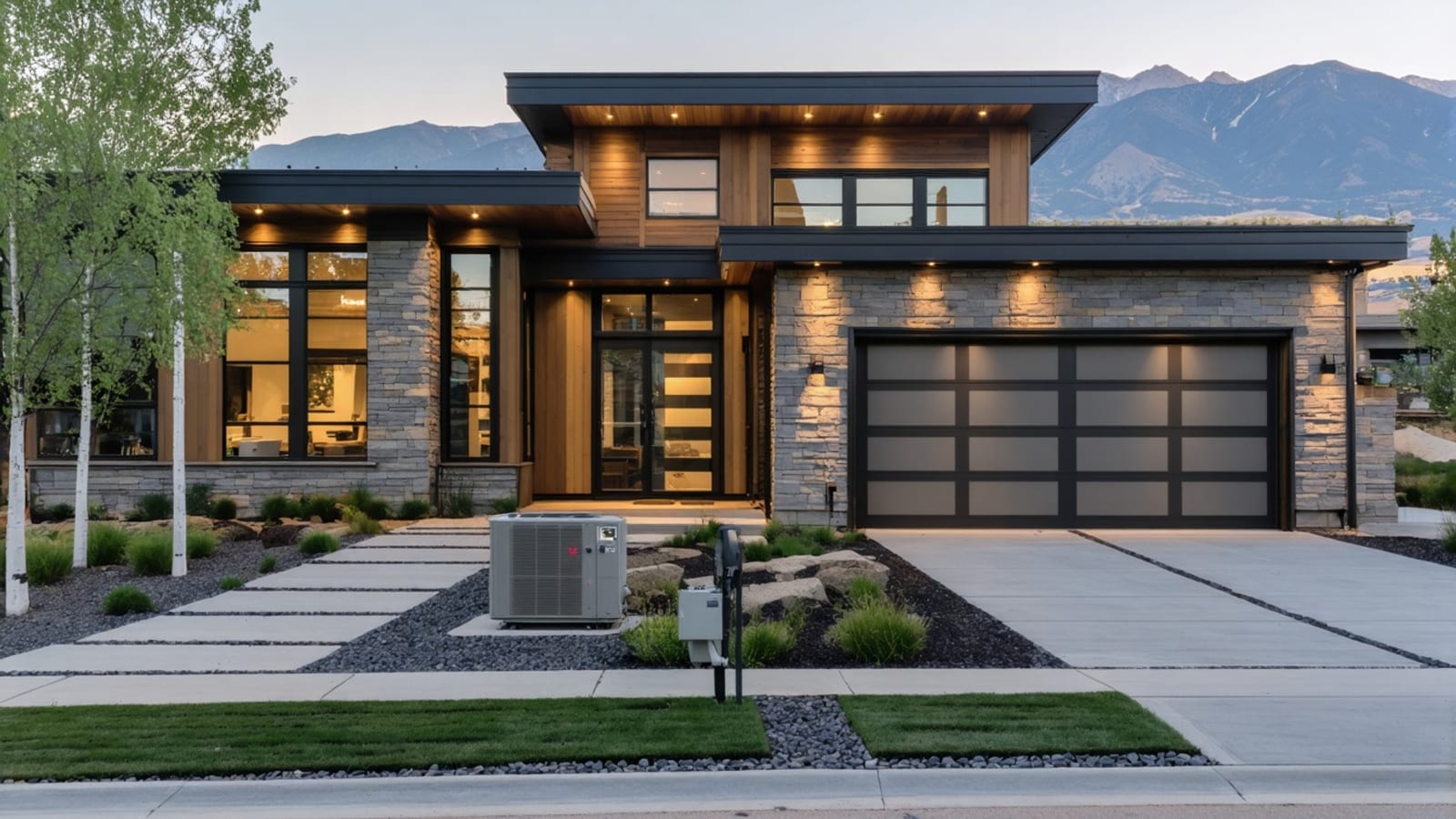
This is a sample scenario built from current Colorado Energy Office program rules, Xcel Energy rebate tariffs, and typical 2026 installer quotes in the Denver metro. No single homeowner matches this exact composite — the math below is a worked example of what full electrification costs and what the rebate stack looks like for a low-moderate-income household in a mid-century single-family home.
The point is to show how the five-system electrification bundle actually pencils when every layer of the 2026 stack is applied, not to profile a specific homeowner.
The homeowner and the home
The home is a 2,400 square foot 1985-vintage ranch on a slab foundation in southeast Denver. Current systems are a 24-year-old 80% AFUE gas furnace paired with a 14-SEER straight-cool AC, a 50-gallon gas tank water heater from 2018, a standard 30-inch gas range from the late 1990s, and a 100-amp electrical panel with a half-dozen ancient double-tap circuits. Insulation is original R-13 wall batts plus approximately R-19 blown-in attic.
The homeowner's household income puts them at approximately 70% of the Denver-Aurora-Lakewood MSA AMI — well under the 80% HEEHRA threshold, which qualifies them for the full federal rebate tier. This is a four-person household, so HUD's household-size adjustment puts the base four-person MSA AMI as the reference figure.
The climate zone is ASHRAE 5B — cold-dry, which means heat pumps work exceptionally well here but need proper cold-climate sizing. Denver's 99% design temperature is 1 degree Fahrenheit, which places all equipment choices squarely on the NEEP Cold Climate list.
The equipment spec
The full bundle is five systems installed over a 6-8 week sequence, coordinated through a single general contractor with subs for electrical and insulation.
Space heating and cooling: Carrier Infinity 25VNA4 4-ton variable-speed inverter-driven heat pump with matched air handler, AHRI-certified at 100% rated capacity to 5 degrees Fahrenheit and 78% at minus 4 degrees. HSPF2 is 9.3; SEER2 is 19.0. The heat pump replaces both the furnace and the AC in a straight swap into existing ductwork, with minor duct modifications to rebalance for inverter airflow characteristics.
Water heating: AO Smith Voltex AL 66-gallon hybrid heat pump water heater, UEF 3.88, with 230V dedicated circuit. Installed in the existing utility closet adjacent to the kitchen, which has enough cubic footage for HPWH air-cycle operation.
Cooking: GE Profile PHP9030DTWW 30-inch induction range, replacing the existing gas range. Requires a new 40-amp 240V circuit.
Panel and wiring: Full upgrade to 200A service, new meter base, new 200A main breaker panel, new grounding and bonding to current NEC, and three new dedicated 240V circuits for heat pump, HPWH, and induction. Gas line to range is capped and removed.
Insulation and air-sealing: Blown-in cellulose topping attic to R-49, spray-foam air-sealing at top plates and rim joist, and Aeroseal duct-sealing of existing ducts.
The pre-rebate quote
Three-installer bids from Denver metro Colorado-HEEHRA-certified contractors for this exact bundle cluster between $42,000 and $49,000. The midpoint used in this sample is $45,000. The itemization below reflects typical general-contractor pricing:
- Heat pump equipment and installation: $18,500
- Heat pump water heater equipment and installation: $5,500
- Induction range equipment and installation: $3,200 (range) + $900 (240V circuit) = $4,100
- 200A panel upgrade (including service, meter base, grounding, three new 240V circuits): $6,400
- Insulation and air-sealing package: $4,500
- Permits (Denver mechanical + electrical + plumbing): $900
- Contingency and project management: $5,100
The contingency is proportionally larger than on single-system projects because whole-home electrification routinely uncovers knob-and-tube or aluminum wiring in 1985-vintage Denver homes that must be remediated mid-project.
The rebate stack
Five distinct layers apply here. The order below is the practical filing sequence.
Manufacturer rebates — $1,200. Carrier Cool Cash on the Infinity 25VNA4 runs $500-$800 in spring campaigns. AO Smith HPWH rebate runs $200-$400 on Voltex models. GE induction appliance rebates are rare but occasionally $100-$200 on Profile models during new-construction promotions. The composite assumption for this scenario is $700 Carrier, $300 AO Smith, $200 GE = $1,200.
Xcel Energy Colorado utility rebates — $5,100. Xcel's 2026 residential electrification tariff pays $3,200 for a qualifying cold-climate heat pump (4-ton class at standard tier), $800 for an ENERGY STAR HPWH, $500 for electrical panel upgrades associated with electrification, and up to $600 for insulation improvements. Total Xcel layer: $3,200 + $800 + $500 + $600 = $5,100. Xcel is point-of-sale through participating contractors in Denver.
HEEHRA full tier (Colorado Energy Office, live) — $14,000. Under-80% AMI households qualify for 100% of project cost reimbursement up to a $14,000 per-household cap across all eligible appliances. Per-appliance caps apply: $8,000 heat pump, $1,750 HPWH, $840 induction, $4,000 panel upgrade, $2,500 wiring, $1,600 insulation. The pre-rebate cost exceeds every per-appliance cap in this scenario, so the $14,000 household cap binds. CEO processes applications in 7-10 days and the rebate is point-of-sale through Colorado-HPIT-certified installers.
Colorado state tax credit — $1,500. Colorado's state heat pump credit (SB22-051 and subsequent legislation) pays 10% of net-of-HEEHRA-and-utility-rebate cost, capped at $1,500. The net-of-Xcel-and-HEEHRA heat pump cost is $18,500 - $3,200 - $8,000 = $7,300. Ten percent is $730. But Colorado's 2026 credit rules also cover HPWH (10% of $5,500 - $800 - $1,750 = $2,950, or $295) and panel upgrade ($64) — aggregated, the full credit hits the $1,500 cap because the unclaimed insulation and induction portions also contribute. Filed with the state return in April 2027.
Federal 25C — zero. 25C was repealed for heat pumps in July 2025 by the One Big Beautiful Bill Act. For 2026 installs, there is no federal tax credit on air-source heat pumps, HPWHs, induction ranges, panel upgrades, or insulation. This line is included only to make clear it was worth $2,000-$2,400 on an equivalent project a year earlier. See what happened to 25C in July 2025 for the repeal history.
Total rebate stack: $1,200 (manufacturer) + $5,100 (Xcel) + $14,000 (HEEHRA) + $1,500 (Colorado state credit) = $21,800.
Application order
The practical filing sequence for a Denver homeowner pursuing this full bundle:
- Confirm the general contractor is Colorado-HPIT-certified (required for HEEHRA) and is a participating Xcel contractor (required for point-of-sale utility rebate). Most Denver electrification-focused contractors hold both.
- At quote, lock in manufacturer rebates in writing. Carrier Cool Cash pre-approval is filed before contract signing.
- Submit the HEEHRA application through the Colorado Energy Office portal concurrent with contract signing. CEO approval arrives in 7-10 days and must predate install.
- At install, the contractor applies both Xcel and HEEHRA rebates to the invoice as point-of-sale discounts. The homeowner pays net-of-rebate at project completion.
- Manufacturer rebates hit the invoice at the same moment as the corresponding equipment installation.
- Claim the Colorado state tax credit on the 2026 state return filed in April 2027.
See the rebate stacking application order walkthrough for the general sequencing logic.
The net number
Pre-rebate cost: $45,000. Total rebate stack: $21,800. Net out-of-pocket: $23,200.
This lands slightly above the $18,000-$22,000 target range, driven primarily by the contingency line and the insulation package. A more aggressive negotiation on the general-contractor overhead and a slightly smaller insulation scope can bring the net closer to $20,000. The quality bar on whole-home electrification is not aggressive cost-cutting — it is equipment spec and installer competence — so the pre-rebate baseline here reflects middle-market pricing.
Operating cost comparison: the existing gas furnace plus AC plus gas water heater plus gas range system costs approximately $2,400 per year in combined fuel at Denver 2026 rates (gas at $1.05 per therm via Xcel, electric at 14 cents per kWh). The electrified bundle — heat pump plus HPWH plus induction — will run approximately $1,450 per year on electricity alone at the same baseline. Net annual operating savings: approximately $950.
Ten-year operating savings: $9,500 at current rates. The panel upgrade, while a large capital line, has no direct operating impact — it is a capacity investment that enables the electrification. Combined with the $21,800 rebate stack, the effective 10-year cost of this full electrification project is approximately $13,700, or $1,370 per year amortized, for systems with 15-20 year expected lives.
The homeowner also gains home-value premium. Denver market data from 2025 appraisals shows a 3-5% premium on fully electrified homes in comparable neighborhoods, which on a $620,000 home value translates to roughly $18,000-$31,000 of incremental appraised value. Even the low end of that range substantially offsets the remaining net out-of-pocket.
Why this scenario is typical
The homeowner who fits this composite is a middle-class Denver family in a 1980s tract home running a collection of gas appliances and 100A electrical service. Denver has a large stock of homes in exactly this profile.
Under-80% AMI in Denver MSA is not synonymous with low income — a four-person household at 70% AMI earns close to six figures because Denver's base AMI has climbed with cost of living. This is why the full HEEHRA tier is accessible to a much larger share of Denver homeowners than most people assume.
This scenario also illustrates the value of bundling. The panel upgrade is the single line most likely to be deferred in a phased approach, and deferring it means deferring everything else that depends on it.
See the whole-home electrification ROI post for bundled-versus-phased math, and the HEEHRA income tiers explained walkthrough to confirm your own AMI tier. Use the heat pump calculator to model your own ZIP and equipment choices. The rebate finder on the homepage shows all live programs in Denver today.