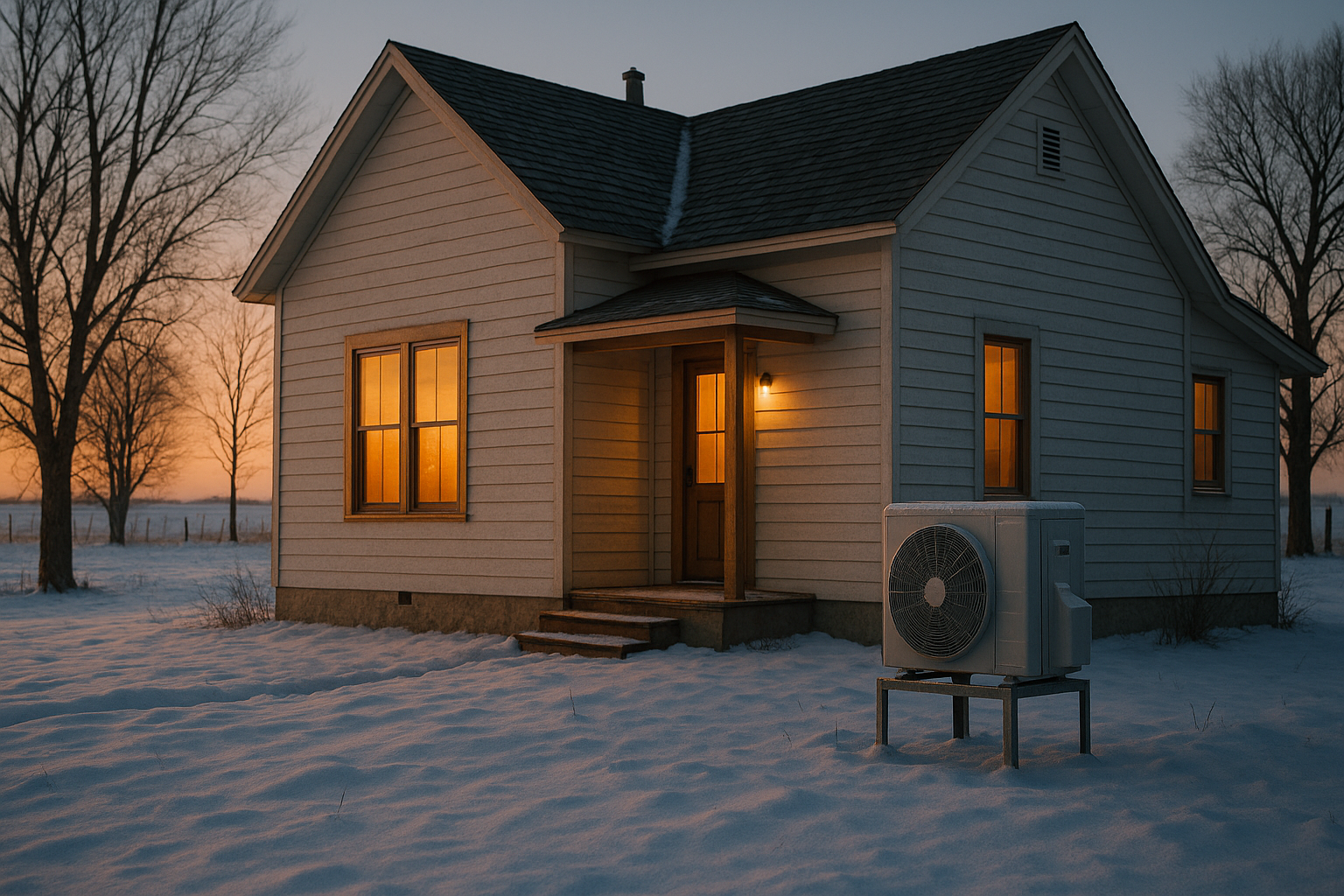
How much heat does a heat pump put out when the thermometer outside Grand Island reads five below zero? If you own a home in Nebraska and are weighing an electrification project before winter, that question underlies every rebate decision you make.
The federal Home Electrification and Appliance Rebates program, known as HEEHRA, can cover a large share of a qualifying heat pump, particularly for households at or below 150% of area median income. That said, a rebate only pays off if the equipment it buys can carry your home through a Plains January, and that is where Nebraska's design temperatures come in.
What HEEHRA Is And Who Runs It In Nebraska
HEEHRA was created by the Inflation Reduction Act of 2022 and is funded through the U.S. Department of Energy (DOE), but each state runs its own program. In Nebraska, the state energy office function sits within the Nebraska Department of Environment and Energy (NDEE), the agency responsible for the state's IRA home energy rebate programs.
Keep in mind that launch dates, registered contractor lists, and application portals vary widely from state to state. Before you schedule an install, confirm where Nebraska's rollout stands on our HEEHRA state-by-state status tracker and directly with NDEE.
HEEHRA in Nebraska follows the federal statutory caps: up to $8,000 for a qualifying heat pump and up to $14,000 per household. The Nebraska Department of Environment and Energy runs the state program.
Federal Rebate Caps That Apply In Nebraska
The HEEHRA dollar ceilings are written into the statute, so they are the same in Nebraska as in every other participating state. Nebraska can shape how the program works, including contractor registration, documentation, and sequencing, but it cannot raise these caps.
The per-category maximums set by the Inflation Reduction Act are shown in the table below:
| Upgrade | Federal cap | Notes |
|---|---|---|
| Heat pump for space heating and cooling | $8,000 | DOE guidance requires ENERGY STAR certification |
| Heat pump water heater | $1,750 | Often paired with a panel or wiring upgrade |
| Electric load service center (panel) upgrade | $4,000 | Common in older homes with 100-amp service |
| Electric wiring | $2,500 | Circuits needed to support the new equipment |
| Insulation, air sealing, and ventilation | $1,600 | Reduces the heat load the heat pump has to meet |
| Electric or induction stove, cooktop, or range | $840 | Appliance category, not space heating |
| Heat pump clothes dryer | $840 | Appliance category, not space heating |
| Household total | $14,000 | Combined across all categories |
All of these figures are maximums. Your actual rebate depends on your income tier and the real cost of the project, and the program never pays more than the project costs.
Note that the envelope category deserves more attention in Nebraska than its modest cap suggests. Every BTU/hr that air sealing and insulation remove from the design load is a BTU/hr the heat pump does not have to produce at its weakest point on the temperature curve.
Nebraska Income Limits: How The AMI Tiers Work
HEEHRA does not use a single statewide dollar threshold. Instead, eligibility is measured against area median income (AMI) for the county or metro area where the home sits, so a household in Douglas County and a household in Cherry County can face different dollar limits for the same tier.
The tiers break down as follows:
- At or below 80% of AMI. The rebate can cover up to 100% of project costs, subject to each category cap and the $14,000 household cap.
- Between 80% and 150% of AMI. The rebate covers up to 50% of project costs, still subject to the same caps.
- Above 150% of AMI. The household is not eligible for HEEHRA, although utility programs may still apply.
The dollar limit behind each percentage comes from income-limit data derived from HUD median-income figures and is updated periodically, so we do not publish fixed Nebraska income numbers here. For a walkthrough of how to find your county's figure and estimate your tier, see HEEHRA income tiers explained.
At or below 80% of area median income, HEEHRA can cover up to 100% of project costs. Between 80% and 150%, it covers up to 50%. Above 150% of AMI, a Nebraska household does not qualify.
In addition, DOE allows states to accept enrollment in certain means-tested assistance programs as proof of income for the lower tier. Check NDEE's list of accepted documents before gathering pay stubs and tax returns, because enrollment in a qualifying program may save you a step.
Why Nebraska's Design Temperatures Change The Equipment Question
A heating design temperature is the outdoor temperature a system is sized to handle. Under ACCA Manual J, that is typically the 99% value, meaning the outdoor air is colder than that figure for only about 1% of the hours in a typical year.
Across Nebraska, 99% heating design temperatures generally run from roughly 0°F down to the high single digits below zero, depending on location. What's more, the state's climate runs on a gradient: the Missouri River corridor sees humid continental winters, the north-central Sandhills tend to run colder, and the Panhandle is higher, drier, and exposed to sharp Arctic outbreaks.
The table below describes how design conditions shift across the state and what that means for equipment selection:
| Region | Representative cities | Design-temperature character | Equipment implication |
|---|---|---|---|
| Eastern Nebraska | Omaha, Lincoln | Near or slightly below 0°F | Cold-climate units hold useful capacity; backup strategy still matters |
| Northeast | Norfolk | Below 0°F, among the colder eastern values | Compare capacity at 5°F and below, not nominal tonnage |
| Central Platte Valley | Grand Island, Kearney | Below 0°F | Extended-performance data should drive sizing |
| Sandhills and north-central | Valentine | Among the coldest in the state | Low-temperature capacity and a planned backup source are essential |
| West-central and Panhandle | North Platte, Scottsbluff | Below 0°F at higher elevation | Ask whether the contractor applied an altitude correction to capacity |
These descriptions are directional, not exact. Your contractor's Manual J should use the ACCA Table 1A value for the weather station nearest your home, and you can sanity-check the load with our heat pump calculator.
Most Nebraska locations have a 99% heating design temperature near or below 0°F. A heat pump sized for that load needs documented capacity at 5°F and colder, not just a strong rating at 47°F.
Capacity Falls As The Temperature Falls
An air-source heat pump moves heat from outdoor air, and the colder that air gets, the less heat the compressor can extract per hour. Meanwhile, your home's heat loss rises as the outdoor temperature drops, so the two lines cross at a balance point below which another heat source has to make up the difference.
Variable-speed inverter compressors push that balance point lower by ramping up in cold weather rather than cycling at a fixed output. For a closer look at the hardware, see our explainer on inverter scroll compressors.
The Nominal Tonnage Trap
A unit sold as a “3-ton” system is rated at 47°F, and its output at 5°F can fall well below that nameplate figure. In fact, two units with the same nominal tonnage can deliver very different BTU/hr at a Nebraska design temperature, so the extended-performance tables matter more than the model name.
Before signing, ask your contractor for the manufacturer's extended-performance data at 5°F and at your design temperature. Our guide to what to know before installer quotes covers the questions to bring, and ductless installs should also account for line-set length limits, which can reduce delivered capacity.
What Counts As Qualifying Equipment
DOE program guidance ties HEEHRA heat pump eligibility to ENERGY STAR certification. States may add stricter requirements, so confirm whether Nebraska's program requires the ENERGY STAR Cold Climate designation or another standard.
For a Plains home, the cold-climate tier is the more meaningful screen even where it is not mandatory. ENERGY STAR's cold-climate criteria test performance at 5°F, including a minimum coefficient of performance (COP) and a minimum share of rated capacity retained, and the current thresholds are published on energystar.gov.
Several references can help you check a specific system, each answering a different question:
| Screen | What it tells you | Why it matters in Nebraska |
|---|---|---|
| ENERGY STAR (standard) | Meets SEER2, HSPF2, and EER2 minimums | Baseline eligibility under DOE guidance |
| ENERGY STAR Cold Climate | Tested capacity and COP at 5°F | Closer to actual Nebraska design conditions |
| NEEP cold-climate ASHP list | Published capacity and COP at 5°F, often lower | Lets you compare units at your design temperature |
| AHRI certificate | Certified ratings for the exact matched indoor and outdoor units | Rebate paperwork commonly requires the AHRI reference number |
Overall, the ENERGY STAR label shows whether a system is eligible for the rebate. The 5°F data shows whether it will heat your home in a Nebraska winter.
DOE ties HEEHRA heat pump eligibility to ENERGY STAR certification. In Nebraska, the ENERGY STAR Cold Climate tier, which tests performance at 5°F, is the better guide to how a unit will perform in winter.
Backup Heat And Dual-Fuel Setups
Most Nebraska installs will include some form of backup heat, either electric resistance heat strips in the air handler or a gas or propane furnace in a dual-fuel configuration. A backup source is a normal part of a well-designed cold-climate system, covering the coldest few dozen hours of the year.
Keep in mind that HEEHRA pays for the heat pump, not the furnace. In rural Nebraska, where many homes heat with propane, a dual-fuel setup lets a household keep an existing furnace as backup while the heat pump carries most of the season.
Electric resistance strips, by contrast, are simple and inexpensive to install, but they run at a COP of 1.0 and can add significant demand on the coldest mornings. Ask your utility how strip heat is billed under your rate before deciding how much of it to install.
For a broader look at whether the numbers work in a cold climate, see whether cold-climate heat pumps are worth it.
How Nebraska's Public Power Utilities Fit In
Nebraska is the only state where every electric customer is served by a publicly owned utility, whether a public power district, a municipal system, or a cooperative. That includes the Omaha Public Power District (OPPD), Lincoln Electric System (LES), and the Nebraska Public Power District (NPPD), along with dozens of smaller rural and municipal systems.
Several of these utilities have offered heat pump incentives through programs such as LES's Sustainable Energy Program and NPPD's EnergyWise program. Amounts and eligibility change from year to year, so confirm current terms directly with your utility rather than relying on last season's figures.
Nebraska utility rebates are non-federal funds, so they can generally stack with HEEHRA. HEEHRA cannot be combined with another federal grant, such as HOMES, for the same upgrade.
The order in which you apply can affect the net result. Our rebate stacking guide explains how utility incentives, HEEHRA, and other programs fit together without overlapping.
Where Federal Tax Credits Stand In 2026
The 25C Energy Efficient Home Improvement Credit does not apply to equipment placed in service after December 31, 2025, and the federal residential solar credit expired on the same date. As a result, HEEHRA, utility programs, and any state-level incentives are the remaining incentives for a Nebraska project in 2026.
For the full federal picture, see our federal tax credit status page. If you are revisiting a quote written before the credit ended, our 25C vs. HEEHRA decision tree explains how the two programs interacted.
HEEHRA is built as a point-of-sale rebate delivered through registered contractors, so installing first and applying afterward may not qualify. Confirm the contractor's registration and the rebate reservation with NDEE before any equipment is ordered.
A Decision Rule For Nebraska Homeowners Before Winter
The right next step depends on where you are in the process. Here is how the decision tends to break down by phase:
- Pre-purchase, no quotes yet. Confirm your AMI tier, then check Nebraska's current rollout status with NDEE. A household under 150% of AMI with a working system has reason to weigh the rebate's timing against the cost of waiting.
- Quotes in hand. Compare each quote's capacity at 5°F against the Manual J heat loss at your design temperature. Then check that the matched system has an AHRI certificate and ENERGY STAR status.
- Existing system failing now. An emergency replacement in December leaves little room for program paperwork. Some households in this position repair to get through the season, while others install a dual-fuel setup that keeps a furnace for backup.
- Above 150% of AMI. HEEHRA does not apply, so utility programs and equipment efficiency drive the economics.
Each of these paths depends on the same two checks: whether the household qualifies for the rebate, and whether the equipment can meet the home's design load. A rebate on a system that cannot heat the house at 0°F does not save money.
Next Steps For Nebraska Homeowners
Nebraska combines statutory federal rebate caps, county-level income tiers, and some of the more demanding heating design temperatures in the HEEHRA map. Taken together, that makes the equipment question at least as important as the rebate question.
Start with our HEEHRA guide for the program's mechanics, then use the heat pump guide to compare cold-climate equipment against your home's load. Remember that NDEE and your public power district have the final word on current program terms.
This article is for informational purposes and is not financial / tax / legal / medical advice. Consult a licensed professional (CPA, elder-law attorney, HVAC contractor, state Medicaid office) before acting.