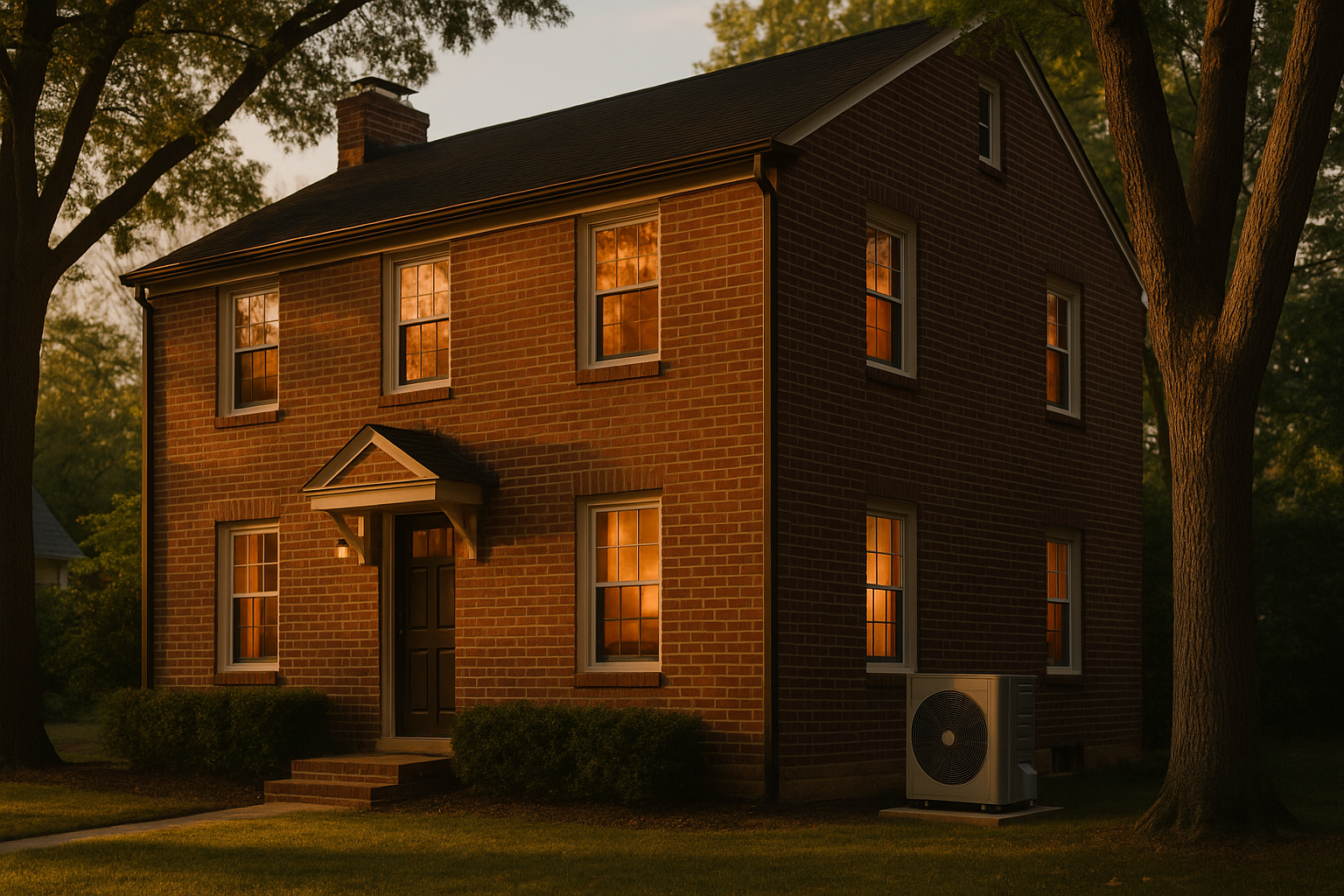
You probably assume HEEHRA is a federal rebate you claim the way you would claim a tax credit — fill out a form, get money back from Washington. However, HEEHRA is a federal appropriation that each state designs and runs on its own timeline, which is why your neighbor in Virginia and your cousin in Maryland may have completely different experiences with the same program.
That distinction matters more than almost any other fact in this guide. The High-Efficiency Electric Home Rebate Act (HEEHRA) — funded under the Inflation Reduction Act — sends block grants to state energy offices, and in Maryland that office is the Maryland Energy Administration (MEA).
If you are weighing a heat pump install in Baltimore, Montgomery County, or the Eastern Shore, the questions you need answered are concrete: how much, who qualifies, and when. Below we walk through each, with the federal caps that anchor the program and the Maryland-specific administration that shapes how you access them.
HEEHRA in Maryland is the state-administered version of the federal High-Efficiency Electric Home Rebate program, run by the Maryland Energy Administration. It provides point-of-sale rebates of up to $8,000 toward a qualifying heat pump for income-eligible households, with the exact amount tied to your income relative to area median income.
What Is HEEHRA, And Why Does Maryland Control It?
HEEHRA is one of two home-electrification rebate programs created by the Inflation Reduction Act, sitting alongside the broader Home Energy Rebates framework administered by the U.S. Department of Energy. The federal government sets the rules and the maximum dollar amounts, then disburses funds to states to operate.
Maryland accepted its allocation and tasked the Maryland Energy Administration with standing up the program. This is the same structure we documented in our HEEHRA program guide and across every state we have covered.
Because the state controls intake, contractor approval, and launch timing, two things follow. First, the rebate is generally delivered at the point of sale — taken off your invoice rather than refunded months later. Second, the program opens in phases, so availability on any given date depends on where Maryland is in its rollout.
How Much Is The HEEHRA Rebate In Maryland?
The dollar caps are federal, so they are the same in Maryland as in every other participating state. What changes state to state is administration and timing, not the ceiling on each measure.
The headline figures are set by the IRA statute and published by the Department of Energy. They represent maximums — your actual rebate is the lesser of the cap, the equipment cost, and your income-based coverage percentage.
| Measure | Federal HEEHRA maximum |
|---|---|
| Electric heat pump (space heating/cooling) | Up to $8,000 |
| Heat pump water heater | Up to $1,750 |
| Electric stove / cooktop / oven | Up to $840 |
| Heat pump clothes dryer | Up to $840 |
| Electrical panel upgrade | Up to $4,000 |
| Insulation, air sealing, ventilation | Up to $1,600 |
| Electrical wiring | Up to $2,500 |
| Total per household | Up to $14,000 |
Keep in mind that the $14,000 figure is a household lifetime ceiling, not a per-project bonus. If you claim $8,000 on a heat pump and $4,000 on a panel upgrade, you have $2,000 of headroom remaining for other measures.
The maximum HEEHRA heat pump rebate in Maryland is $8,000, set by federal statute. A household can receive up to $14,000 total across all qualifying measures — heat pump, heat pump water heater, panel upgrade, wiring, and weatherization combined — with each measure carrying its own individual cap beneath that ceiling.
What Are The Income Limits For HEEHRA In Maryland?
HEEHRA is an income-targeted program, and this is where the rebate amount actually gets decided for your household. Eligibility and coverage are pegged to your household income relative to your area median income (AMI), as determined for your Maryland county or metro area.
There are two tiers, plus an exclusion above the upper threshold. The structure below is federal and applies in Maryland exactly as it does elsewhere — we break the mechanics down further in our explainer on how HEEHRA income tiers work.
| Household income | Share of project cost covered |
|---|---|
| Below 80% of area median income | 100% of cost, up to each measure's cap |
| 80% to 150% of area median income | 50% of cost, up to each measure's cap |
| Above 150% of area median income | Not eligible for HEEHRA |
Note that AMI varies significantly across Maryland. The Washington-Arlington-Alexandria metro area that includes Montgomery and Prince George's counties carries one of the highest AMIs in the country, while parts of the Eastern Shore and Western Maryland are considerably lower — which means the same salary can land in different tiers depending on where you live.
Be aware that because higher-income households are excluded from HEEHRA, many Maryland homeowners above 150% AMI will instead route their incentive through the federal 25C tax credit. We compare those two paths directly in our 25C vs. HEEHRA decision tree.
HEEHRA income limits in Maryland are tiered by area median income (AMI). Households below 80% of AMI receive 100% of project costs up to each cap; households between 80% and 150% of AMI receive 50%. Households above 150% of AMI are not eligible and should evaluate the 25C federal tax credit instead.
Where Does Maryland's Rollout Stand?
This is the question with the least durable answer, because HEEHRA launches are phased and dates shift. The Maryland Energy Administration is the authoritative source, and you should confirm current status with MEA directly before assuming the program is open for your specific measure.
States have generally rolled HEEHRA out in stages — often opening the income-qualified electrification rebates and contractor enrollment before the full menu of measures is live. That pattern is worth expecting in Maryland as well.
We track launch status for every state in our regularly updated HEEHRA state-by-state status tracker, which is the fastest way to see whether Maryland's program is accepting applications today. For binding eligibility determinations, the Maryland Energy Administration remains the only official authority.
How Does HEEHRA Stack With Maryland Utility Programs?
HEEHRA does not exist in isolation in Maryland — the state already runs substantial utility-funded efficiency incentives through EmPOWER Maryland. EmPOWER rebates are delivered by the regulated utilities, including BGE, Pepco, Delmarva Power, Potomac Edison, and SMECO, depending on your service territory.
These programs can often be combined, but the order in which you apply them affects the final math. Generally, you cannot use two different funding sources to pay for the same dollar of cost, so stacking works by covering different portions of the project.
The sequence matters enough that we wrote a dedicated guide on rebate stacking and application order. Get the order wrong and you can leave money unclaimed or trip an exclusion rule.
Yes, HEEHRA can often be combined with Maryland's EmPOWER utility rebates from BGE, Pepco, Delmarva Power, Potomac Edison, or SMECO. The two sources generally cannot cover the same dollar of cost, so stacking works by applying each program to different portions of the project — and application order affects your total.
What Equipment Qualifies, And How Should You Size It?
HEEHRA dollars only flow to qualifying high-efficiency equipment, which in practice means heat pumps meeting the program's efficiency thresholds — typically referenced through ENERGY STAR and AHRI-listed performance ratings. Your installing contractor must verify the model qualifies before the rebate applies.
Maryland's climate spans roughly the same design conditions across the state, with cold but not extreme winters, so a properly sized variable-speed heat pump can serve as the primary heating system for most homes. The key word is properly sized.
Oversizing is the most common and most expensive mistake we see, because an oversized unit short-cycles, wastes the efficiency you paid a premium for, and undercuts the comfort the rebate was meant to deliver. A Manual J load calculation — not a rule-of-thumb based on square footage — is the correct basis for sizing.
For the full methodology, see our walkthrough on cold-climate heat pump sizing before you sign a proposal. A contractor who sizes off square footage alone is a contractor to be skeptical of.
HEEHRA-eligible equipment in Maryland must meet the program's efficiency thresholds, typically verified through ENERGY STAR and AHRI ratings. A variable-speed heat pump sized via an ACCA Manual J load calculation — not a square-footage rule of thumb — qualifies as a primary heating system for most Maryland homes and avoids costly short-cycling from oversizing.
What Steps Should You Take Before Applying?
Because Maryland delivers HEEHRA at the point of sale through approved contractors, your path runs through the installer rather than around them. The groundwork you do first determines how smoothly the rebate applies.
Here is a practical sequence to follow:
- Confirm program status. Verify with the Maryland Energy Administration that HEEHRA is open for the measure you want, since phased rollouts mean not every rebate launches at once.
- Determine your income tier. Compare your household income to your county's area median income to establish whether you fall under 80%, between 80% and 150%, or above the eligibility ceiling.
- Get a Manual J load calculation. Insist on a room-by-room or whole-home load calc rather than a quick square-footage estimate, so the equipment is sized to your actual home.
- Use an approved contractor. Point-of-sale rebates flow through MEA-enrolled installers, so confirm your contractor is in the program before signing.
- Map your stacking order. Identify any EmPOWER Maryland utility rebates you also qualify for and sequence them correctly.
All of these add up to one principle — verify before you commit. The homeowners who get the full rebate are the ones who confirmed status, tier, and contractor enrollment in advance rather than after the install.
A Decision Rule For Maryland Homeowners
If your household is below 150% of area median income and the Maryland Energy Administration shows HEEHRA open for heat pumps, the income-qualified rebate is almost always your strongest single incentive — pursue it first, then layer EmPOWER utility rebates on the remaining cost. If you are above 150% of AMI, HEEHRA is off the table, and your evaluation should center on the 25C federal tax credit and utility programs instead.
Either way, confirm current program status with MEA before you build a budget around any figure here, because the caps are stable but availability is not.
This article is for informational purposes and is not financial, tax, or legal advice. Consult a licensed professional — a CPA, your state energy office, or a qualified HVAC contractor — before acting.